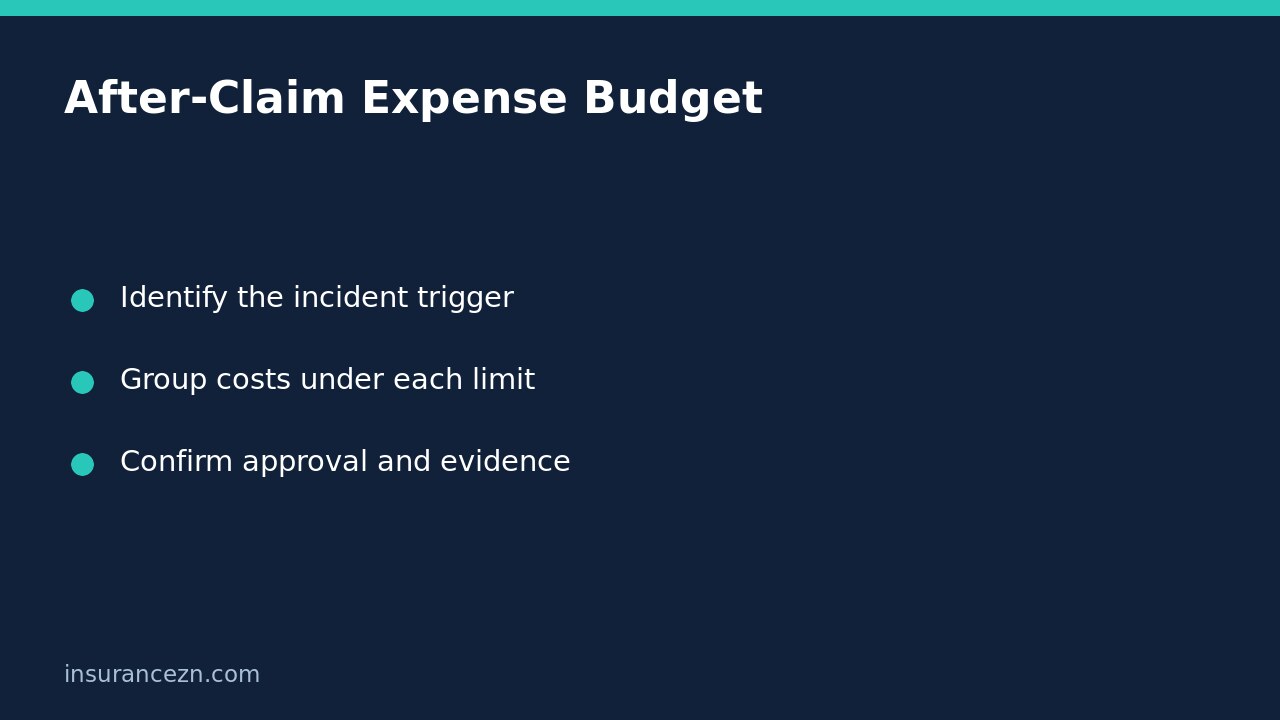

When comparing car insurance, do not add every advertised after-claim expense allowance as though each has its own pot of money. Emergency travel, temporary repairs and damaged belongings may share one combined limit. Start with the event that triggers the benefit, then put every eligible expense against the correct cap before comparing policies.
This is general information for Australian readers, not personal financial advice. Cover depends on the applicable Product Disclosure Statement (PDS), certificate, exclusions and claim assessment. A product overview is a starting point, not confirmation that a particular expense will be paid.
Read the combined limit before comparing individual benefits
As a provider-specific example, Suncorp’s comprehensive car insurance overview describes after-claim expenses of up to a total of $1,000 when the car is stolen or damaged in an incident. Its listed expenses include qualifying emergency travel and accommodation, emergency repairs, and replacement of personal property lost or damaged at the time of the incident. It also asks for invoices and receipts.
The important comparison word is total. The overview does not present three independent $1,000 allowances. Nor should you assume another insurer uses the same cap, trigger or grouping. Check the precise policy version and level of cover quoted, including whether another section provides a separate benefit.
Match each expense to its own conditions
Write down what must happen before each category becomes potentially payable. Suncorp’s overview links emergency travel and accommodation to a car that is unsafe to drive and being more than 100 kilometres from home. It describes emergency repairs as making the vehicle roadworthy or safe to reach a destination or repairer. Those are provider-specific conditions, not universal Australian rules.
For personal property, record the item, ownership evidence and when it was damaged or lost. Do not treat a car policy as general portable-contents protection simply because electronics or clothing appear in a summary. Ask about exclusions, item restrictions and any other applicable insurance, without assuming either policy will respond.
A useful comparison sheet has columns for the expense, event trigger, eligible purpose, combined cap, separate sublimit, evidence and authorisation requirements. Mark unresolved entries as questions, not as included cover.
Use one incident budget to expose a shared-cap shortfall
Consider a hypothetical eligible incident with $450 of emergency accommodation, $300 of qualifying temporary repairs and $500 of damaged personal property. These invented amounts total $1,250. If all three expenses fall within a single $1,000 cap, at least $250 falls outside that cap, even before any exclusions, excess or valuation adjustments. This is arithmetic illustrating a limit, not a settlement estimate.
Now compare a second policy using the same incident and expenses. Record whether it has one combined allowance or distinct limits, and whether the conditions would admit each cost at all. A larger advertised allowance is not more useful for an expense that fails its eligibility conditions. Keep the main vehicle repair settlement separate unless the wording expressly combines it with these expenses.
Confirm spending authority and preserve the evidence
Before committing to non-urgent expenditure, ask the insurer which costs need prior agreement and how to obtain it. Record the claim reference, date, contact and any spending boundary. Do not delay urgent safety action merely to complete insurance paperwork, but do not mistake necessary action for guaranteed reimbursement.
Keep itemised invoices, payment evidence, photographs and a brief explanation of why each cost arose. A submitted receipt establishes submission, not acceptance of the expense or payment approval. If the insurer requests clarification, send it against the existing claim reference rather than opening another claim for the same event.
When assessing wider transport needs, separate emergency travel reimbursement from a hire-car benefit. Our guide to comparing not-at-fault recovery handling addresses a different question: who handles recovery after a crash. It does not establish entitlement under an after-claim expense allowance.
Questions to settle before choosing a quote
- Are the listed expenses separate allowances or one shared total?
- Which incident, distance and roadworthiness conditions apply?
- Does the cap apply per incident, claim or policy period?
- What approvals, invoices and ownership evidence are required?
- Could an excess, sublimit or exclusion change the amount payable?
Does a receipt guarantee repayment? No. It helps prove expenditure; the insurer still assesses the relevant benefit and conditions. Should I compare only the largest cap? No. Compare the same realistic expense bundle, the qualifying event, total premium and applicable conditions together.