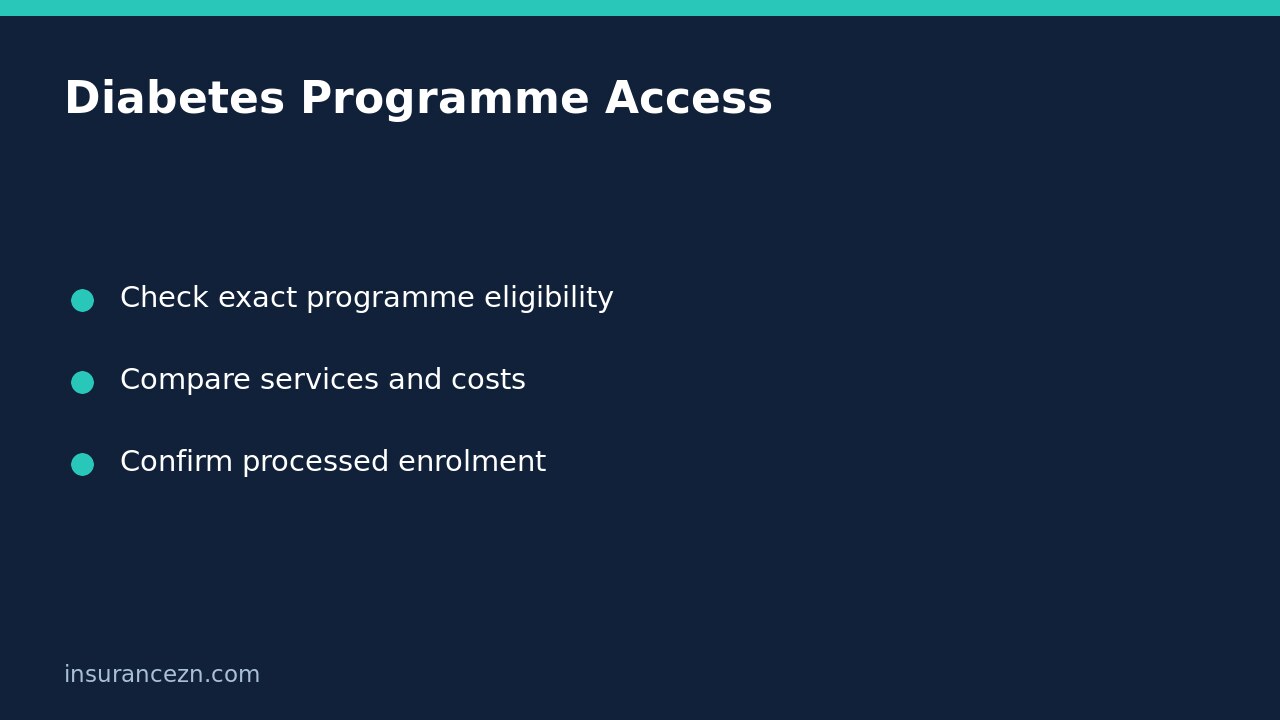

If a health fund promotes diabetes management or education, compare whether you can actually access the specific programme, not just whether the fund mentions diabetes. Ask what services are offered, which membership qualifies, what clinical criteria apply and what you would pay. An included hospital category or an extras balance does not by itself answer those questions.
This is general information for Australian readers, not personal financial advice. Check the relevant policy information, policy/PDS limitations where applicable, fund rules and programme conditions. Do not delay necessary clinical care or change treatment based on an insurance comparison; discuss appropriate care with your treating professional.
Separate the programme from hospital and extras benefits
The Australian Government’s PrivateHealth.gov.au overview of private health insurance explains that insurers can cover clinically appropriate alternatives to hospital treatment and programmes to manage or prevent chronic disease. It gives diabetes management and education as examples. Importantly, it says offering these services is not mandatory and participation may depend on cover and eligibility criteria.
That supports a checking framework, not a promise that every fund must accept every person with diabetes. A diagnosis does not establish programme eligibility. Likewise, acceptance into an education programme does not establish benefits for a later hospital admission, a particular device or every related consultation.
Keep three separate headings on your worksheet: ordinary hospital benefits, extras services, and the proposed management programme. Ask the fund which pathway funds each proposed service so that the same appointment is not counted twice in your comparison.
Describe the actual support you want to compare
Start with your treating professional’s recommended support, rather than a programme’s marketing name. For example, you might want to ask about structured education and follow-up support. Do not assume that coaching, dietitian appointments, monitoring equipment, tests and medicines are all part of the same arrangement.
Request a written service list. For every component, ask who delivers it, whether delivery is remote or in person, where it is available, how appointments are arranged and whether the provider is available to you. A national fund membership does not establish local appointment availability.
Also ask about duration, appointment frequency, re-entry and what happens when the programme ends. These are comparison questions, not claims that all programmes impose a particular time limit. If details are unknown, record them as unresolved rather than assigning an assumed benefit.
Get member-specific eligibility and cost answers
Give each prospective fund the exact product name and your proposed commencement date. Ask what clinical assessment, referral, consent or other documentation is required, whether any waiting or eligibility conditions apply, and who decides acceptance. Do not send unnecessary sensitive medical records through an unverified channel.
Ask whether participation changes any extras allowance or involves separate charges. If a consultation is funded through ordinary extras rather than the programme, obtain the service-specific estimate and applicable remaining limits. The government’s overview notes that extras benefits can have service, annual and lifetime limitations; it does not establish the rules for your particular programme.
Compare actual premiums over the same period alongside the costs you would personally face. Do not value an unconfirmed programme as though every advertised component were cash paid to you. Where a fund cannot confirm access before you join, recognise that uncertainty explicitly instead of treating a sales enquiry as acceptance.
Use a written access comparison, not a benefit headline
Imagine two funds both mentioning diabetes support. One describes a programme but has not assessed your eligibility. The other supplies a personal eligibility response but has not confirmed an appointment. Neither situation is identical to active participation. Compare the stage reached, outstanding requirements, service scope and costs without inventing a dollar value for support not yet available.
Our guide to comparing dietitian extras against an actual appointment quote can help if the proposed service is a separately billed dietitian visit. It does not mean that the visit is automatically included in a diabetes programme.
Before cancelling existing cover, confirm any accepted new membership commencement and the specific programme access position. A membership change and a clinical enrolment decision are separate processes. Avoid assuming that acceptance by the programme provider means the fund has approved funding.
Final access checklist and common questions
- Which exact product and programme are being compared?
- Which services and providers are included for you?
- What assessments or documents remain outstanding?
- What personal charges or ordinary benefit limits apply?
- Has enrolment been processed, and is the start date confirmed?
Does the fund having a programme mean I can join? No. Obtain the member-specific eligibility decision and complete outstanding requirements. Does enrolment guarantee all diabetes-related bills? No. Keep the programme scope, separate policy benefits and actual claim assessments distinct, and retain written confirmations for each.