
A hospital policy that lists your treatment with restricted benefits is not necessarily a practical substitute for fuller cover at your chosen private hospital. Before comparing premiums, ask each fund and the hospital for a written estimate based on the same treatment and admission details. Your comparison needs the accommodation shortfall as well as any excess and separate medical accounts.
This is general information for Australian readers, not personal financial advice. Benefits depend on your policy terms, applicable PDS and fund rules, waiting periods, provider arrangements and individual circumstances. An estimate is not a guarantee of claim payment.
Start with the hospital you actually intend to use
The Australian Government’s PrivateHealth.gov.au guide explains that restricted benefits provide a limited amount of cover and can leave considerable out-of-pocket costs for private treatment. It distinguishes this from an exclusion, for which the relevant private-patient treatment is not covered. Neither description tells you the dollar shortfall at a particular hospital.
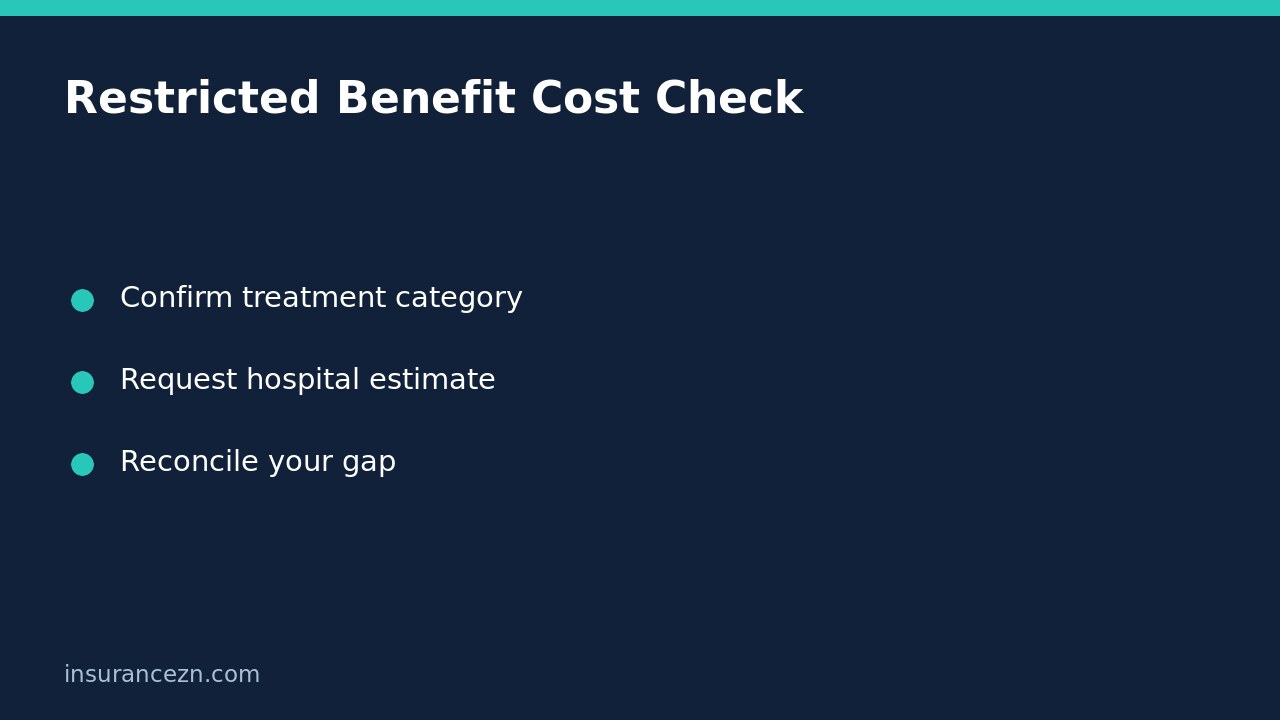
Write down the proposed hospital, treatment, expected admission date and clinician’s available procedure details. Ask the fund which clinical category applies and whether that category is included, restricted or excluded on the exact product being quoted. Do not infer this from the policy’s marketing name or from a different member’s experience.
Request two matched estimates, not two benefit labels
Send the same information to both shortlisted funds. Ask each to explain its accommodation benefit for the proposed private-hospital admission, what information is still missing, and whether a hospital agreement changes the estimate. Then ask the hospital what it expects to charge you after that benefit.
- Is the quoted treatment restricted on this exact policy?
- What hospital charges are included in the estimate, and which are outside it?
- What accommodation amount would remain payable by me?
- Are an excess or daily co-payment additional, already included, or not yet calculated?
- Does the estimate depend on admission length, particular services or confirmation from the fund?
Keep the written replies together. If the hospital assumes full benefits while the fund confirms restricted benefits, ask them to reconcile that discrepancy before treating either figure as reliable. A booking confirmation is not confirmation that the hospital bill is funded.
Build a comparison without double-counting costs
Use separate rows for premiums over the same comparison period, the hospital’s estimated net patient charge, and separately quoted doctors’ fees. Add other identified costs only once. If the hospital’s net figure already contains the excess, adding the excess again exaggerates the shortfall; if it excludes the excess, leaving it out understates it.
Consider a purely hypothetical comparison with two blank worksheets labelled Policy A and Policy B. Policy A has the lower quoted premium but restricted benefits for the planned category. Policy B costs more and lists that category as included. Enter the actual quotes rather than inventing a standard restricted-benefit amount. The useful question is whether the premium difference compensates you for the estimated cost and uncertainty at your chosen hospital, not simply whether both brochures mention the treatment.
Included treatment still does not establish that every expense is covered. Check the specialist, assistant surgeon and anaesthetist separately where relevant. Our guide to confirming whether your specialist will use a gap scheme addresses that different part of the bill.
Compare alternatives without assuming they are interchangeable
The government guide notes alternatives including public-patient treatment or, for restricted conditions, private-patient treatment in a public hospital. These are different pathways, not a promise that your existing private booking can simply be moved at the same price or time. Discuss clinically appropriate options and availability with your treating team.
If an upgrade is being considered, ask when the higher benefit becomes available and what waiting periods apply. An accepted membership change does not make an imminent admission eligible for the new benefit. See our comparison of hospital upgrade benefit dates before relying on an upgrade estimate.
Final questions before deciding
Does restricted mean no benefit? Not necessarily: it means a limited benefit, unlike an exclusion. Obtain the actual estimate rather than substituting either zero or full cover.
Will a hospital agreement solve every gap? Do not assume so. Ask how the agreement, treatment restriction and specific admission interact, and retain separate medical estimates.
What if treatment details change? Request revised estimates for the changed procedure, hospital or admission length. Do not delay urgent clinical care to complete an insurance comparison.
Source: PrivateHealth.gov.au, Managing your policy, including its explanations of exclusions, restricted benefits and hospital cost contributions.