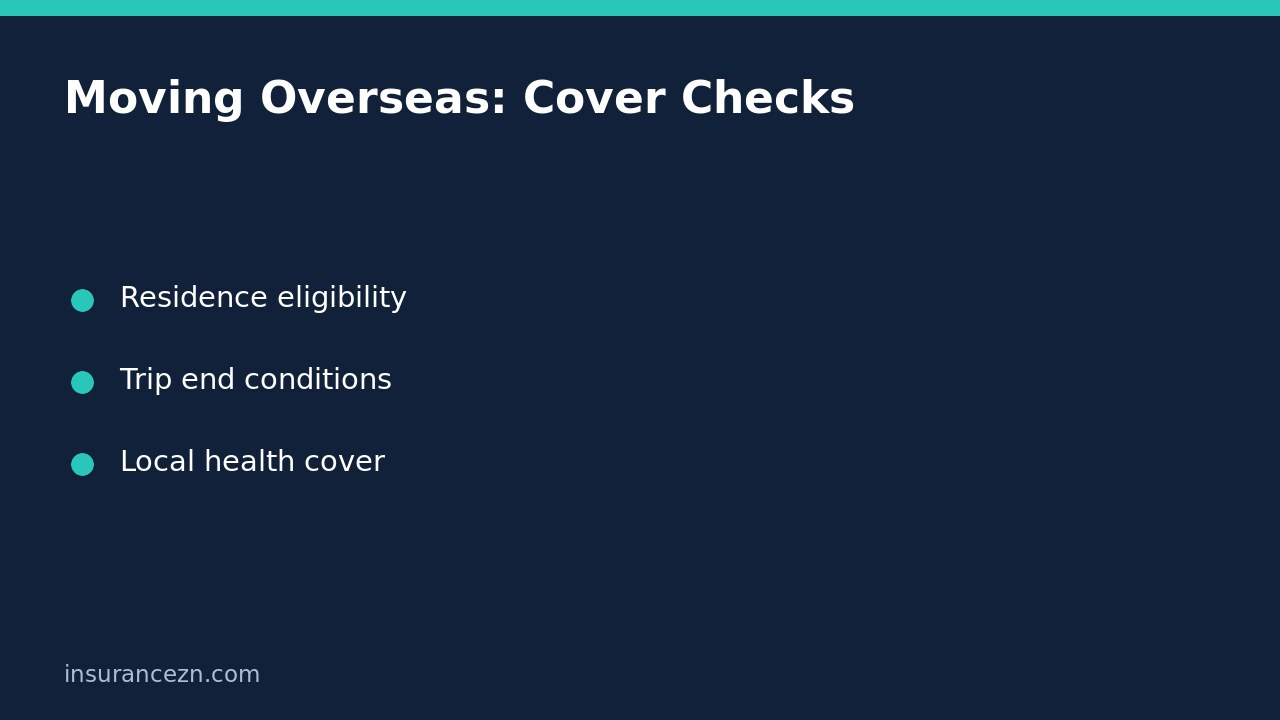

If you are moving overseas rather than taking a holiday, establish whether an Australian travel insurance policy accepts your actual circumstances before comparing its medical limit. A policy designed around a temporary trip may not suit a person establishing a new home abroad. Neither a completed quote nor a large advertised benefit answers that eligibility question.
This is general information for Australian readers, not personal financial advice. Eligibility, benefits, exclusions and claims depend on the specific policy, Product Disclosure Statement (PDS), schedule and any accepted amendments. Check immigration and healthcare requirements separately with the responsible authorities.
Why relocation changes the first question
Smartraveller’s travel insurance guidance says Australian insurance providers might not cover people living overseas long-term, and visa conditions may require a local health insurance policy. That does not establish that every relocating traveller is excluded, or that every local policy meets every visa rule. It means the product and circumstances must be matched explicitly.
Begin with a factual description: departure date, intended destination, whether you have a return booking, expected duration, purpose of the move and where you intend to live. Include any planned work or study. Do not describe a relocation as a short holiday merely because the first flight resembles one.
Read definitions before the benefits table
Find the PDS provisions dealing with eligibility, residence, the insured journey and when cover begins and ends. Ask the insurer which clauses apply to your move. These are questions to resolve, not universal conditions that can be assumed across Australian insurers.
- Am I eligible while leaving Australia to establish residence abroad?
- Does a one-way booking affect this particular product?
- Does cover end on arrival, after a specified period, or on another defined event?
- What happens if I start work or become ordinarily resident in the destination?
- Are visits back to Australia treated differently?
Record the answers against the exact product name and document version. If an answer appears inconsistent with the PDS, ask for clarification rather than choosing the more reassuring interpretation. Request written confirmation of any accepted arrangement and its effective dates.
Separate the journey from ongoing healthcare
A relocation can create several different needs: protection during travel, emergency assistance shortly after arrival and ongoing healthcare while living in the destination. Do not assume one policy meets all three. A travel emergency benefit is not evidence of comprehensive routine healthcare, and a local membership is not evidence that the flight overseas is insured.
Check the destination’s official visa and healthcare information, then ask the proposed local insurer about eligibility, commencement, waiting periods and the services included. Smartraveller’s general warning about local insurance requirements is a starting point, not a determination of your individual visa obligations.
Keep these enquiries separate from the travel insurer’s decision. Approval from an employer, accommodation provider or immigration adviser does not establish acceptance under an insurance contract.
Build a dated handover worksheet
Consider this hypothetical example: an Australian leaves on 10 February to take up a job abroad, arrives on 11 February and expects employer-arranged health insurance to start on 1 March. Those dates reveal a question about the arrival-to-March period; they do not prove either policy covers it.
Make one row for each stage: departure and transit, arrival, the interim period and ongoing residence. Beside each row, record the relevant policy, confirmed eligibility, accepted start and end dates, and unresolved questions. Obtain the employer plan’s actual documents rather than relying on an offer letter saying insurance is provided.
If an insurer has only acknowledged your enquiry, mark the row pending. A submitted application, premium payment or requested date change is not by itself confirmation that the exact arrangement has been accepted and recorded. Resolve uncertainty before relying on that row as insured.
Compare price only after the eligibility gate
Once the arrangement fits your circumstances, compare relevant medical benefits, assistance access, exclusions, excesses and separate baggage or cancellation needs. Smartraveller advises reading the PDS and considering the trip’s destination, duration, activities, age and health; relocation does not remove those checks.
Prepare assistance details that remain accessible during the move. Our offline travel insurance emergency-card checklist helps organise contact information, but carrying a card is not proof of eligibility or medical-cost approval.
Quick questions before departure
Is a one-way ticket automatically uninsured? Do not assume either answer. Ask the insurer about the specific product and your intended residence arrangements.
Can I just extend a holiday policy? First establish whether extension is permitted for the changed circumstances. A longer date range does not necessarily resolve a residence restriction.
What is the useful final document? Keep the issued policy documents, accepted dates and written clarification together with the separate local healthcare confirmation. The goal is a coherent, processed arrangement, not a folder of unanswered requests.