
A bungee-jump ticket is not proof that your travel insurance covers the activity. Before paying for an overseas jump, send the insurer the actual activity details and ask how the policy treats it. A tour operator accepting your booking, an insurer receiving your enquiry and an insurer accepting an amendment are three different outcomes.
This is general information for Australian readers, not personal financial advice. Cover depends on the applicable Product Disclosure Statement (PDS), policy schedule, exclusions and any accepted amendments. No example below establishes an entitlement to claim.
Start with the policy definition, not the attraction name
Smartraveller’s travel-insurance guidance identifies bungee jumping as an activity that may require extra cover. It also explains that insurers use activity definitions and that comprehensive policies do not cover everything. That supports checking the individual product, not assuming every insurer either includes or excludes every jump.
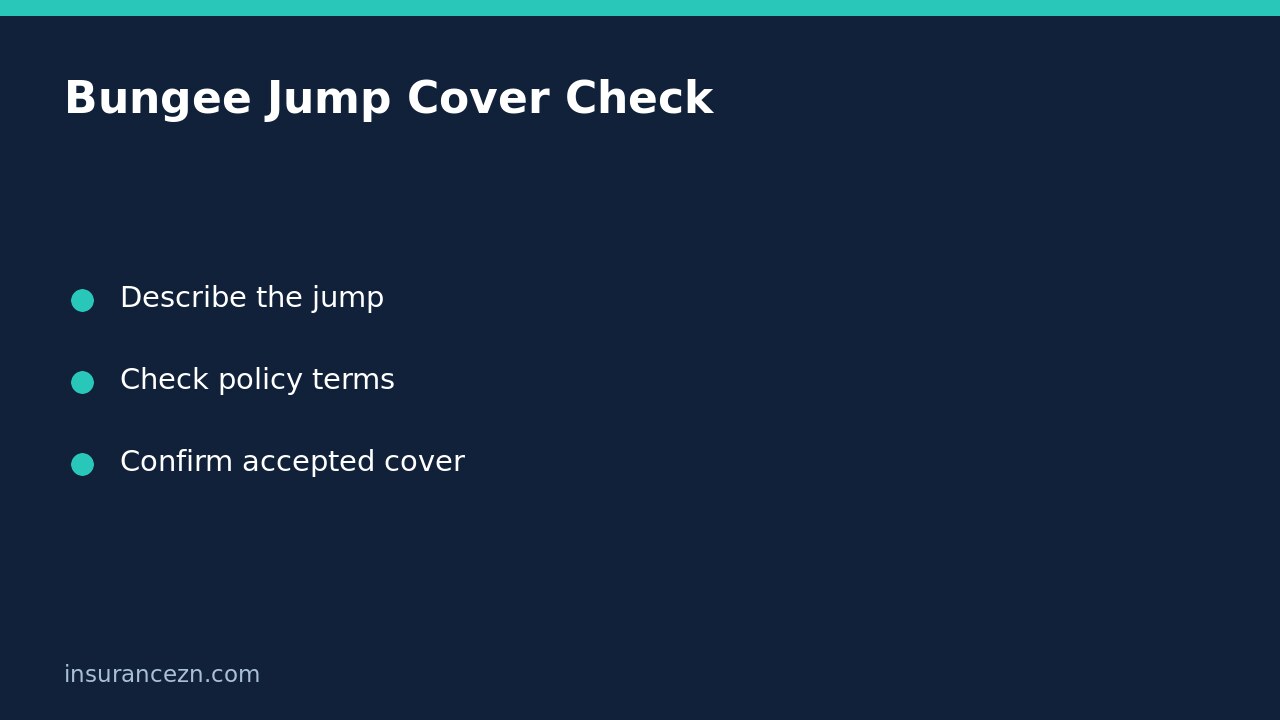
Save the operator’s written activity description. Record the country, location, planned date and whether the booking involves one jump or a package of different activities. If the attraction uses a different name, such as a swing or launch experience, describe what participants actually do rather than assuming it falls within the bungee-jumping entry.
Keep operator participation conditions separate. Meeting a venue’s age, health or equipment requirements does not demonstrate insurer acceptance. Equally, insurance does not establish medical suitability or make an unsafe activity safe. Ask an appropriate clinician about personal health concerns.
Ask questions about the benefits you would need
Begin with the included and excluded activities in the PDS. If a paid option is available, check what that option changes and what it leaves unchanged. Do not rely on a headline saying adventure activities are available.
- Does this exact activity, in this destination, fall within the policy’s accepted definition?
- Is it included now, or would an optional amendment be required?
- What conditions apply to participation, supervision or the operator, if any?
- How would an injury during the accepted activity be assessed under medical benefits?
- What separate conditions apply to emergency assistance, transport or evacuation?
- Are cancellation costs for the jump itself covered by any relevant insured event, or would they remain your responsibility?
Do not assume that acceptance under one section establishes every other benefit. Activity acceptance and payment approval are different questions. Smartraveller also warns that breaking the law, alcohol or drugs, and excluded activities can affect claims; use the exact policy wording rather than inventing a universal threshold.
Reconcile the reply with the actual policy record
Give the insurer your policy number and the saved activity description. Ask for a written answer identifying the applicable clause and any outstanding requirements. If the response says an option can be added, that is not confirmation it has already been added.
Before relying on a change, reconcile the accepted activity, any additional premium, effective date and revised policy documents. A payment receipt alone does not explain whether the requested amendment was accepted or whether it starts before your jump. Resolve conflicting documents through the insurer’s ordinary enquiry channel.
For example, suppose a traveller requests an adventure option on Tuesday for a Thursday jump. An automated acknowledgement on Tuesday establishes receipt of the request, not Thursday eligibility. The practical next step is to obtain the processed amendment and confirm its commencement, not to assume that submitting the form completed the change.
Compare booking flexibility alongside insurance
Read the operator’s own cancellation and rescheduling terms before paying. A refundable ticket and an insurance benefit are different ways of managing different risks. If the activity cannot be confirmed as covered, consider postponing the purchase, choosing a different activity or comparing another suitable policy before committing.
Do not buy a second policy on the assumption that it fixes everything. Compare its destination, dates, eligibility and exclusions, and clarify any overlap with existing insurance. Keep the original policy and correspondence so later questions can be answered accurately.
If your itinerary also includes snow activities, use the separate checklist for adding skiing after buying travel insurance. Acceptance of one activity does not automatically extend to another.
Before-you-book checklist and FAQ
- Keep the exact activity description and booking conditions.
- Read the activity definition, exclusions and relevant benefit sections.
- Obtain any required accepted amendment before participating.
- Check the effective date against the actual jump date.
- Save updated documents and assistance details offline.
Does comprehensive cover automatically include bungee jumping? No. Compare the actual product’s activity wording and optional sections.
Does an accepted activity guarantee a medical claim? No. The event and costs still need assessment under the policy. In an emergency, seek appropriate urgent help rather than delaying care for insurance administration.