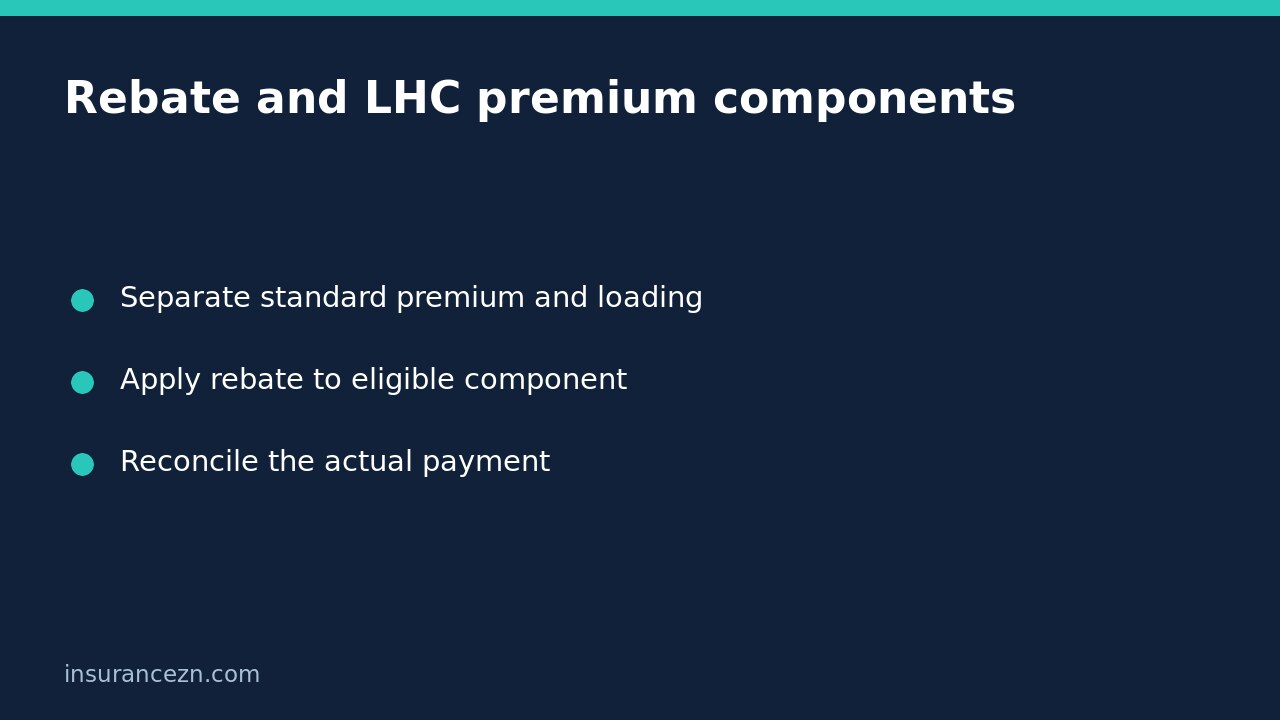

If your hospital premium includes Lifetime Health Cover (LHC) loading, do not calculate the government rebate by applying a percentage to the whole loaded premium. The rebate does not apply to the LHC component. It can still apply to the eligible standard component, subject to your rebate entitlement.
This is a premium-breakdown question, not necessarily an incorrect charge. Before disputing a debit, ask the health fund to separate the underlying premium, LHC loading and rebate. A smaller-than-expected reduction may reflect the base used in your calculation rather than a missing rebate.
Separate the two mechanisms
The Australian Government’s private health insurance rebate explanation says rebate entitlement varies with age and income. Eligible people can receive it as a premium reduction through their insurer or as a tax offset when lodging their annual tax return.
The same official guidance expressly states that the rebate does not apply to the LHC component of hospital cover premiums, while the standard component can still receive the rebate. LHC loading and rebate entitlement therefore need separate lines in your calculation. Receiving a rebate does not mean the loading disappears or is discounted by that rebate.
Do not confuse this with an insurer’s commercial discount, an excess payable for an admission, or a treatment benefit. These are different amounts with different purposes. A rebate changes eligible premium costs; it is not money promised toward a particular doctor’s account.
A simple component example
Suppose an illustrative premium statement has a standard eligible premium of $200 and a separate LHC loading amount of $40 for the same payment period. Suppose, solely to demonstrate the arithmetic, the rebate rate were 20%. These are invented teaching figures, not a current rebate rate, an insurer quotation or a personal entitlement calculation.
Applying that illustrative rate to the standard $200 component produces a $40 rebate. The payable amount is then $200 minus $40 plus the unchanged $40 loading: $200. Applying 20% to the combined $240 would instead suggest a $48 reduction and a $192 payment. The second method incorrectly rebates the loading and understates the payment by $8.
Your actual statement may contain further components or adjustments. Do not substitute this example for the fund’s confirmed base, your actual entitlement, the relevant dates or the treatment of other discounts. Ask for a written reconciliation where the calculation is not transparent.
Request a breakdown you can reproduce
Collect the premium notice, policy identifier, payment period and the bank transaction you are checking. Ask the fund to identify:
- The standard hospital premium for the exact period.
- The LHC loading percentage and dollar component it applied.
- The premium amount eligible for the rebate and the rebate rate used.
- Whether the rebate is being claimed through reduced premiums.
- Any extras component, discounts, credits, arrears or part-period adjustments.
- The final amount due and the payment allocated to that period.
A useful request is: ‘Please show the calculation from the standard premium to the final payable amount, separating LHC loading and the rebate-eligible base. Please identify any assumptions awaiting evidence and confirm the payment period covered.’
Ask about the exact policy components rather than trying to infer the hospital loading from a combined hospital-and-extras debit. Keep all amounts on the same time basis; mixing an annual loading figure with a monthly premium will not produce a meaningful reconciliation.
Do not correct the wrong input
If the dispute is about the rebate base, changing your nominated income tier does not fix that base. Equally, a correct base does not establish that the income tier, age information or loading history is correct. Ask which input explains the difference before requesting a change.
The official guidance explains that an incorrect estimated income tier can be reconciled through the tax return, with a possible tax offset or tax liability depending on the circumstances. This article does not calculate your tax position. Use current official guidance or appropriate tax advice for personal entitlement questions rather than treating the fund’s next debit as a final tax assessment.
For a related but different comparison task, read how to compare premium savings from a higher hospital excess. Changing an excess is a cover-cost decision, not a way to make the rebate apply to LHC loading.
Final checks and common questions
Does correcting the calculation remove my loading? No. Establishing whether loading should apply requires a separate history and eligibility assessment. A premium worksheet alone does not prove its removal date.
Is a submitted correction enough? No. Obtain the fund’s processed breakdown, effective date and revised amount. Check any credit or refund separately against the membership record and bank transaction; an acknowledgement is not a completed adjustment.
Should I simply pay my own calculated amount? Avoid assuming a disputed figure replaces the amount due. Ask the fund about payment requirements while it reviews the issue and preserve written correspondence.
This is general information for Australian readers, not personal financial advice. Premiums and entitlement depend on the applicable policy wording, fund rules, PDS where provided, government rules and personal circumstances. Confirm your actual rebate and LHC treatment before relying on a calculation.