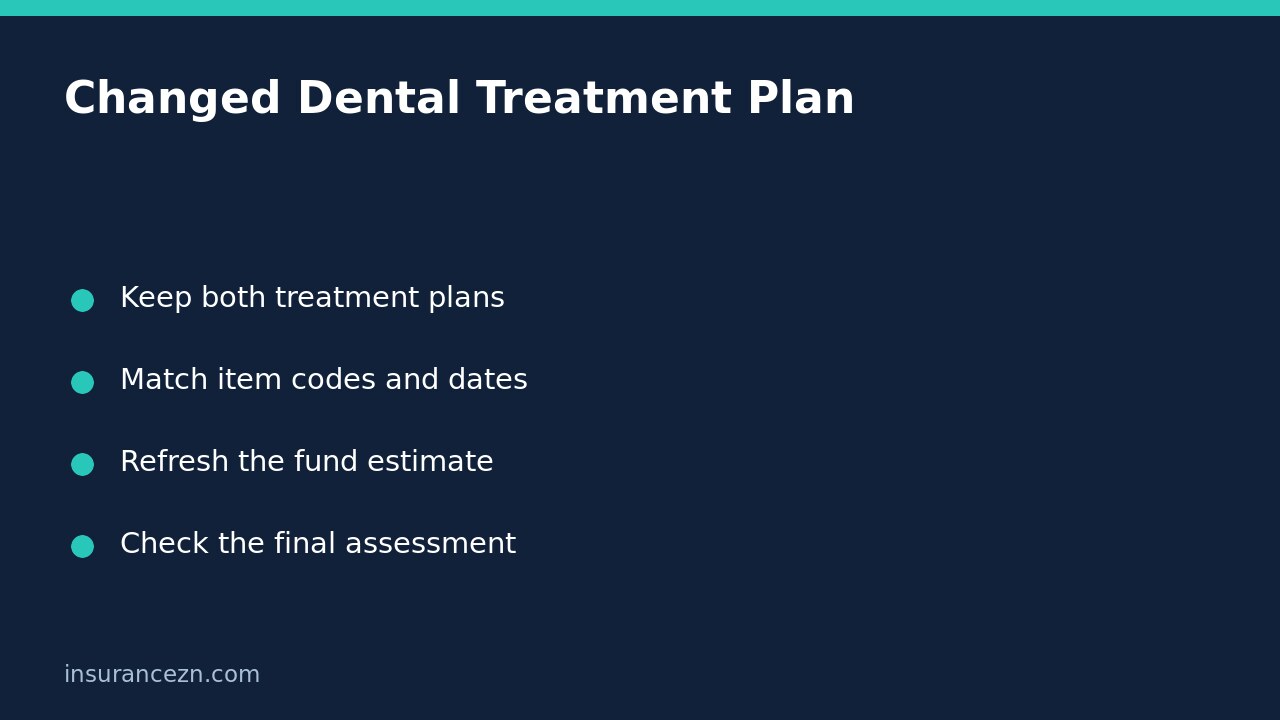

If your dentist changes a proposed treatment plan, do not assume the benefit estimate for the original plan still describes your likely extras payment. Get the revised itemised plan, ask your fund to estimate benefits for those exact services and dates, and keep both versions. A dentist’s recommendation, an estimate request and a final paid claim are different records.
This is general information for Australian readers, not personal financial advice. Benefits depend on your policy, applicable policy booklet or PDS, service eligibility, waiting periods, limits and claim assessment. Do not delay necessary dental care to complete insurance administration; discuss clinical urgency with your dentist.
Identify what actually changed
A changed total price is not enough detail to check insurance. Ask the practice for a revised written plan showing dental item codes, descriptions, quantities, tooth or site details where relevant, proposed service dates and fees. Identify the treating practitioner and location as well. Ask which earlier items have been replaced, removed or deferred, rather than treating every line in both plans as work that will occur.
For example, a hypothetical patient first receives a plan for a restoration. After further examination, the dentist recommends a different procedure and a separate review appointment. The patient should not carry the old estimated benefit across to the new total or add both versions together. The clinical reason belongs in the dental record; the fund needs the actual proposed services to assess its own benefit rules.
Send a versioned request to the health fund
The Australian Government’s private health insurance overview explains that dental treatment can fall within extras cover, but not all policies cover all services. It also explains that general-treatment benefits may have per-service, annual or lifetime limits. That overview does not establish your fund’s estimate validity period or guarantee payment for a particular dental code.
Send the revised plan through your fund’s ordinary enquiry channel and label it clearly, such as ‘revised plan dated 6 November, replacing the earlier proposed plan’. Keep the earlier estimate for comparison. Ask the fund to identify:
- Which revised items are eligible on your actual product.
- The estimated benefit for each eligible item and the assumptions behind it.
- Whether practitioner recognition, waiting periods or other requirements remain outstanding.
- Which available limits were used and whether other claims could change those balances.
- How the proposed service dates affect the estimate and when it should be checked again.
An automated acknowledgement only shows that a message was received. Obtain the substantive response and verify that it refers to the revised plan, not the superseded version.
Rebuild your personal cost comparison
Make a small worksheet with one row per proposed service: new item code, fee, proposed date, fund estimate and unresolved question. Compare the revised fees with the estimated benefits for the same items. Label the result an estimated personal cost, not a guaranteed gap. Keep any deposit as a separate payment record so it is not mistaken for an additional treatment charge.
If treatment crosses benefit years, ask the fund how the actual service dates will be treated. Do not assume the year in which you paid a deposit determines the benefit year. Also avoid assuming that moving an appointment creates a fresh allowance or removes a lifetime limit. Get the product-specific answer before relying on it.
A plan can change again during treatment. Ask the practice to explain clinically necessary variations and document the services actually provided. Where practical, update the fund enquiry when a material change affects the items or fees. Insurance estimates should support an informed cost discussion, not substitute for clinical consent.
Check the assessment after the appointment
Match the final itemised invoice to the services provided and the fund’s claim assessment. If something differs, first identify whether the discrepancy concerns the performed treatment, submitted code, charged fee or benefit rule. Request correction of a factual error through the appropriate party; do not ask the dentist to substitute an inaccurate code merely to obtain a higher benefit.
Retain the original assessment and any amended assessment. A revised invoice or confirmation that documents were uploaded is not proof of an increased benefit or processed refund. For a related example of keeping different services separate, see our guide to assessment and therapy quotes under extras cover.
Quick questions before relying on the new estimate
Does the old estimate reserve my benefits? Do not assume so. Ask the fund what its estimate establishes and what can change before assessment.
Is a higher fee automatically a higher rebate? No. The fee and the policy’s benefit calculation are separate; obtain an item-specific response.
What should I keep? Both plans, both estimates, enquiry references, consent and payment records, the final invoice and the processed claim assessment provide a clearer trail than an unlabelled total.