
Animal damage is not one uniform home-insurance event. A wild animal accidentally trapped indoors, damage by a household pet and an infestation can raise different policy questions. Make the area safe, record what is actually known and ask your insurer to apply the relevant animal-damage and exclusion wording. An animal being present does not, by itself, establish either cover or a valid exclusion.
This is general information for Australian readers, not personal financial advice. Your policy schedule, applicable PDS, definitions, conditions, exclusions and assessment determine cover. The insurer example below is provider-specific, not an Australian-wide rule or a recommendation of that product.
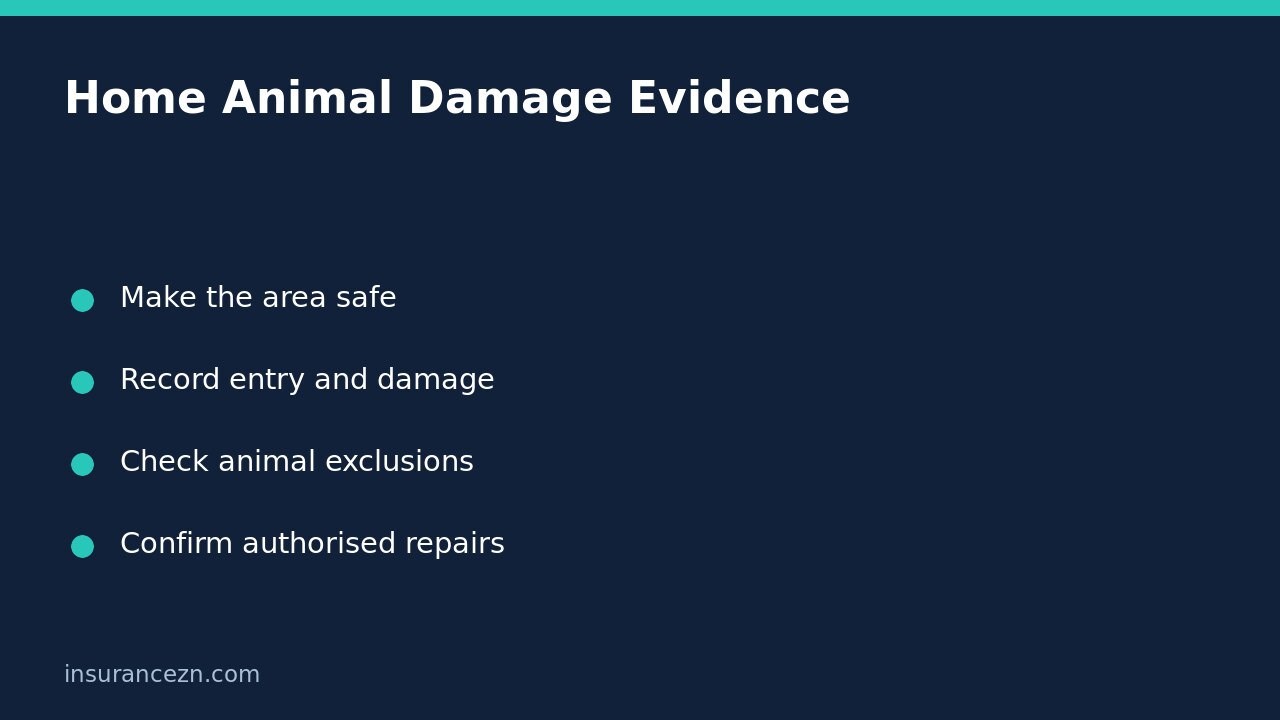
Start with safety, not an insurance conclusion
Keep people and pets away from a distressed or potentially dangerous animal. Use an appropriate licensed professional or wildlife service where needed; do not handle wildlife or damaged electrical wiring to improve a claim photograph. If there is immediate danger, obtain urgent help rather than waiting for an insurance response.
When safe, photograph the affected room, damaged items and any visible entry point. Write down when you first noticed the problem, who was present and what you directly observed. Separate those observations from possibilities. Finding droppings near damaged wiring does not establish the species, timing or full cause of every fault.
If a professional attends, request an itemised report distinguishing observations from conclusions, the affected areas and any urgent safety work. Keep the invoice and payment record. Paying for an inspection does not automatically make that expense reimbursable.
Read the animal wording and exclusions together
For a concrete example, Suncorp’s home-insurance overview describes cover for damage by an animal accidentally trapped inside the home, or entering without the policyholder or tenant knowing when a reasonable person would not have known it was there. The same overview says it does not cover damage caused by animals the policyholder, tenant or their guest own, are responsible for or have allowed onto the property.
That page also excludes damage from insects, vermin or rodents unless covered under fire or escape of liquid. These are important distinctions, but the summary is not a substitute for the applicable PDS. It does not establish that every wild animal incident is covered, that every electrical fault is an insured fire, or that every water problem meets an escape-of-liquid definition.
Ask your own insurer which clause it is considering, how it classifies the animal on the available evidence and whether a separate resulting event needs assessment. Do not import another insurer’s definition into your contract.
Build an incident record without guessing the cause
Consider a hypothetical household that discovers torn curtains and damaged window fittings after an unidentified animal was found inside. A useful record describes the discovery, the animal if reliably identified, the route of entry if known and each damaged item. It does not add unrelated old damage merely because it is in the same room.
Another household discovers chewed material in a ceiling space but has no confirmed entry date. The accurate record says the date damage was discovered and preserves the professional findings. Do not invent a sudden incident date or describe an infestation as an accidentally trapped animal to fit a perceived benefit.
- List building damage separately from damaged contents.
- Mark pre-existing defects and uncertain causes honestly.
- Keep original photographs and reports, not only edited extracts.
- Record temporary safety measures separately from permanent repairs.
- Ask before disposing of affected materials when safe storage is practical.
Our guide to photographing damage before cleanup explains the evidence-preservation task in more detail. Safety takes priority over retaining hazardous material.
Confirm the approved scope before permanent repairs
Ask the insurer whether it needs an inspection and what work, if any, it authorises. Distinguish animal removal, pest treatment, electrical safety work, building repairs and replacement contents. A contractor’s combined quote can contain several tasks that the policy treats differently; an approved repair line does not approve the whole invoice.
Keep separate records of what the insurer authorised and what you instructed the contractor to do at your own cost. If urgent work was necessary before contact, explain why and retain supporting evidence, without assuming retrospective reimbursement. Ask for written clarification of any proposed contribution, exclusion or excess and the reasoning used.
Questions to resolve before closing the file
Does a pest-control report prove the claim is covered? No. It can support factual findings, but the insurer must still assess the applicable policy and damage.
Does submitting photographs authorise repairs? No. Evidence receipt, claim acceptance, repair authorisation and payment are distinct stages.
What if only part of the damage is accepted? Ask for an itemised decision separating accepted damage, excluded costs and unresolved items. Reconcile that decision with the final authorised scope and settlement record rather than treating a general acknowledgement as a completed outcome.