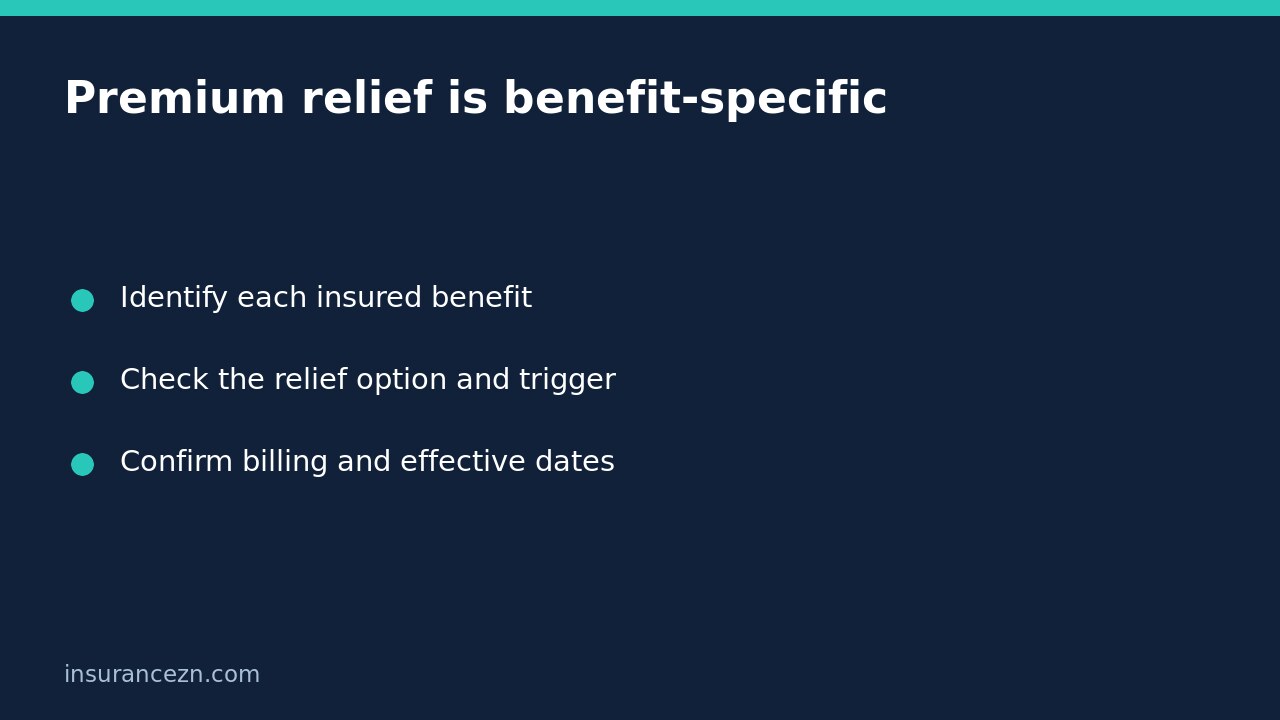

Being on an insurance claim does not automatically mean every premium on your policy stops. A premium waiver attached to an income protection benefit and an optional premium relief feature for other life insurance benefits can have different triggers and scope. Identify the exact benefit and contractual feature before deciding that a debit is wrong or stopping payments.
This is general information for Australian readers, not personal financial advice. Your policy, Product Disclosure Statement (PDS), schedule, accepted options and claim circumstances determine the outcome. The provider example below illustrates distinctions to check; it does not establish the terms of every Australian life insurance policy.
Separate the claim payment from premium relief
A claim payment provides money under an insured benefit. Premium relief concerns whether specified insurance charges remain payable. One outcome does not automatically establish the other. Even where a contract includes relief, it is important to know which cover it applies to, when the requirements are met and how the insurer will implement it.
The TAL insurance FAQs explain that customers receiving income protection payments no longer pay those premiums while claiming a benefit. However, TAL says life, total and permanent disability and recovery insurance premiums remain payable unless the Premium Relief Option has been selected. This is TAL’s published explanation, and readers should check the specific product and policy version rather than transplanting it to a different insurer.
The same FAQs describe Premium Relief as an option for life, TPD and recovery insurance, with an inability to work for at least three consecutive months due to illness or accident in the overview. That summary is not a complete definition of eligibility. Obtain the actual option wording before assuming a particular absence from work qualifies or a particular premium has been waived.
Check that the option was purchased, not merely advertised
An option listed on a website is not evidence that it appears on your policy. Find the current schedule and any accepted amendment. Look for the feature’s name, the benefits it attaches to and any individual conditions. If the wording differs from the marketing page, ask the insurer to identify the applicable contract provision.
- List each insured benefit and its current premium, where separately shown.
- Record whether premium relief is included, optional and selected, or not shown.
- Identify the disability or other trigger, required duration and evidence requirements.
- Ask when relief starts, when it ends and what changes must be reported.
- Check whether any charges remain payable during the relief period.
If the records are unclear, request confirmation rather than treating a missing label as a final decision. A bundled debit can be particularly confusing: a smaller payment may reflect relief on one component while other components remain chargeable.
Use a component ledger instead of an all-or-nothing assumption
Consider a hypothetical policy with income protection and separate life and TPD benefits. The customer starts receiving an accepted income protection benefit and expects the entire regular insurance debit to disappear. The insurer’s billing response needs to explain each component: which premium is affected by the income protection claim, whether any separate relief option applies and which charges continue.
No invented premium figures are needed to resolve that task. Use the actual statement and ask for an itemised explanation. If the insurer says relief applies from a particular date, compare that date with the billing period covered by the debit, not merely the day the bank transaction appeared. Ask whether an adjustment is proposed or has already been processed.
Confirm the processed billing outcome before changing payments
Send a focused request with the policy and claim references, the benefits concerned and the relevant debit dates. Ask for the clause relied on, the relief decision, effective dates and any information still required. Provide medical or financial evidence through the insurer’s approved channel, sharing only what is needed for the request.
A message saying documents were received is not a decision that relief applies. Likewise, an accepted relief decision and a corrected premium ledger are separate records. Where an adjustment is due, obtain confirmation of its amount, allocation and whether it will be refunded or credited. Avoid submitting a second claim simply because the first billing enquiry has not been resolved.
Do not cancel a direct debit solely on the strength of a general article. Ask how any disputed amount should be handled while the insurer investigates, and what continuing payments are required to preserve other benefits. If payment frequency is also changing, use our first-new-debit checklist to distinguish the revised collection schedule from the separate relief decision.
Quick checks before you close the enquiry
- Does claim acceptance waive every premium? Not necessarily; identify the applicable benefit and feature.
- Does an advertised option prove I hold it? No. Check the schedule and accepted amendments.
- Is a missing debit proof of relief? No. Obtain the billing explanation and confirm the remaining payment obligations.
- What confirms the issue is resolved? Keep the written decision, effective dates, itemised ledger and any processed adjustment together.
The useful result is not simply a promise that premiums will be checked. It is a benefit-specific explanation that matches the policy and the actual payment record.