
If your car now spends more time parked, review the annual kilometres recorded on your insurance. Use a realistic estimate of future driving, not the smallest number a quote form accepts. A lower distance can affect pricing with some insurers, but it does not guarantee a discount, refund or unchanged cover.
This is general information for Australian readers, not personal financial advice. Your policy schedule, applicable Product Disclosure Statement (PDS), endorsements and insurer’s accepted amendments determine cover, conditions and payment obligations.
Separate an estimate from an accepted policy change
In its explanation of how reducing kilometres may affect car insurance premiums, AAMI says annual-distance estimates form part of its pricing. It describes updating the Kilometres per year field through My Account and says a resulting premium reduction is displayed after the change. This is AAMI’s explanation, not a rule that every Australian insurer uses the same categories, portal or calculation.
There are three separate records to check: your proposed estimate, the distance actually accepted on the policy, and the premium adjustment actually processed. A saved quote or screen showing a potential saving is not proof that an existing policy has been amended.
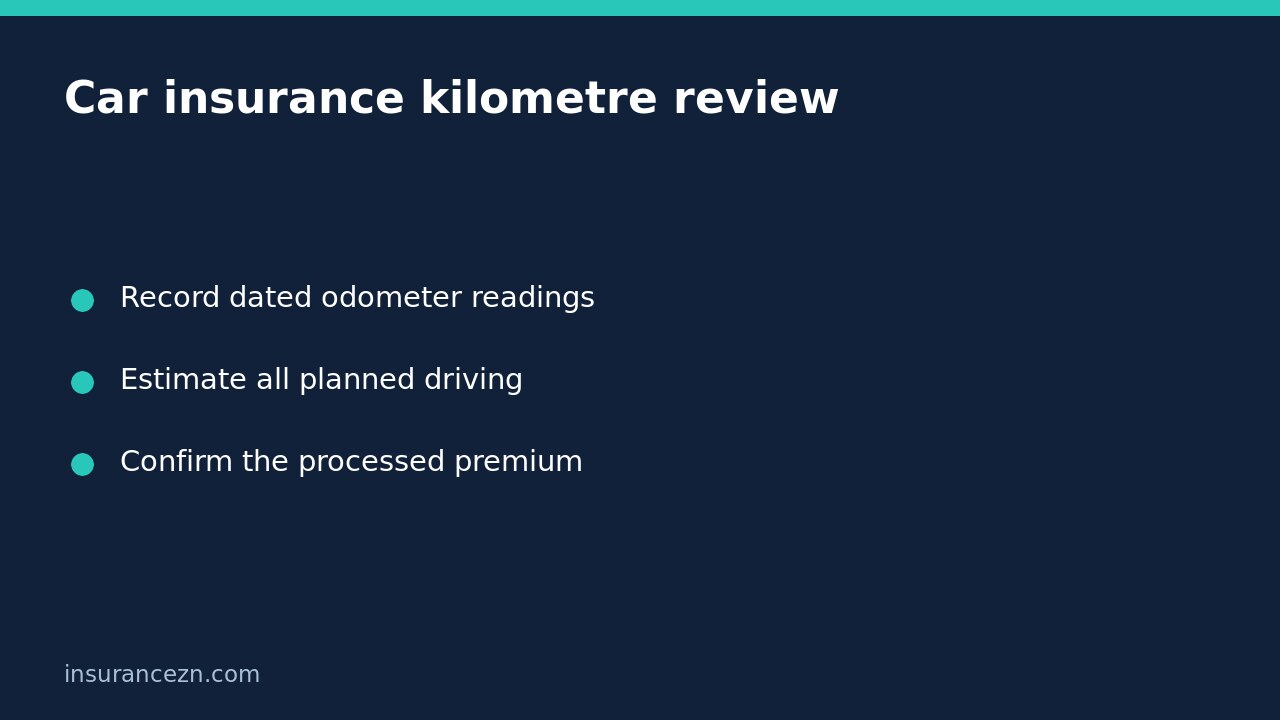
Build a distance estimate you can explain
Start with two dated odometer readings if available. Service invoices can provide historical readings, but a long period containing an unusual holiday or extended absence may not represent the year ahead. Note why your driving changed and when the change began. Do not change historical readings to fit a preferred pricing band.
- List regular work, study, school and shopping journeys.
- Include driving by other household members using the same vehicle.
- Add reasonably planned holidays, regional visits and other longer trips.
- Consider whether a new job or return to office will increase use again.
You do not need to pretend the estimate is exact. Explain uncertainty and ask the insurer how to select its appropriate distance category. Reduced commuting does not necessarily mean the vehicle’s usage classification has changed: business, delivery or rideshare use needs its own accurate discussion.
Use a worked planning example, not a pricing promise
Consider a hypothetical driver who previously commuted daily but now works mostly from home. Their evidence pack contains an earlier service reading, a current odometer photograph and a list of upcoming trips. Rather than simply removing commuting kilometres from last year’s figure, they include their partner’s weekend driving and a planned interstate holiday.
They ask the insurer which annual-distance period the estimate should describe, whether the existing policy can be updated mid-term, and what revised premium would apply. This example illustrates the checking process; it does not establish a universal kilometre threshold or a particular dollar saving.
Compare the amendment without changing other protection accidentally
Keep a copy of the current schedule and payment plan before requesting a change. Ask for a comparison that holds the insured vehicle, drivers, cover type, insured value, optional benefits and excesses constant. If several fields change together, you cannot assume the entire price difference comes from kilometres.
For a related motor-policy comparison, see comparing car insurance renewal quotes without losing agreed value. Keep the settlement basis visible when checking a lower price, rather than assuming the vehicle’s insured value stayed unchanged.
Do not remove a genuine driver or misstate use simply to obtain a lower quote. Ask how an unexpectedly longer driving year should be handled under the actual product. A pricing estimate and any contractual distance condition are different questions; obtain the insurer’s explanation rather than assuming either an unlimited allowance or an automatic claim refusal.
Check the processed record and your next payment
After the insurer accepts an update, obtain the amended schedule or written confirmation. Check the recorded distance category, effective date and any other changed fields. Then reconcile any stated refund, credit or changed instalment with the payment record. A displayed annual saving need not equal an immediate bank refund for the same amount.
If the payment does not match, provide the amendment reference and ask for the calculation and allocation. Do not stop a scheduled payment based only on your own estimate of what should be owed.
Quick questions before you finish
- Will driving less always reduce the premium? No. Confirm the actual quote for your product and circumstances.
- Does updating a quote change my current policy? Not necessarily. Check the processed policy record.
- What if my driving increases later? Ask when another update is required and keep your estimate accurate.