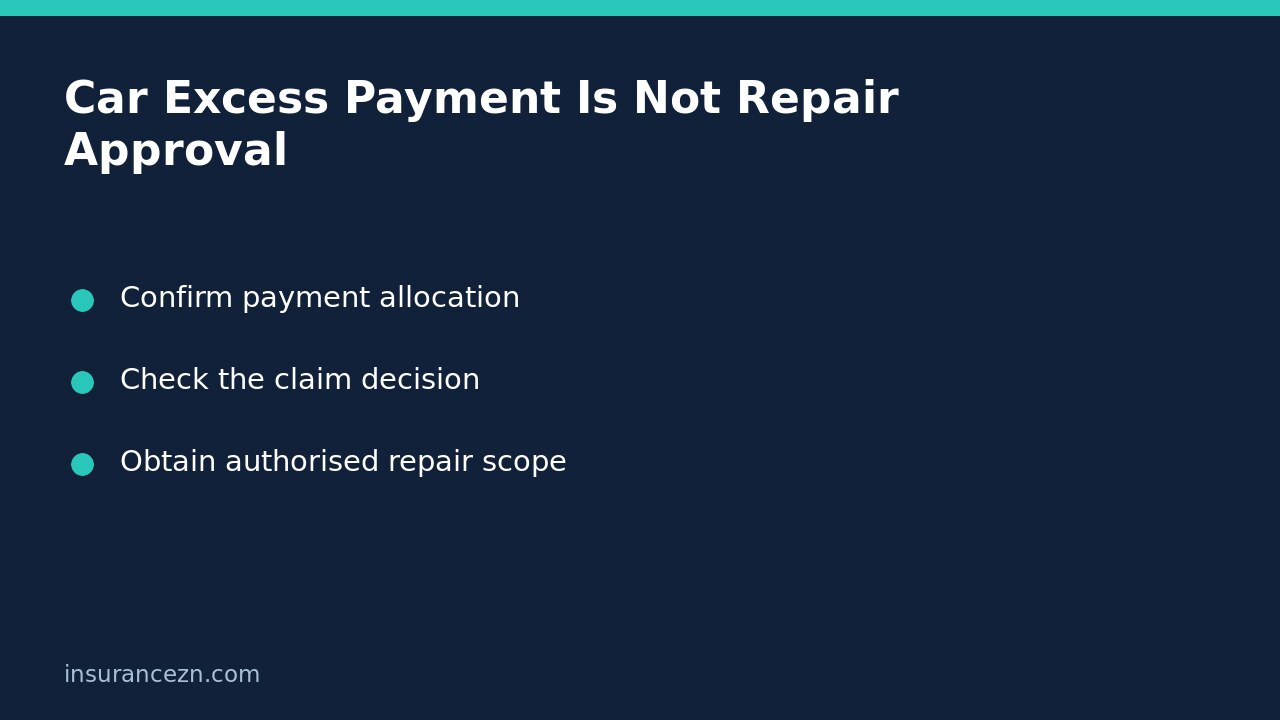

Paying a car insurance excess and receiving a receipt does not, by itself, establish that the insurer has accepted every part of your claim or authorised your workshop to start repairs. Keep the payment record, but separately confirm the claim decision and the exact work the insurer has approved. This matters when a repairer is waiting for your instructions and a payment confirmation looks like the final administrative step.
This is general information for Australian readers, not personal financial advice. Your policy, Product Disclosure Statement (PDS), schedule, exclusions and claim circumstances determine the applicable requirements. The checks below do not establish entitlement to repairs or a refund.
Read what the receipt actually confirms
Check the receipt’s insurer, claim reference, amount and transaction date. Compare those details with the payment request. A completed bank transaction shows money left an account; ask the insurer whether it received and allocated that money to the intended claim. Neither fact should be substituted for a coverage decision.
As a provider-specific example, Suncorp’s comprehensive car claims instructions separately describe claim confirmation, reviewing an excess, uploading documents, booking a repairer and receiving further contact about next steps. Its tracking service also lists excess payment and authorised-repairer details as separate functions. That separation is a useful reason to check the actual status rather than infer authorisation from a payment screen. Other insurers’ processes may differ.
Ask three questions before instructing the workshop
- Payment: Has my excess been allocated to this claim, and is any balance outstanding?
- Assessment: What has been accepted, what remains under review, and what information is still required?
- Repairs: Which workshop, quotation version and individual work items have been authorised?
Ask who will communicate the authorisation to the repairer and whether you need to do anything further. Save the answer alongside the payment receipt. If the insurer has only arranged an assessment, do not describe that appointment to the workshop as approval for the entire repair quotation.
For example, imagine a driver pays an excess after submitting collision photographs. The workshop’s quotation includes bumper repairs and investigation of an engine noise. The payment does not resolve whether the noise relates to the collision or whether diagnostic work is approved. The driver should identify those lines explicitly and ask for the current authorised scope.
Separate your instructions from the insurer’s instructions
A workshop may ask you to sign a job card or approve extra work. Read what you are agreeing to and ask which charges you could personally owe. If you want unrelated servicing completed at the same visit, obtain a separate estimate and distinguish it from the insurance repair. Do not assume an excess payment funds all work carried out while the vehicle is there.
If more damage is discovered after dismantling, ask how the workshop should request a variation and who must approve it. An initial authorisation is not a blank cheque for later additions. Equally, an outstanding question about one item does not prove the insurer has rejected every other item; ask for an itemised position.
Do not drive an unsafe car while sorting out paperwork. For necessary safety measures, seek the insurer’s urgent instructions through verified channels and preserve records without delaying emergency assistance.
Resolve conflicting messages without paying again automatically
If a receipt says paid but the tracking page still requests an excess, send the existing payment evidence through the insurer’s approved channel. State the claim reference, amount, date and transaction reference. Ask whether the display is awaiting an update, the payment was misallocated or a separate amount is genuinely due. Do not make a second payment simply to clear a confusing screen.
If assessment is still pending, ask what the payment means at this stage and what happens to it under the possible outcomes. Obtain the applicable explanation rather than assuming all excesses are automatically refundable when a claim changes. Keep original receipts and later corrections together.
Quick questions before the car goes in
Does a claim number mean repairs are approved? No. It identifies the claim record, not necessarily an accepted repair scope.
Can I treat a payment acknowledgement as a workshop instruction? Only rely on an actual authorisation covering the relevant work, not your interpretation of a receipt.
What should I keep? Save the receipt, allocation confirmation, assessment status, authorised quotation and any customer-paid work agreement. If you are still establishing whether the claim was submitted, our saved-claim submission checklist addresses that earlier, separate problem.