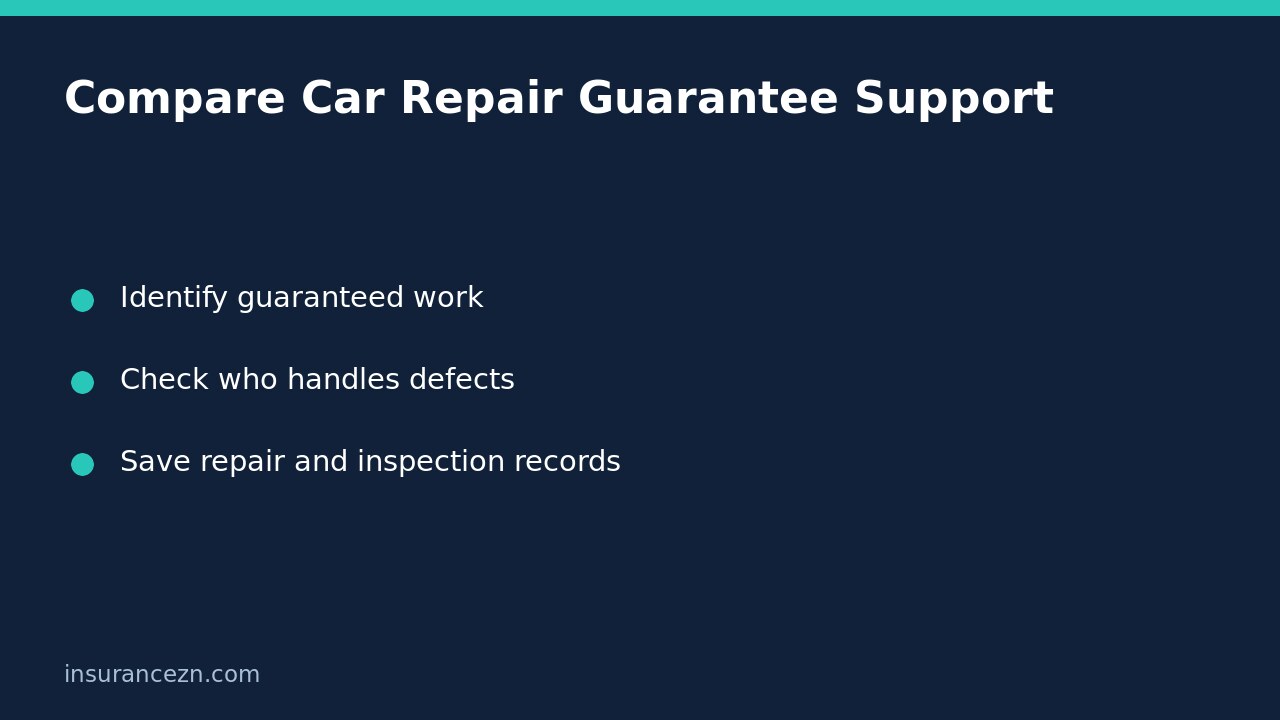

When two Australian car insurance quotes advertise a repair guarantee, compare how you would use it if a problem appeared after collection. Record which repairs qualify, who stands behind the promise and how a suspected defect must be reported. A reassuring duration does not tell you whether a particular workshop job or later fault falls within the guarantee.
This is general information for Australian readers, not personal financial advice. Cover and guarantee conditions depend on the relevant Product Disclosure Statement (PDS), policy documents, repair authorisation and circumstances. The provider example below is not a recommendation or a universal Australian insurance rule.
Start with the work that qualifies
Suncorp’s comprehensive car insurance overview says it guarantees the quality of workmanship of repairs it authorises and arranges. Its lifetime-repair-guarantee explanation also describes the quality of materials and workmanship for repairs it authorises. These qualifiers matter: do not turn a statement about authorised repairs into a promise about every mechanical problem the vehicle may develop.
For each quote, locate the actual guarantee wording and note the applicable cover level. Ask whether the same conditions apply to insurer-selected and customer-nominated repairers. If a cash settlement is available, ask separately what happens when you arrange the repairs yourself. Do not assume a guarantee attached to insurer-arranged work automatically follows a different settlement method.
Compare the response route, not just the duration
Before purchasing, ask each insurer to explain the process for reporting a suspected repair defect. You are collecting information, not requesting a finding about a fault that has not occurred. Keep written answers with the quote reference and applicable document version.
- Should the customer contact the insurer first, the original repairer, or a dedicated repair-support team?
- What repair reference and evidence should accompany the report?
- Who decides whether another inspection is needed?
- Must rectification be authorised before another workshop starts work?
- How are disagreements about the cause or repair standard reviewed?
If the public overview does not answer these questions, mark them unresolved rather than filling the gaps with assumptions. An insurer’s claims team may explain the process, but ask where important conditions appear in the contract or guarantee documentation.
Use one realistic defect scenario for both quotes
Imagine a hypothetical bumper repair followed by a loose trim panel noticed after collection. Ask both insurers how that suspected workmanship issue would be recorded and assessed. Then contrast it with a new scrape caused by a later parking incident. The two situations require different factual investigations; a lifetime label alone does not decide whether either event qualifies.
Keep the scenario neutral. Do not assert that every loose panel must be defective work or that every later symptom is ordinary wear. The practical comparison is who investigates, what records help and what authorisation is needed before rectification. A guarantee assessment and acceptance of a separate new claim are different decisions.
Ask about transport and inspection arrangements separately. A workmanship promise does not, by itself, establish a free hire car, towing entitlement, reimbursement of independent inspection costs or a guaranteed completion date. If these services influence your choice, request the relevant benefit conditions and compare them independently.
Check what the owner must preserve
Ask what records the insurer recommends keeping after repairs. A useful private file includes the original authorised scope, repair invoice or completion statement, collection date, photographs and later communications. These records help describe what was repaired and when the concern arose; they do not prove the cause on their own.
If a safety concern arises, stop using the vehicle when necessary and seek appropriate assistance. Do not continue driving simply to demonstrate the defect. Equally, do not commission non-urgent rectification on the assumption that another workshop’s invoice will automatically be reimbursed. Obtain instructions and preserve evidence where safe.
Also ask whether guarantee duration, ownership changes or other eligibility conditions affect the promise. Do not infer that the word lifetime necessarily means your lifetime, the first owner’s lifetime or an unconditional transferable benefit. Record the provider’s actual definition.
Finish with a compact quote comparison
Use one row per quote with columns for qualifying work, guarantee provider, duration definition, first contact, inspection process and prior-authorisation requirements. Add a separate column for transport benefits so you do not confuse repair quality protection with temporary mobility.
Is repairer choice the same comparison? No. Choosing or nominating a workshop is an earlier decision. Our repairer-choice and quote-approval checklist covers that stage; this checklist focuses on support after a suspected defect appears.
Does the longest headline guarantee automatically win? No. Compare the qualifying work and usable reporting process alongside premiums, excesses and other cover. An unresolved question is a reason to obtain clarification, not evidence that one policy must be better.