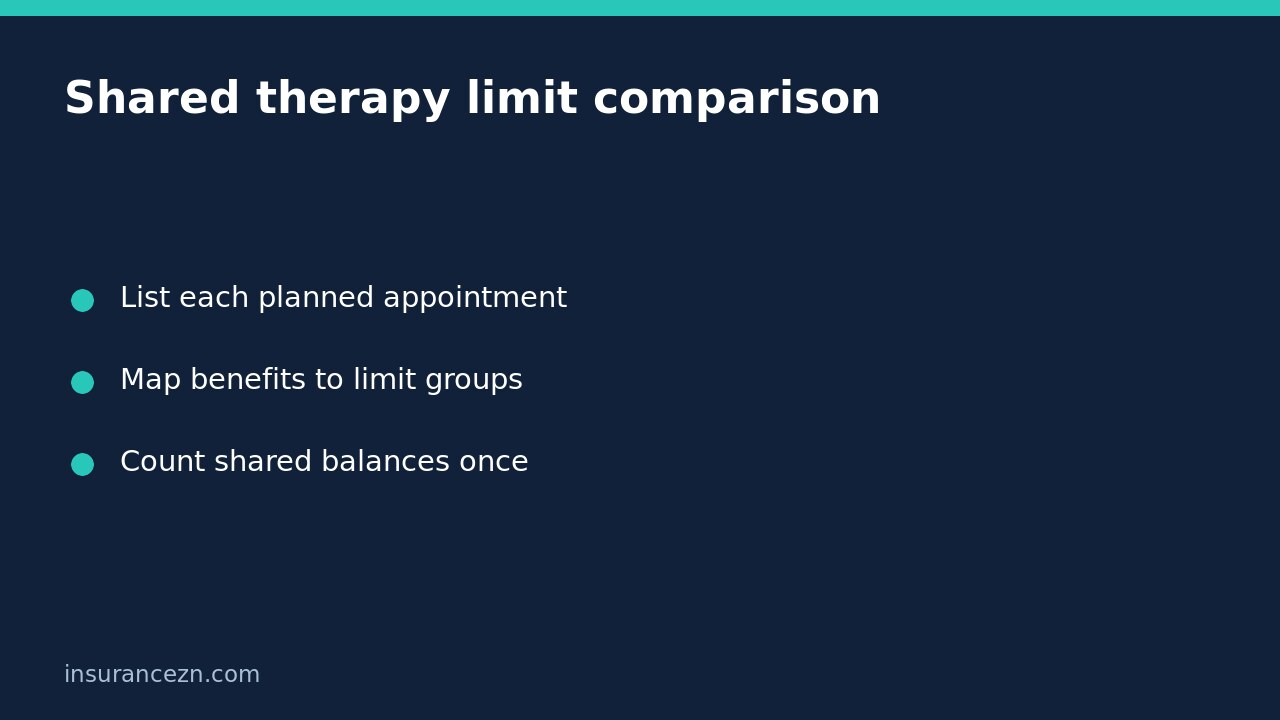

When comparing extras for more than one therapy, calculate the benefits for your whole appointment plan, not each service in isolation. If the policy puts two services under one combined limit, the same remaining dollars cannot be used twice. A larger advertised benefit per visit can still produce a smaller total contribution once that shared ceiling is reached.
This is a comparison exercise for Australian readers planning several types of treatment. It is different from transferring another family member’s unused allowance: first establish which services draw on the same limit for the person receiving treatment.
Start with the actual services and providers
Ask your clinicians for the proposed appointment sequence and itemised fees. Record initial assessments separately from follow-up visits. Do not book unnecessary treatment to use insurance; clinical decisions belong with your treating professionals.
The government’s General Treatments definitions distinguish physiotherapy, chiropractic, exercise physiology and other extras services. Similar-sounding treatments should not be treated as interchangeable claim categories. Ask each proposed fund whether the exact practitioner and service are eligible, and what benefit applies to the quoted appointment.
For a dietitian appointment, our guide to comparing dietitian extras against the actual quote explains why the appointment details matter before inserting a benefit into a worksheet.
Draw a map of the policy’s limit groups
For each candidate product, list the quoted per-visit benefit, the service-specific annual ceiling, any combined ceiling, and the benefit year. Ask whether the limit applies per person or per membership. A product may use separate limits, grouped limits, or another structure: do not assume all funds organise therapies in the same way.
PrivateHealth.gov.au’s coverage overview explains that extras benefits are limited and may have per-service, annual or lifetime limits. It recommends reading the Private Health Information Statement and obtaining details from the insurer. That general explanation does not establish the exact grouping on a product you are considering.
- Which of my listed services draw on the same balance?
- Is a smaller individual service limit applied before the combined ceiling?
- What benefits have already reduced the available balance?
- Are pending claims missing from the displayed balance?
- What waiting periods, provider rules and service-date conditions apply?
Work through one combined treatment plan
The following figures are hypothetical, not insurer quotes. Assume all visits are eligible, all waits have been served, and there are no earlier claims. The plan contains six physiotherapy visits at $90 each and four chiropractic visits at $70 each: total fees of $820.
Illustrative Product A pays $40 for each physiotherapy visit and $30 for each chiropractic visit, but both draw on one $300 annual pool. Before the shared ceiling, the appointment benefits total $360. The pool caps the contribution at $300, leaving $520 of treatment fees for the patient.
Illustrative Product B pays $35 for each physiotherapy visit, subject to a separate $250 limit, and $25 for each chiropractic visit, subject to a separate $150 limit. Those planned visits generate $210 and $100 respectively: $310 in total benefits and $510 in patient fees. Product B contributes slightly more despite its lower per-visit figures.
This does not make B automatically cheaper. Compare actual premiums over the same period and include any other benefits you realistically expect to use. A premium difference can outweigh that treatment-cost difference. Mark unknown benefits as unconfirmed rather than entering the advertised maximum as a guaranteed payment.
Model the transition before switching
Ask the new fund how it will treat previous claims, served waiting periods and the proposed commencement date. Do not assume switching creates a fresh unused pool. Obtain a written estimate based on the actual services and your current claim history. Keep both the outgoing balance record and the new fund’s response.
If treatment dates or providers change, update the calculation. An annual ceiling is not an instruction to bring appointments forward, and a submitted transfer request is not proof that the new membership and benefits have commenced.
Quick questions before choosing
Can I add every advertised service limit together? Only after confirming they are independent. Where a combined ceiling applies, cap the grouped calculation at that ceiling.
Does an available balance guarantee my next claim? No. The actual service, practitioner, waiting periods and applicable rules still need to qualify.
What should I save? Keep dated quotes, the relevant policy documents, your appointment worksheet, existing claim history and written explanations of shared limits. Reconcile actual assessments against that worksheet after treatment.
This is general information for Australian readers, not personal financial advice. Benefits depend on the product, policy wording, exclusions, waiting periods and individual circumstances. Read the fund rules, policy documents and any applicable PDS before deciding.