
When comparing Australian car insurance for work equipment, start with whether you qualify for the tools-of-trade benefit. A large advertised limit is not useful if the benefit’s conditions do not fit your business, vehicle use or tax status. Do not assume that insuring a ute comprehensively also insures every tool carried inside it.
This is general information for Australian readers, not personal financial advice. Read the applicable Product Disclosure Statement (PDS), supplementary documents and certificate. Eligibility, insured events, exclusions, excesses and settlement rules depend on the actual product; this article does not establish your entitlement.
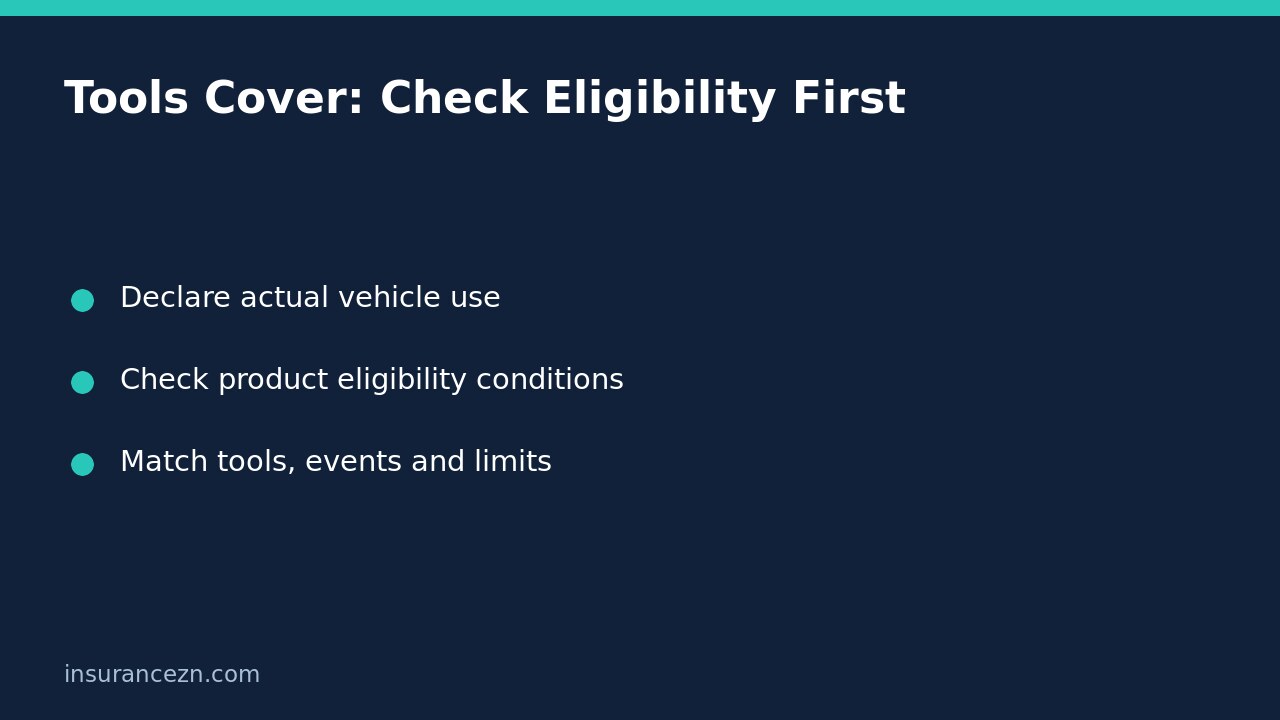
Use the eligibility wording as the first filter
A concrete provider-specific example appears in Suncorp’s comprehensive-car overview. Its tools-of-trade explanation says you must have told it the car is used for business, with that use shown on the certificate of insurance. It also says you must be registered for GST and entitled to claim an input tax credit.
Those are Suncorp’s stated conditions, not universal Australian rules for every tools policy. An ABN, ownership of equipment or an occasional work journey should not be treated as a substitute for any of those separate requirements. If you are unsure about your tax position, establish the facts with an appropriate adviser rather than changing a quote answer to obtain a benefit.
Ask each candidate insurer to identify its corresponding clause and confirm how it applies to your circumstances. Record ‘not yet confirmed’ where the response is incomplete. Do not replace missing information with an assumption that another insurer’s wording applies.
Describe the vehicle use and equipment accurately
Prepare the same factual description for every quote. Include the type of work, how the car is used, who owns the tools and where they are normally kept. Separate portable equipment from accessories fixed to the vehicle and from stock being delivered. Ask which section, if any, responds to each category.
- List the major tools and approximate replacement needs, using existing purchase records where available.
- Identify employee-owned, hired or borrowed items instead of describing everything as your own property.
- Explain whether equipment stays in the vehicle overnight or is unloaded at the premises.
- Describe trailers, storage boxes and security arrangements accurately.
- Tell the insurer about the actual work activity rather than choosing the nearest inexpensive quote category.
This inventory is a comparison aid, not evidence that any item is accepted. Request correction if the quote summary or issued certificate describes a different use from the one you disclosed.
Compare events and conditions before comparing dollar figures
Once eligibility is established, ask what must happen for the benefit to respond. Does the wording require damage to, or theft of, the insured vehicle? How does it address tools stolen without the car? What location, locking, unattended-storage or evidence conditions apply? These are questions to resolve from the product wording, not promised features.
Then record the limit, whether it is per item or shared across an incident, any applicable excess and how the insurer values a damaged or missing tool. Ask whether the benefit interacts with another personal-property allowance. Do not add two displayed limits together unless the insurer confirms that both can apply to the same loss without double counting.
Keep business liability separate: protection against third-party allegations does not itself establish cover for your own stolen drill. Likewise, payment for damaged equipment does not automatically include lost work income or the cost of temporary replacement hire.
Use a realistic comparison scenario
For a hypothetical comparison, consider a self-employed worker carrying personally owned tools who is not registered for GST. The useful question is not simply ‘Which car policy has the highest tools limit?’ It is ‘Am I eligible for this benefit on these facts, and what other suitable equipment cover should I investigate if I am not?’
Under Suncorp’s published overview condition, the GST requirement needs to be addressed; it should not be ignored because business use is listed. Another product might have a different test, but that must be checked rather than inferred. This example does not recommend registering for GST or selecting a particular insurer.
Compare any alternative equipment policy using the same items and journeys. The business-tools journey checklist helps separate premises, transit and worksite questions. For broader car-policy repair arrangements, also review repairer-choice quote approval rules.
Keep proof of the accepted arrangement
Before relying on the benefit, retain the accepted quote, relevant wording and issued certificate. Check the business-use entry and effective date. A submitted change request is not proof that the insurer has processed the amendment, and a newly added benefit should not be assumed to protect an earlier loss.
Does business use automatically include tools? Not necessarily. Confirm the separate equipment benefit and its conditions.
Is the overview enough? Use it to identify questions, then check the applicable PDS and written confirmation for your policy. Marketing summaries are not a complete statement of cover.
What if eligibility remains unclear? Mark the benefit as unresolved in your comparison and seek a product-specific answer before treating its limit as usable protection.