
Owning business property insurance does not, by itself, establish cover for tools carried to a customer’s premises. Check where the equipment is insured, which events are covered, and whether storage, transport and on-site use fall within the policy. A useful review follows the equipment through its working day rather than stopping at the workshop inventory.
Business Queensland’s insurance overview distinguishes property damage, general property, burglary and theft, and marine, cargo and transit insurance. It describes general property as covering items such as tools, equipment, phones and stock samples, while transit insurance concerns goods moving through the supply chain. These are starting points for questions, not interchangeable promises of cover.
Map one real journey from storage to return
Choose equipment you actually take off site: a camera kit, measuring instrument, cleaning machine or set of power tools. Write down where it stays before work, how it travels, where it is used, and where it remains between jobs. Include overnight arrangements and any temporary storage at another person’s premises.
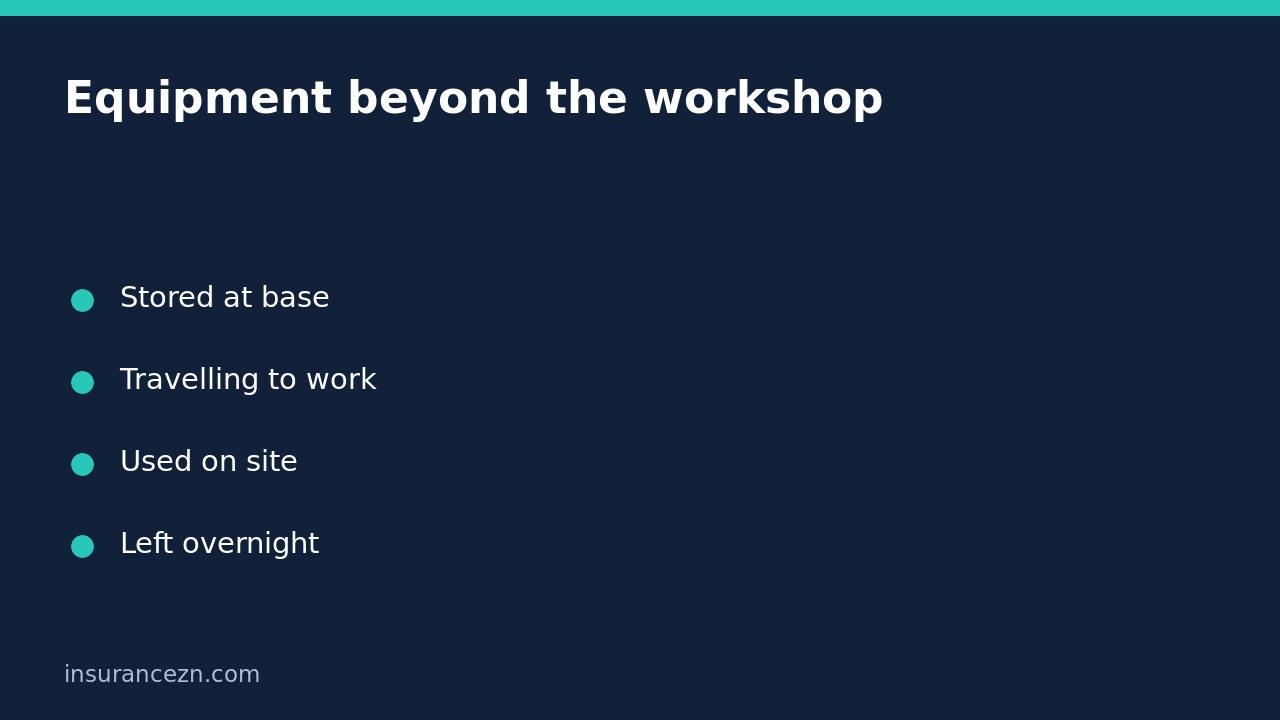
A small repair business might keep diagnostic equipment in a workshop, drive it to a client, use it indoors and leave it in a vehicle between appointments. Those are four different circumstances to describe to the insurer. Do not reduce them to the vague statement that the equipment is for business use.
Identify who owns the item too. Owned, hired, leased and borrowed equipment may need different checks. Record the serial number, purchase evidence and a realistic current replacement description without assuming the policy pays replacement cost in every situation.
Match each stage to actual wording
Review the schedule, relevant definitions and endorsements together. Ask the insurer or broker to identify the section that would respond to the item at each location and stage. A product name such as portable equipment is not a substitute for the terms underneath it.
- At the workshop: Is the item included in the insured contents and at the declared address?
- In transit: Are your own deliveries and journeys included, or is a separate arrangement needed?
- At a customer’s site: Does cover extend to use there, temporary storage there, or both?
- In a parked vehicle: What theft, security, time or location conditions apply?
- With another worker: Does the answer change if an employee or contractor transports it?
Ask about geographical limits, per-item and total limits, excesses and any requirement to list valuable items. Do not assume every policy has the same conditions. A vehicle policy, a liability policy and equipment insurance address different risks; confirmation of one should not be treated as confirmation of the others.
Test a specific loss scenario before there is a loss
Suppose a photographer takes two cameras and lighting equipment to a client’s office. The practical question is not simply whether cameras are insured. Ask how the policy treats accidental damage while being used at that office, theft from temporary storage there, and theft from the transport vehicle. These are hypothetical questions, not statements that a particular event is covered.
Request a written explanation of the relevant clauses and any required endorsement. If an answer depends on security arrangements, describe the real arrangements accurately. Avoid accepting a reassuring summary that contradicts an exclusion or condition in the supplied wording.
Where cover is not available on acceptable terms, discuss operational alternatives: taking fewer items, arranging secure storage, changing transport arrangements or avoiding unattended overnight storage. Such precautions reduce exposure but do not create an insurance entitlement.
Keep equipment damage separate from other losses
Damage to your own equipment is different from damage it causes to a customer’s property. Business Queensland explains public liability in terms of potential third-party injury or property damage, while property sections concern business assets. If equipment stops working, distinguish a breakdown from theft or accidental damage, and check the relevant section rather than assuming one policy heading covers everything.
For that separate diagnostic question, see our explanation of equipment breakdown versus maintenance costs. Also ask separately about lost income, hired substitutes and urgent freight. Paying to repair an item does not automatically establish payment for every consequential expense.
Before the next off-site job
Is a certificate of currency enough? It can establish that a policy is current, but you still need the wording and any endorsements to assess the journey and item. Our certificate of currency checklist explains what to check before sending one.
What evidence should I retain? Keep an equipment register, purchase or hire records, current photographs and written coverage answers securely. Update the register when items or working arrangements change.
This is general information for Australian readers, not personal financial advice. Cover depends on the insurer, policy wording, schedule, exclusions, limits and conditions. Read the applicable PDS and endorsements, and obtain advice appropriate to your business. The Queensland source provides useful general distinctions; it does not establish identical legal or compulsory-insurance requirements across Australia.