
If your planned hospital procedure changes after you obtain a benefit estimate, ask for the new treatment details and have the relevant costs checked again. An earlier estimate relates to the information originally supplied; do not assume it also confirms benefits for a different operation, additional service or changed provider.
This is general information for Australian readers, not personal financial advice. Your policy, fund rules, Product Disclosure Statement (PDS) where applicable, eligibility and final claim assessment determine benefits. Necessary clinical care should not be delayed for insurance administration; discuss timing and treatment questions with your treating team.
Start with the revised treatment information
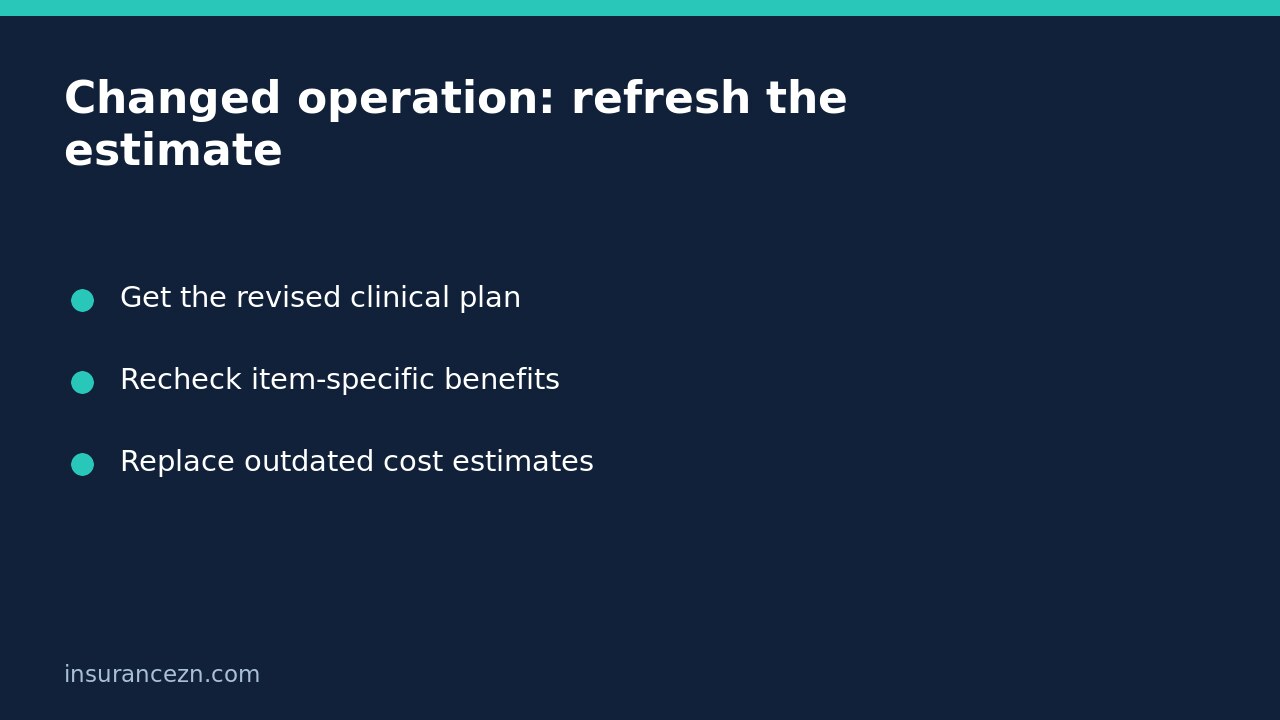
Ask the specialist’s office what has changed and request an updated written fee estimate. Obtain the proposed Medicare Benefits Schedule (MBS) item numbers where applicable, the intended procedure, date, hospital and treating providers. Ask whether an earlier item has been replaced or an additional service is now proposed. Do not choose a clinical code yourself or ask for a different code simply to obtain a benefit.
The government’s out-of-pocket costs guidance recommends obtaining MBS item numbers, preferably written estimates, and checking those details with the insurer. It also explains that not all medical services are listed in the MBS and that benefits may not be payable for a non-listed service. The practical task here is to apply those checks again to the changed plan, rather than carrying forward an old answer.
Identify which earlier answers no longer match
Keep the original estimate, but label it as the earlier version. Create a short change list alongside the updated plan. This is more useful than forwarding a new document without explaining what changed.
- Procedure or MBS item: record the old and proposed replacement details.
- Provider: note any new surgeon, assistant, anaesthetist or other practitioner.
- Facility and admission: identify a changed hospital or expected stay.
- Charges: show which professional and hospital estimates were revised.
- Benefit enquiry: retain the earlier reference and request an updated response.
You need not invent missing entries. Mark unconfirmed details as outstanding and ask the responsible office to supply them. If a clinician says the final procedure may depend on findings during treatment, ask what can reasonably be estimated now and what remains uncertain.
Ask the insurer about the actual replacement plan
Send the revised information through the fund’s usual secure channel. Ask whether the proposed treatment is included under your current hospital cover, whether waiting periods or restrictions affect the estimate, and what benefits are estimated for the identified medical items. Request the assumptions and unresolved questions in writing.
Also confirm the exact hospital’s agreement position and any expected hospital contribution, excess or co-payment. An agreement hospital does not eliminate every patient cost. Government guidance distinguishes hospital charges from doctors’ medical fees, and explains that policy excesses or co-payments may still apply.
If a doctor previously offered a gap arrangement, ask that doctor and the insurer whether it will apply to this revised episode. The official guidance says doctors can decide on a case-by-case basis whether to use a fund’s gap arrangement. Participation generally is not confirmation for the changed service.
Rebuild the cost picture without double-counting
For example, imagine a hypothetical patient whose planned operation changes and now involves an additional treating doctor. The useful comparison is not simply old surgeon quote versus new surgeon quote. Obtain the additional doctor’s estimate, the revised hospital estimate and the insurer’s updated benefit information. Keep each account separate, with its expected patient contribution and any payment already made.
Check whether a quoted patient contribution already includes a particular charge before adding it elsewhere. Do not treat an MBS fee as a cap on what the practitioner can charge. An estimate is also not the final claim assessment: the services actually performed and billed still need to match the applicable benefit rules.
If you have not received an anaesthetist estimate, our questions to ask before surgery when the anaesthetist estimate is missing cover that separate gap in the paperwork.
Before admission: a short confirmation checklist
Keep one current pack containing the revised clinical details, dated provider estimates, insurer response and outstanding enquiries. Tell the hospital and specialist’s office if their documents still describe the superseded procedure. Ask which version they are using rather than assuming a new attachment automatically replaced every old record.
Does uploading the revised estimate establish cover? No. Receipt is not a benefit decision. Obtain the insurer’s response to the actual new details.
Should I cancel treatment if an answer is missing? That is not an insurance-only decision. Discuss urgency and safe options with your treating team and ask the insurer to clarify the unresolved financial questions promptly.
What should I check afterwards? Compare the final itemised accounts and insurer assessments with the updated estimates. Ask about differences using the correct admission reference and preserve both versions rather than silently overwriting the earlier record.