
If you are moving an insurer-funded heart-health programme to another provider, ask the health fund to confirm the replacement arrangement before assuming your remaining sessions transfer. A clinician’s referral, the new provider’s willingness to see you and the fund’s agreement to pay are different decisions. Keep necessary clinical care moving while resolving the funding questions with the relevant organisations.
PrivateHealth.gov.au explains broader health cover, including chronic disease management programmes for heart and cardiovascular health. It says insurers are not required to offer these services and participation may depend on cover and eligibility criteria. That overview does not establish a universal transfer entitlement, session allowance or approval process.
Identify which funding arrangement you are actually leaving
Start with the original programme acceptance or funding letter, rather than an extras balance displayed in an app. Ask the fund whether this is a chronic disease management programme, hospital substitute treatment or an ordinary extras service. Those descriptions should not be treated as interchangeable. The government’s overview describes them separately, and the individual fund must explain the arrangement applying to you.
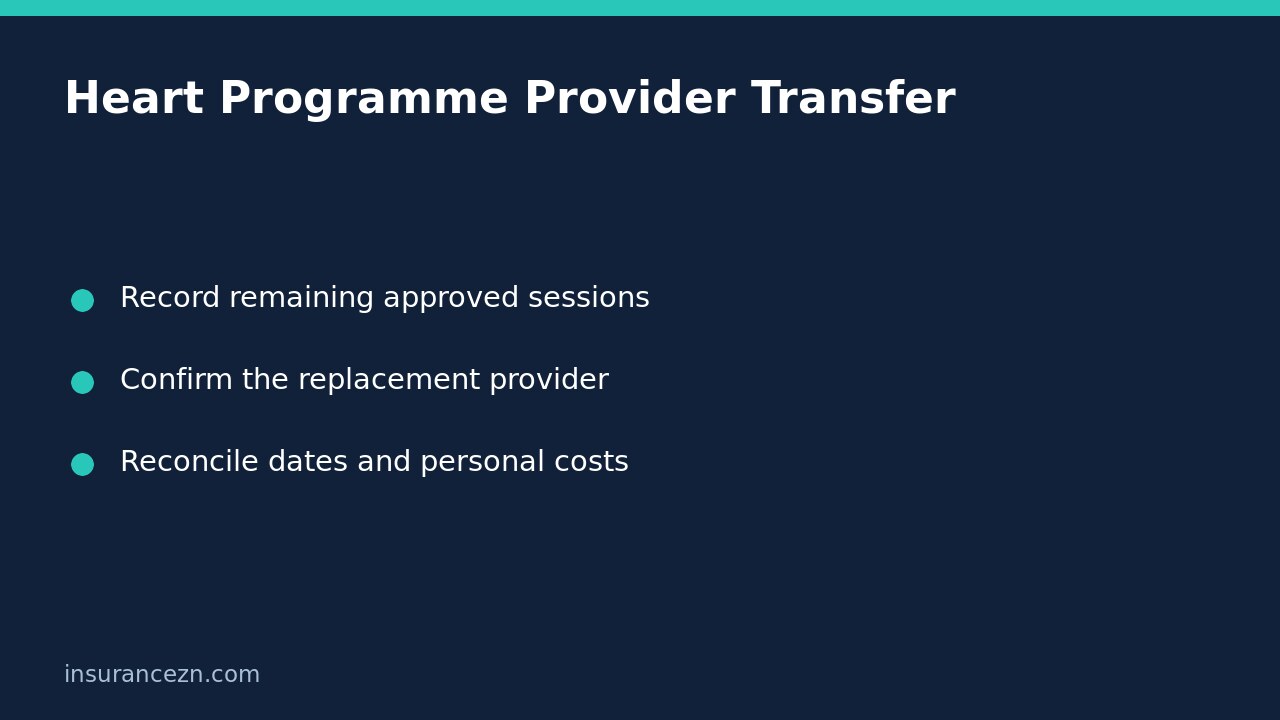
Record the programme name, provider, accepted service description, commencement date, any stated end date and the reference for the fund’s decision. Ask the existing provider for a list of appointments delivered, cancelled and still booked. Mark any uncertain claims as pending rather than counting them as unused entitlement.
Ask about the replacement provider and actual services
Give the fund the new provider’s details and a description of the proposed appointments. A clinic offering a similar-sounding service is not enough to establish that it is part of your programme. Ask whether the fund accepts that provider for this arrangement and whether another referral, assessment or written approval is required.
- Which services and appointment formats are accepted at the new provider?
- Does the existing approval continue, or is a new decision required?
- What dates would the replacement funding cover?
- Are any remaining sessions transferable, and how are pending claims counted?
- Will the provider bill the fund directly, or must you pay and seek reimbursement?
- What fees or services would remain your responsibility?
These are questions to obtain your product’s rules, not statements that every fund offers transfers or reimbursements. Request the answer in writing, including any outstanding requirements. An acknowledgement that the fund received the request is not confirmation that the new arrangement has been accepted.
Use a handover record rather than an assumed balance
Consider a hypothetical member, Sam, whose old provider has three appointments still shown as booked. One appointment has already happened but has not appeared on the fund’s claim record. Sam should not tell the replacement clinic that three funded sessions are definitely available. Instead, Sam asks the old provider to identify the delivered service and asks the fund to reconcile it before confirming any remaining funding.
Use one row per appointment: planned date, actual service date, provider, booked or delivered status, billed amount, claim status and personal charge. Keep the original approval alongside the updated answer. Do not add the old provider’s remaining bookings to the new provider’s proposed bookings and call the result an approved allowance.
If a cancellation charge may apply, ask the provider for its terms. Fund approval of treatment does not necessarily include that charge. Equally, cancelling an appointment does not by itself establish that an insurer has restored a session or reversed a claim.
Coordinate clinical continuity separately from payment
Ask your treating team how to arrange a safe clinical handover, including necessary records and any changes to your care plan. Do not change exercise, medicines or treatment on the basis of an insurance administration checklist. Discuss symptoms and urgent care needs with appropriate clinicians; funding enquiries must not delay emergency help.
For a different home-based service, our guide to confirming the home wound-care funding pathway explains why the service setting alone does not establish who pays. It does not establish eligibility for a heart-health programme.
Final checks before relying on the transfer
Is a new clinic booking proof of funding? No. Obtain the fund’s decision for the exact provider and services, then confirm the clinic’s billing arrangement.
Does a provider change start a fresh allowance? Do not assume so. Reconcile delivered services, pending claims and the fund’s written limits before budgeting.
Keep the approval, appointment reconciliation, provider estimate and any cancellation confirmations together. After the first transferred service, compare the invoice and fund assessment with the accepted arrangement and query discrepancies promptly.
This is general information for Australian readers, not personal financial advice. Services, eligibility, benefits and costs depend on the fund’s rules, your policy documents, any applicable PDS, exclusions and individual approval. Obtain product-specific confirmation and clinical advice for your circumstances.