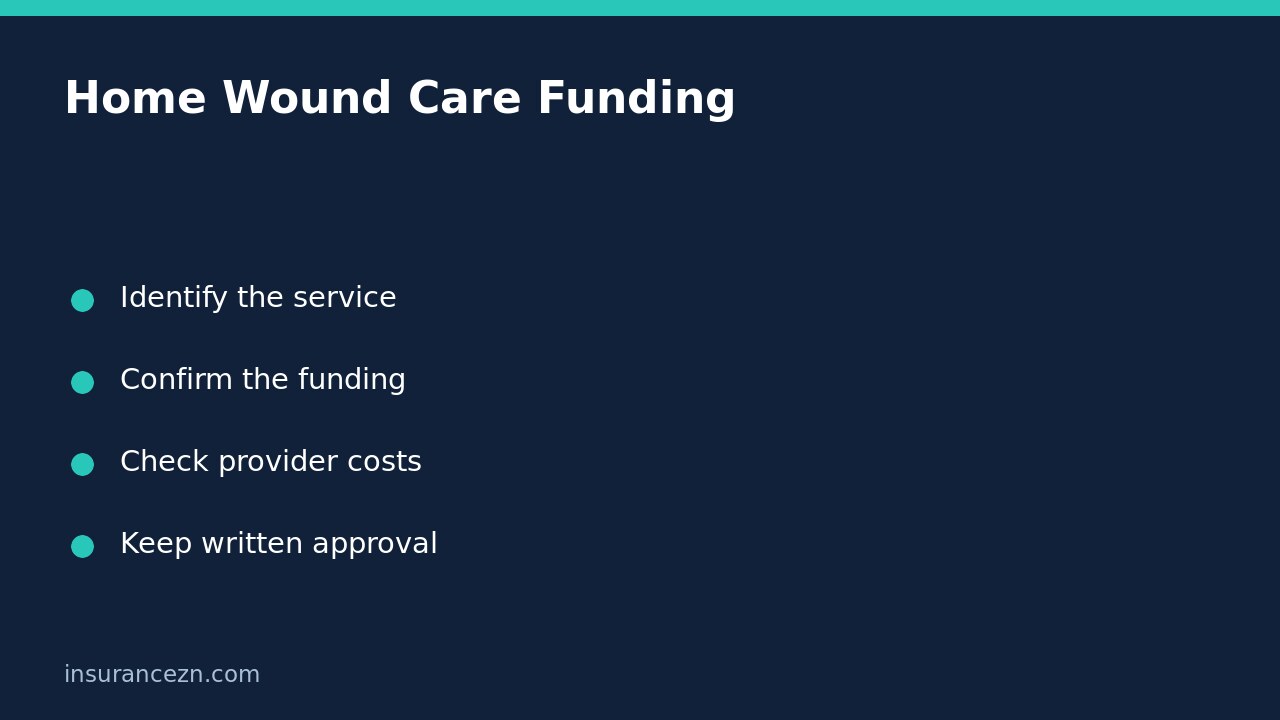

A discharge plan that includes wound care at home is not, by itself, confirmation that your health fund will pay for it. Ask the hospital team and insurer to identify the proposed service, its funding pathway and your expected costs before you rely on a benefit. Keep clinical decisions with your treating team; do not postpone necessary care while checking insurance.
This is general information for Australian readers, not personal financial advice or medical advice. Benefits depend on your membership, policy terms, eligibility and any required approval. Check the relevant policy documents and PDS where applicable, and obtain a product-specific answer from your insurer.
Start by naming the proposed service
Wound care at home can sound like one straightforward arrangement, but the insurance question is more precise: what service is being supplied, by whom, and under which benefit? Ask the discharge coordinator for a written outline describing the proposed visits, provider, expected start date and any separately supplied items.
A useful question is: “Is this being arranged as an insurer-funded alternative to hospital treatment, as home nursing under extras, or through another funding arrangement?” Do not choose the answer based only on where the nurse will visit. Home location alone does not identify the insurance benefit.
Understand hospital substitute treatment without assuming eligibility
PrivateHealth.gov.au explains that health insurers can cover clinically appropriate alternatives to hospital treatment, including treatment at home or in community clinics. It lists wound care, IV therapy and early discharge as examples of hospital substitute treatment.
The same official guidance says insurers are not required to offer these services. Participation may depend on your level of cover and eligibility criteria. A general website statement that home wound care exists therefore does not establish that your insurer offers a suitable program or that your planned care qualifies.
Ask the fund whether your proposed arrangement fits a program it actually provides. Request confirmation of any assessment, referral or approval required. The treating team’s recommendation is important clinical information, but it should not be mistaken for the insurer’s funding decision.
Check whether extras nursing is a different pathway
The official overview also lists home nursing among services that general treatment, or extras, cover may include. It explains that services can have limits per service, per year or over a lifetime, and that some services may not be covered at all.
Do not assume that having home nursing on an extras summary creates the same entitlement as an approved hospital substitute arrangement. Ask the insurer which part of your membership it would use for these particular visits, what benefit is available and what limitations apply. Request the answer for your exact product rather than another policy advertised by the same fund.
If someone suggests using extras after another pathway is unavailable, obtain a separate benefit answer. The rejection of one funding option does not automatically establish eligibility for a different one.
Reconcile the provider quote with the insurer’s answer
Consider a hypothetical discharge plan involving several nursing visits and separately supplied dressings. The hospital says a referral will be sent, while the provider says it can accept the patient. Neither statement tells the patient what the insurer will pay.
Ask the provider to list charges and identify anything billed separately. Then ask the insurer whether its answer includes those exact services and items. Do not assume travel charges, consumables or additional visits are included; equally, do not assume they are excluded without checking. The purpose is to identify the actual arrangement, not invent standard benefit rules.
- Confirm the provider’s name and proposed service.
- Identify which membership component or program will fund it.
- Record any conditions, limits and patient contribution.
- Check the start date and what happens if the care plan changes.
For separate inpatient hospital charges, our agreement hospital checklist explains why the exact facility also matters. An inpatient benefit answer should not be extended to home services without confirmation.
Keep a discharge funding record
Save the referral, service quote, insurer correspondence and any approval reference together. Ask whether a request has merely been received or whether the arrangement is approved and recorded. Where approval is required, clarify the accepted services and effective dates rather than treating an automated acknowledgement as a funding commitment.
Give the provider the relevant confirmation through an appropriate secure channel. If the provider’s understanding differs from the insurer’s, ask them to reconcile it before relying on a quoted patient contribution. An approval for a defined arrangement is not a blanket promise to pay every later invoice.
What if the insurer cannot confirm funding yet?
Tell the discharge team promptly so they can discuss clinically appropriate arrangements and any alternative funding options. Ask who is following up the insurance question and when you should expect an answer. If your wound or health worsens, follow your clinician’s instructions and seek appropriate medical help rather than waiting for an insurance response.