
Before booking a sleep study, ask whether the proposed test involves an admission to hospital, an outpatient appointment or equipment used at home. Then check benefits for that exact arrangement. A referral for snoring or suspected sleep apnoea does not by itself establish private hospital insurance cover.
This is general information for Australian readers, not personal financial advice. Your policy documents, applicable PDS where provided, membership rules, waiting periods, exclusions and benefit conditions determine any entitlement. This article is not medical advice: let your clinician recommend the appropriate investigation and discuss any concerns about timing with them.
Sleep studies is its own hospital category
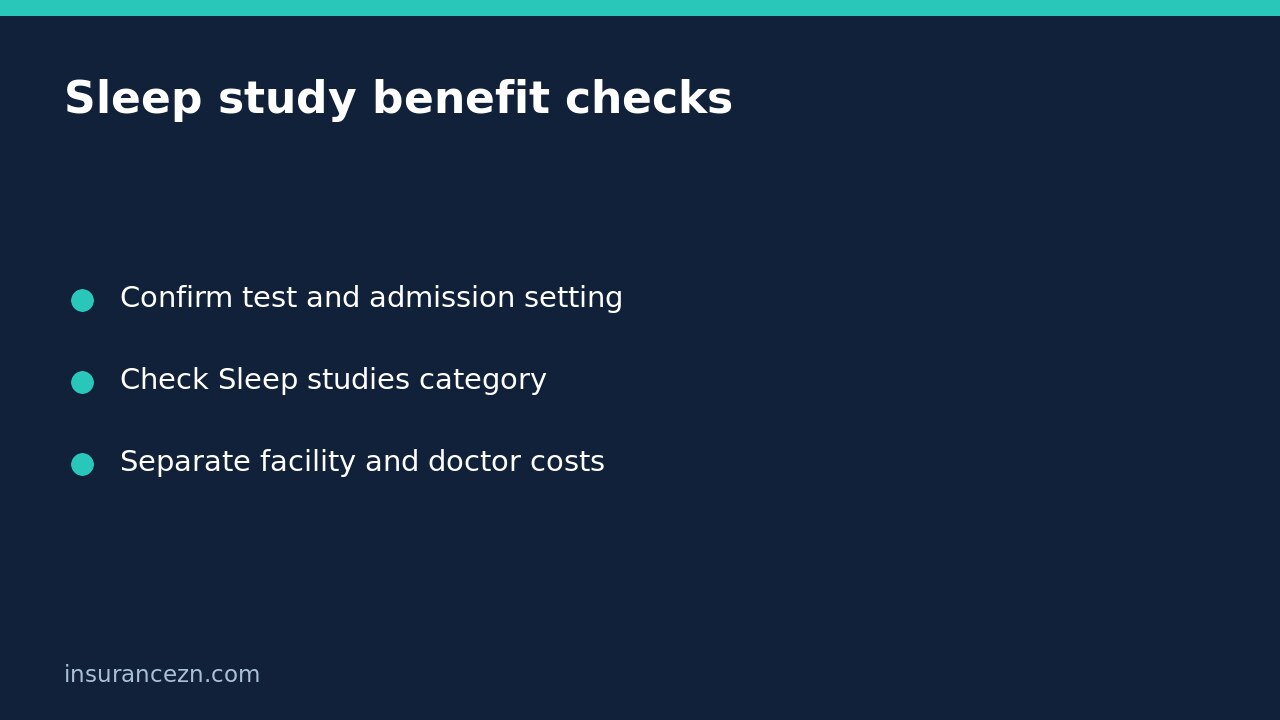
The Australian Government’s clinical categories guide describes Sleep studies as hospital treatment investigating sleep patterns and anomalies, including sleep apnoea and snoring. It lists sleep studies separately from Ear, nose and throat. A symptom involving your throat therefore does not mean the investigation falls under your policy’s Ear, nose and throat inclusion.
Check the actual Sleep studies category on your current hospital policy rather than relying on a broad description such as respiratory cover. Ask the insurer whether it is included, excluded or subject to restricted benefits, and what that means for the proposed facility. The category description identifies a treatment grouping; it does not promise that every account will be paid in full.
Get the test setting and billing details first
Ask the referring practice or testing service for the exact test name, location, proposed service date and relevant item numbers if available. Confirm whether you will be formally admitted as a patient. The fact that a clinic operates inside a hospital building is not a sufficient answer.
For a home-based investigation, ask who supplies the equipment, interprets the recording and bills for each part. Do not apply a hospital-category benefit estimate to that different arrangement. Likewise, an overnight appointment should not be assumed to be an insured admission merely because it takes place overnight.
- Is this an admitted hospital service, an outpatient service or a home test?
- Which provider will issue the facility account and which will issue medical accounts?
- What item numbers and provider identifiers can the insurer use for an estimate?
- Are there separate equipment, consultation, reporting or other charges?
These questions establish what needs checking. They do not establish that every listed charge exists for your test or is eligible for a benefit.
Keep hospital and medical estimates separate
The government’s health-system overview distinguishes hospital costs from associated medical costs and explains that private-patient expenses depend on the policy. Out-of-hospital medical services have a different funding framework. An estimate for one component should not be treated as a quote for the entire investigation.
Obtain an itemised provider estimate and ask the insurer to identify the expected benefit for each relevant component, any hospital excess or co-payment, and any remaining patient cost. Confirm the facility’s agreement status where relevant. Our guide to checking the exact agreement hospital explains why a provider group’s name alone is not enough.
In a hypothetical booking, a testing service supplies a facility estimate while a specialist sends a separate reporting account. A reassuring answer about the facility charge leaves the specialist account unresolved. Record each quoted charge once and avoid adding an excess twice if it is already included in a patient-cost estimate.
Check eligibility for the proposed date
Give the insurer the test details and ask about applicable waiting periods, membership status and any pre-existing-condition assessment requirements. A referral or confirmed booking is not evidence that those requirements have been met. If a policy change is needed, confirm the accepted commencement date and any new waiting periods rather than assuming the booking date secures benefits.
Keep a dated written estimate or reference to the insurer’s explanation, together with the provider quote. Clarify what assumptions the estimate uses and what may change. An estimate supports planning; the final claim still depends on the actual service, submitted accounts and applicable rules.
Do not extend the test estimate to later treatment
Does an eligible sleep study also cover a device or surgery? Not automatically. If your clinician later recommends a device, an operation or further consultations, obtain a fresh benefit check for that exact service and setting. Investigation cover is not a blanket authorisation for everything that follows.
Can the insurer choose which test I should have? Ask your clinician about clinical suitability. Use the insurer’s answer to understand funding, not as a substitute for diagnosis or treatment advice.
What should I save? Keep the referral, itemised quote, insurer response, final invoice and claim assessment. If the assessment differs, compare the billed service and admission details with the original estimate before asking for a review. Submitting a correction request is not the same as a processed benefit adjustment.