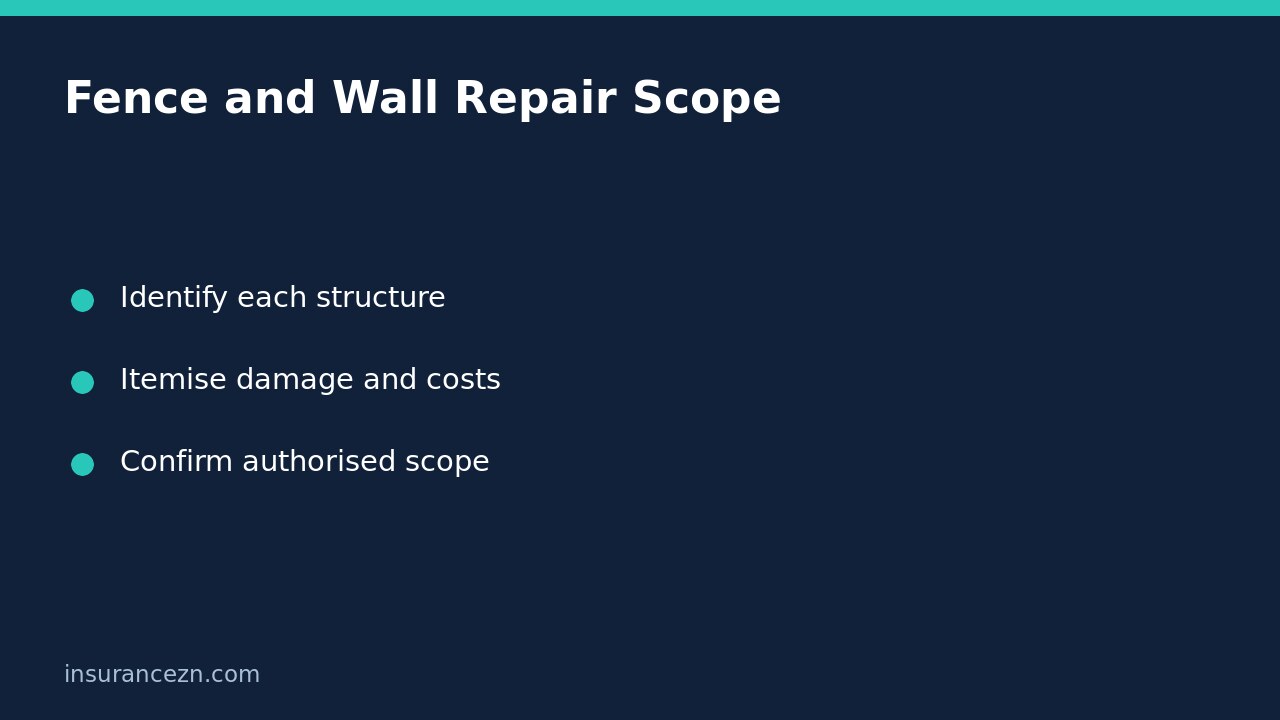

When a storm damages a fence sitting above a retaining wall, ask for an itemised repair quote rather than assuming the whole structure is covered as one insured fence. Identify the fence, supporting wall and associated work separately, then ask your insurer which parts of the proposed scope it accepts under your actual policy. A combined builder’s price is not an insurance coverage decision.
This is general information for Australian readers, not personal financial advice. Read your policy schedule, PDS and applicable conditions, limits and exclusions. This article does not determine ownership, boundary obligations, engineering requirements or entitlement to payment.
Why the distinction matters
A policy can include storm damage yet exclude a particular structure or cause of damage. Suncorp’s Building Insurance overview, for example, lists storm among insured events but expressly says it does not cover retaining walls. Its storm explanation also distinguishes specified storm-related subsidence from erosion, structural faults and design faults. Those are provider-specific summaries, not a statement that every Australian policy uses identical wording.
The practical lesson is to check both the event and the damaged property. An accepted storm event does not by itself establish that every component in a repair quote is insured. Conversely, do not assume an exclusion affecting the wall automatically decides the treatment of every separate fence component. Ask for the actual policy reasoning for each part.
Record the fence and wall as separate items
From a safe position, take wide photographs showing how the structures relate to each other, then closer photographs of damaged panels, posts, wall sections and visible movement. Retain older photographs, maintenance records and any prior reports that help establish the condition before the event. Record the incident date and when each problem was first noticed without guessing when hidden deterioration began.
Do not dig beside a moving wall, remove structural supports or approach unstable ground to obtain better evidence. Keep people away from an unsafe area and seek appropriate emergency or professional assistance where necessary. Ask the insurer how urgent safety measures should be recorded and authorised, without delaying action needed to protect life.
Request an itemised contractor scope
Ask the contractor to describe the structures and proposed work in ordinary language. If specialist assessment is needed, distinguish observations from conclusions that still require investigation. A quote should not silently convert a damaged fence into a complete landscaping upgrade.
- Fence: identify panels, posts, gates and the lengths proposed for repair or replacement.
- Wall: list affected sections and any proposed structural reconstruction separately.
- Associated work: identify demolition, excavation, drainage, access, disposal and reinstatement.
- Other changes: distinguish existing damage, maintenance, design changes and requested upgrades.
- Shared costs: explain how access or demolition costs relate to each component rather than allocating everything to the fence.
Itemisation does not make any line payable. It gives the insurer and homeowner a clearer basis for discussing what is being assessed, what remains uncertain and which costs would be the homeowner’s responsibility.
Reconcile the quote with the insurer’s decision
Send the scope under your existing claim reference and request a line-by-line response. Ask which property definition, insured event, exclusion or limit applies to the fence and wall respectively. If the insurer needs further evidence about cause or structural condition, ask what question the additional report should answer.
For example, suppose a contractor proposes replacing damaged fence panels and rebuilding the wall beneath them. Ask whether the insurer accepts the panel work, whether the wall is excluded, and whether the accepted work can safely proceed without the wall reconstruction. Do not assume either that the entire quote is covered or that an accepted panel allowance resolves the engineering problem.
Keep any disagreement about ownership or a neighbour’s contribution separate from the insurer’s assessment. Do not promise a fixed percentage contribution or admit liability on someone else’s behalf. Obtain appropriate local advice where boundary rights or responsibilities are disputed.
Confirm authority before permanent repairs
Ask who is engaging the contractor, which exact scope is approved, and who pays for excluded or elective work. Your signature on a building contract may create payment obligations that are different from the insurer’s agreed contribution. A contractor’s availability, site visit or quote acceptance by you is not evidence of insurer repair authority.
Before clearing the site, use the home insurance cleanup photo checklist to preserve evidence. Ask whether materials or reports need to be retained and how any unavoidable safety work should be documented.
Final checklist
Keep the original quote, revised versions, photographs, policy wording and written scope decision together. Check that fence and wall costs remain separate in the final invoice. If the decision is unclear, request written reasons and the insurer’s complaint process. Neither a more detailed quote nor a new report guarantees payment, but both can help ensure the actual disputed component is assessed rather than lost inside one combined total.