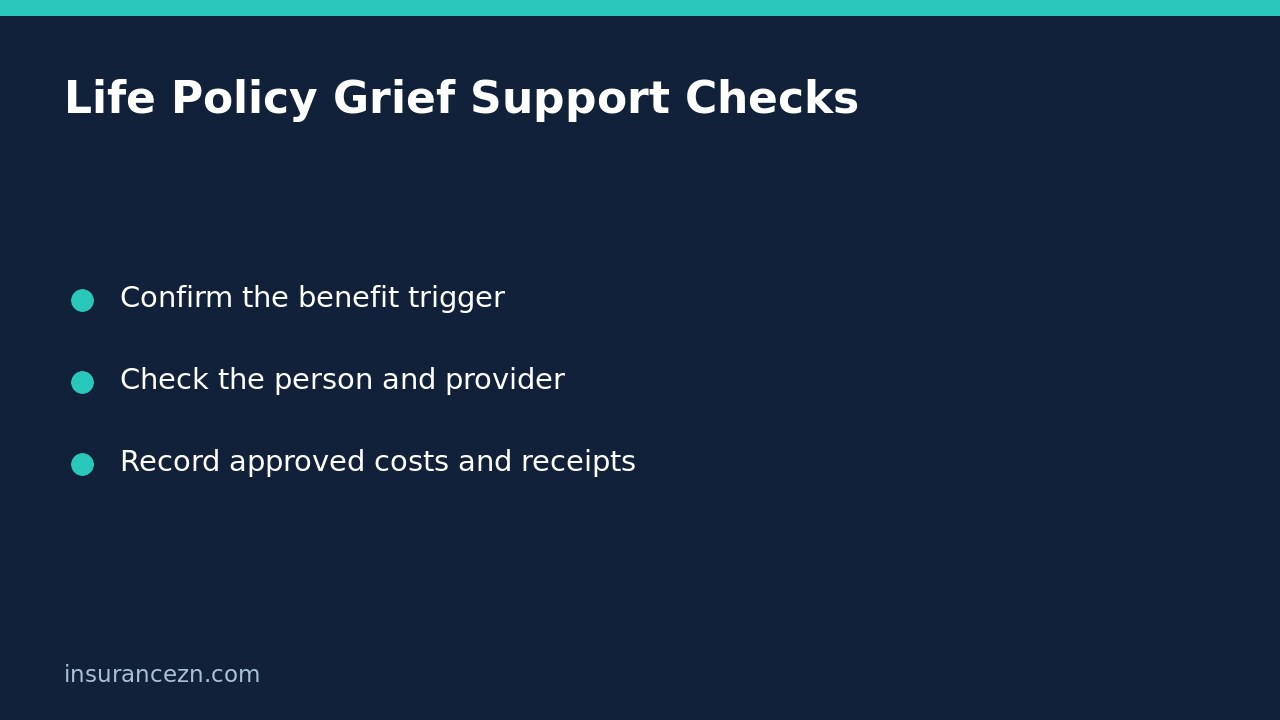

A life insurance policy may include help with grief counselling, but a benefit heading is not confirmation that any session, for any family member, will be reimbursed. Before booking on the assumption that insurance will pay, check the benefit trigger, the eligible person, the provider requirements and the remaining allowance under the actual policy.
This is an administrative checklist, not a recommendation to wait for insurance before seeking support. If help is needed urgently, seek appropriate clinical or emergency assistance rather than delaying care for a benefit decision.
Start with the exact policy and payment trigger
Find the policy schedule and applicable wording, then ask whether grief support is included in that particular contract. An insurer’s current sales page may describe a different product or version from an older policy, a superannuation arrangement or cover obtained through another channel.
As a provider-specific example, TAL’s life insurance page describes a Grief Support Benefit available to the insured person or an immediate family member when TAL pays 100% of the benefit amount. The page describes reimbursement for up to three grief support sessions, with a total maximum of $1,000 across those sessions, using an accredited health provider approved by TAL. These are TAL’s stated conditions, not a universal Australian entitlement.
A lodged death claim, an acknowledgement or an early partial payment should not be treated as proof that this separate benefit has been triggered. Ask which qualifying payment has occurred and what confirmation the person arranging counselling needs.
Check the person, practitioner and session separately
Tell the insurer who will attend and their relationship to the insured person. Ask how the contract defines immediate family and whether the proposed attendee satisfies that definition. Avoid sending a full family history when a smaller amount of information is sufficient.
Next, identify the practitioner, their qualifications, the service and the proposed appointment dates. Ask whether the insurer must approve the practitioner before the first session, what evidence it needs and whether an existing approval covers later appointments. A professional being registered or respected does not establish approval under this particular insurance benefit.
Keep provider suitability separate from the financial decision. The treating professional can discuss appropriate care; the insurer must explain the reimbursement conditions. Neither a receptionist’s booking confirmation nor an invoice establishes the insurer’s agreement to pay.
Reconcile the allowance before committing to a package
Request a written explanation of the available session count, dollar balance and any sharing rules. In TAL’s example, the published maximum is a total for the three sessions, not that amount for each session. Do not assume every eligible relative receives a fresh allowance, or that unused sessions can be converted to cash.
For a hypothetical family considering several appointments, prepare a short list showing each attendee, practitioner, session price and proposed date. Send it through the insurer’s approved channel and ask which items are eligible. Obtain clarification about earlier reimbursements before using an apparent remaining balance to plan more appointments.
If the practitioner offers an upfront package, ask how reimbursement would be assessed against actual sessions and invoices. Do not buy a package solely because the headline insurance limit appears large enough. Ask the provider separately about cancellations and refunds.
Keep a small reimbursement record
- Record the policy and claim reference, without including unnecessary sensitive details.
- Save the insurer’s confirmation of the trigger, eligible attendee and approved practitioner.
- Keep itemised invoices identifying the actual service and appointment date.
- Retain payment evidence and the submission acknowledgement.
- Compare the processed reimbursement with the invoice and updated allowance.
Uploading a receipt proves submission, not assessment or payment. If the amount differs from the expected reimbursement, ask for a line-by-line explanation and the relevant policy clause. Preserve the original documents rather than silently replacing an invoice.
Questions families commonly ask
Does this benefit replace the main life claim? Do not assume so. Ask how it operates alongside the main benefit, including its trigger and any separate conditions. General family preparation is covered in our life insurance claim readiness plan.
Can I choose any counsellor? Not on the strength of a general benefit description. Confirm the actual provider requirements and obtain any required approval.
This is general information for Australian readers, not personal financial advice. Benefits depend on the applicable policy, Product Disclosure Statement (PDS), definitions, exclusions and claim conditions. Read your own documents and obtain product-specific confirmation.