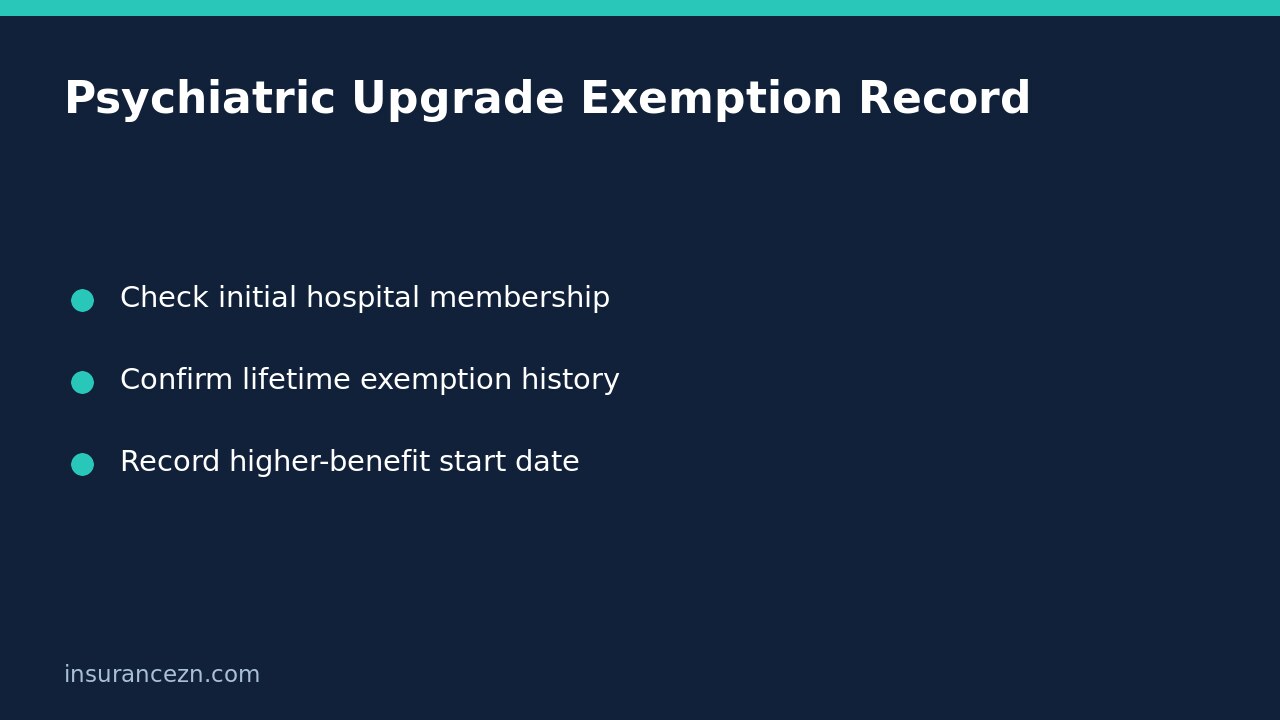

The psychiatric waiting-period exemption is a specific pathway to higher hospital psychiatric benefits, not a general waiver of all health insurance waiting periods. Before relying on it for an admission, ask your insurer to check whether you meet the initial membership requirement, whether you have used the exemption before, and when the higher benefit will actually apply.
The important task is reconciling your membership history with a written insurer decision. A new membership number or a change of insurer does not establish that a once-per-lifetime entitlement has become available again. Never delay urgent mental health care while resolving insurance administration; discuss appropriate treatment pathways with your treating team.
Understand what the exemption changes
The Australian Government’s PrivateHealth.gov.au waiting-period guidance explains that someone on a hospital policy with restricted psychiatric benefits would usually upgrade and complete a two-month waiting period to access higher benefits. Its mental health exemption allows eligible members to upgrade without serving that waiting period for higher psychiatric benefits in hospital or hospital substitute treatment.
The guidance states that this exemption applies only once per lifetime and requires completion of an initial two months of membership on any level of hospital cover. Ask the insurer to apply those requirements to your own history. Do not translate this into immediate cover for a new member who has not completed that initial period.
The exemption concerns the waiting period for higher psychiatric benefits. It does not turn outpatient psychology extras into hospital cover, remove every charge or make unrelated clinical categories immediately claimable. Our explanation of hospital versus extras waiting-period rules sets out that separate boundary.
Build a membership and exemption timeline
Collect the names of current and previous insurers, policy identifiers where available, approximate membership dates and records of earlier upgrades. Note any earlier psychiatric admission for which you recall asking for an exemption. An admission alone does not tell you whether this particular exemption was used, so do not guess either way.
Ask your current insurer what records it holds, what it needs from previous insurers and who will obtain missing information. Send documents through its official secure channel. Keep a dated note of what you supplied, but remember that an upload acknowledgement is not a finding that the lifetime requirement has been satisfied.
If two records conflict, identify the precise disagreement. For example, one letter may confirm a past upgrade while another records a waiting period being served. Ask whether the exemption was actually applied, on what date and to which benefit. Request correction of an inaccurate record rather than treating the uncertainty as permission to use it again.
Request a decision for the proposed treatment
Give the insurer the proposed hospital, treatment description and admission date available from your treating team. Ask for a written response covering these points:
- Whether your initial hospital membership requirement has been met.
- Whether its records show previous use of the lifetime exemption.
- Whether the proposed upgrade and treatment qualify for the exemption.
- The exact date higher psychiatric benefits become available.
- Any remaining information needed before a benefit assessment can be completed.
A sales quote saying that an upgraded policy can start today is not the same as confirmation that the exemption has been applied. Keep the quote, the requested change and the processed benefit decision as separate records.
Check costs even after the waiting-period question is resolved
Obtain the hospital’s estimate and ask the insurer about the hospital arrangement, accommodation benefits, excess and co-payments. Ask treating doctors about their own accounts. A confirmed waiting-period exemption does not by itself mean the hospital or doctors will charge no gap.
For a hypothetical member offered an admission soon after upgrading, the useful comparison is between the processed higher-benefit date, the actual admission arrangements and itemised estimated costs. The words upgrade accepted alone do not reconcile those three things. Reconfirm if the hospital, treatment or admission date changes.
Keep the final answer usable
What if I cannot remember using the exemption? Ask the insurer to investigate the record and explain any uncertainty. Avoid an unsupported declaration that it has never been used.
What should I save? Retain the membership timeline, documents supplied, written eligibility decision, effective benefit date and cost estimates. These help distinguish a pending request from a processed exemption if you need to query an assessment later.
This is general information for Australian readers, not personal financial advice. Benefits depend on the policy, applicable Product Disclosure Statement (PDS) or fund rules, exclusions, restrictions, waiting periods and provider arrangements. Obtain confirmation for your own membership and treatment.