
A rejected Medicare claim does not, by itself, mean your private health fund must pay the bill through extras. The rejection tells you something about that Medicare submission. Extras eligibility is a separate question about the actual service, practitioner, policy and applicable limits.
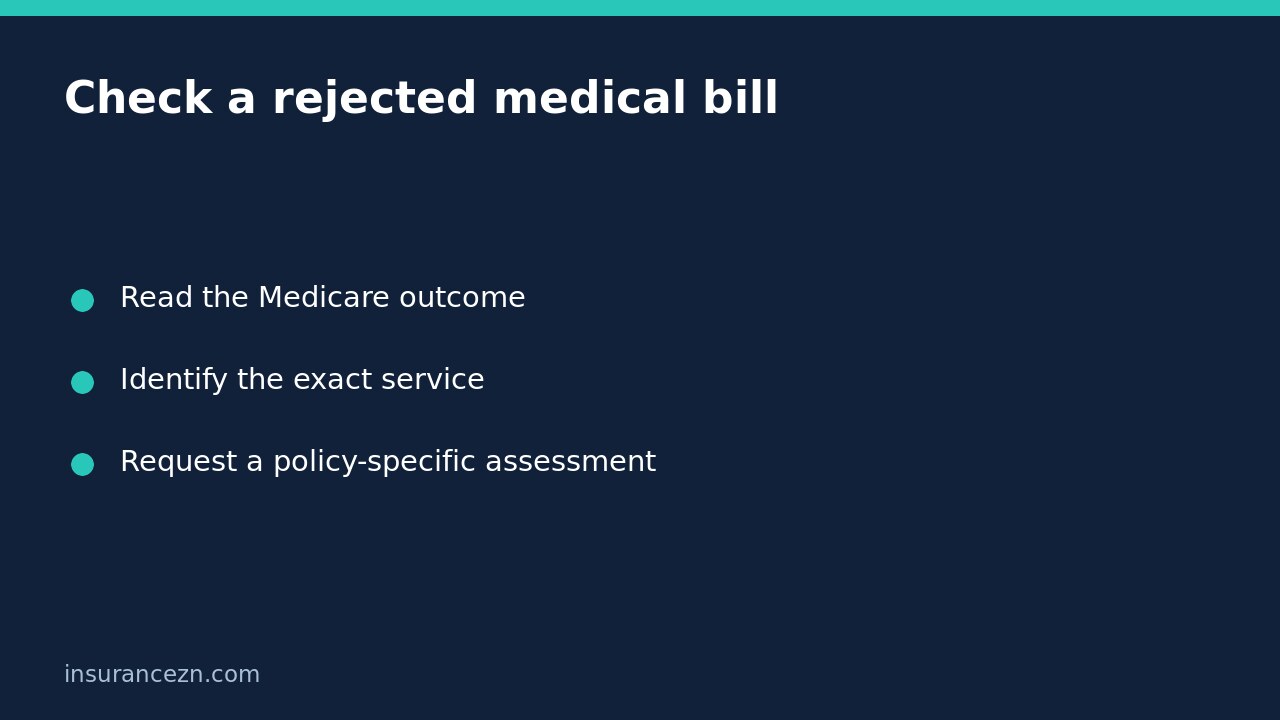
Start by preserving the invoice and the Medicare outcome. Do not ask a provider to rename treatment simply to make it fit an insurance category. The useful next step is to establish what happened and ask the appropriate organisation to assess the correct information.
Find out what Medicare actually decided
Read the rejection explanation rather than treating a zero payment as a complete coverage decision. Ask Medicare or the provider to clarify whether the issue concerns the information submitted, your eligibility, the service or another requirement. Avoid guessing the reason from a short banking description or a clinic’s verbal summary.
Keep the service date, provider details, item information, amount charged and any Medicare reference together. If there is a factual error, ask the provider how to correct the original record and how to avoid an unintended duplicate submission. A correction request is not proof that Medicare has reassessed or paid the account.
Separate medical bills from extras services
The Australian Government’s health-system overview distinguishes Medicare medical benefits from private cover for many general-treatment services. Private health insurance is not one interchangeable pool for every unpaid health expense.
Its private health insurance explanation describes hospital, general treatment or extras, and ambulance cover as different kinds of protection. Extras can include services such as dental treatment, physiotherapy, optical items and some appliances, depending on the policy. It also explains that some services are not included and that per-service, annual or lifetime limits may apply.
These overviews support checking the correct pathway; they do not establish that your particular rejected bill is payable. A specialist consultation, an allied-health appointment and a pair of glasses are different services even if all appear on receipts from a medical precinct. The building’s name is not an insurance category.
Send the fund an itemised question, not an assumption
Ask your insurer to identify whether your exact service can be considered under the extras product you held on the treatment date. Supply the genuine invoice and the Medicare outcome where requested, using the insurer’s secure channel. Check what sensitive information is actually necessary before sending a full medical file.
- What service or item is the fund assessing, and under which policy category?
- Is this practitioner recognised for this service at the practice where treatment occurred?
- Were any waiting periods or other eligibility conditions relevant on the service date?
- What per-service, shared, annual or lifetime limits apply, and what balance remains?
- Does the Medicare outcome affect eligibility, or is more information needed before assessment?
Ask for the relevant rule and a written response. A document-upload receipt means the insurer received material; it is not a benefit approval. Likewise, a receptionist’s statement that the clinic accepts health funds does not establish payment under your membership.
A practical example: two different questions
Consider a hypothetical allied-health appointment for which Medicare paid nothing. First, the patient needs the explanation for that Medicare outcome. Separately, the fund needs to decide whether the particular appointment qualifies under the patient’s extras policy. Neither answer should be inferred from the other.
If the fund provides an estimated benefit, note the assumptions, including the item, practitioner, treatment date and available limits. After assessment, compare the actual benefit statement with the original invoice. An estimate does not guarantee final payment, and a positive available balance does not make an excluded service eligible.
If the account concerns tests before an operation, also check whether it was an outpatient service. Our guide to tests before private surgery and outpatient cost checks explains why an upcoming admission should not be used to classify every earlier bill as inpatient treatment.
Questions to resolve before closing the file
Can I change the invoice description? Ask for evidence-backed corrections when details are wrong, not a different description for treatment that was actually provided. Preserve the original and corrected versions.
Should I submit the same expense everywhere until someone pays? First establish the right pathway, disclose relevant prior assessments or payments and ask how coordination works. Do not assume multiple submissions create additional entitlement.
What if the fund declines? Ask for the assessed service, reason and applicable rule, then use its review or complaint process if the facts or interpretation remain disputed. Keep payment deadlines with the provider separate from the review; an enquiry does not automatically suspend an account.
This is general information for Australian readers, not personal financial advice. Benefits depend on your policy, fund rules, applicable PDS or other disclosure documents, eligibility and the service date. Confirm your individual position directly with Medicare, your provider and your insurer. Do not delay necessary medical care for insurance administration.