
Comparing extras cover for compression garments starts with a specific question: will this policy pay a benefit for the actual garment you intend to buy, from the intended supplier, on the relevant purchase date? A broad health-aids allowance does not answer that question. Obtain an itemised quote and a written, product-specific benefit estimate before treating an advertised limit as a saving.
This is general information for Australian readers, not personal financial advice. Entitlement depends on the applicable policy terms, Private Health Information Statement, fund rules and any relevant PDS. This checklist does not establish that compression garments are included in any particular policy or recommend a garment for a medical condition.
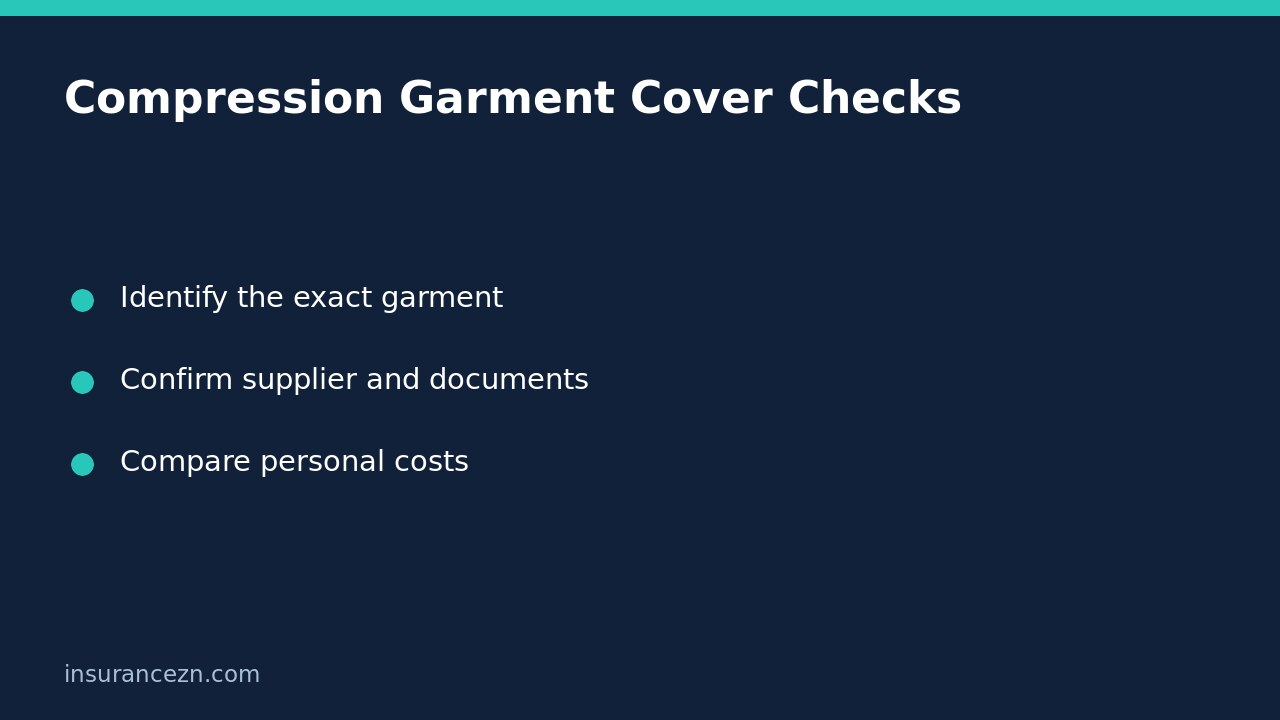
Identify the garment rather than just its marketing description
Ask the treating professional or supplier to identify the exact product being recommended. Record its name, model or ordering code, whether it is ready-made or custom-made, the quantity, and each separately charged service. Keep a fitting appointment or consultation distinct from the garment price. A quote described only as a compression package can be difficult for a fund to assess accurately.
Do not choose a compression level or substitute a cheaper product on the strength of insurance information. Those are clinical questions for an appropriately qualified treating professional. Insurance eligibility and suitability for your care are separate decisions; a benefit estimate cannot replace clinical advice.
Ask whether the exact item is eligible
The Australian Government’s overview of private health insurance explains that not all policies cover all services and that general-treatment benefits commonly have service, annual or lifetime limits. It directs readers to the policy’s Private Health Information Statement and insurer for details. That overview supports checking the product rules; it does not establish a compression-garment benefit.
Send the same quote to each shortlisted fund and ask:
- Does this exact garment qualify under the named extras product, and under which benefit category?
- Must the supplier or fitting professional meet particular recognition requirements?
- Are any referral, prescription, clinical or invoice details required?
- Are consultation, fitting, delivery and garment charges assessed separately?
- Does the intended purchase date fall after any applicable waiting period?
These are questions to resolve, not universal requirements. Ask the fund to identify the relevant rule and retain its response with the policy version. A supplier saying that customers often claim a benefit is not confirmation about your membership.
Turn the answer into a personal cost comparison
After establishing eligibility, request an estimate using your remaining benefit balance and planned quantity. Ask whether another item or service uses the same allowance, whether there are replacement-frequency restrictions, and how the fund determines the relevant benefit year. Do not assume that two garments each receive the headline maximum.
Build a small worksheet with columns for the quoted garment charge, separately quoted services, estimated benefit, remaining allowance and expected personal payment. Mark any unanswered component as unknown rather than zero. Keep the estimate date and membership details beside the figures so an old assessment is not mistaken for a current balance.
Compare the ongoing premium as well. A policy offering a larger possible garment benefit can still cost more overall, particularly when other useful benefits or package discounts change. If the quote includes future replacements, ask for their rules separately instead of extending today’s estimate across later purchases. For household comparisons, also read whether unused family extras benefits can be shared; an unused family balance is not automatically available to the person ordering the garment.
Confirm timing before paying the supplier
A pending application or requested upgrade does not prove that the new benefit is available. Obtain the processed membership start or change date and the date on which the specific benefit becomes eligible. Ask which event determines the claim date for an ordered garment, especially if payment, fitting and supply occur on different days. Do not assume a deposit or order placed before eligibility can be claimed later.
If treatment is time-sensitive, discuss the clinical timetable with the treating professional rather than delaying necessary care solely for an insurance comparison. Ask the supplier about its written cancellation, alteration and refund conditions before paying. Those commercial conditions are separate from the insurer’s benefit decision.
Before-order checklist and common questions
- Keep the itemised quote and exact product identification.
- Save the fund’s supplier and documentation requirements.
- Confirm the personal estimate, remaining limits and eligible dates.
- Retain the final invoice and compare the processed assessment with the estimate.
Does a recognised supplier guarantee a benefit? No. Recognition is only one possible condition; the item, policy, limits and timing still need checking.
Is a written estimate a guaranteed payment? No. Ask what assumptions it uses and what could change before the final assessment. If the invoice or supplied product changes, obtain an updated estimate rather than relying on the earlier description.