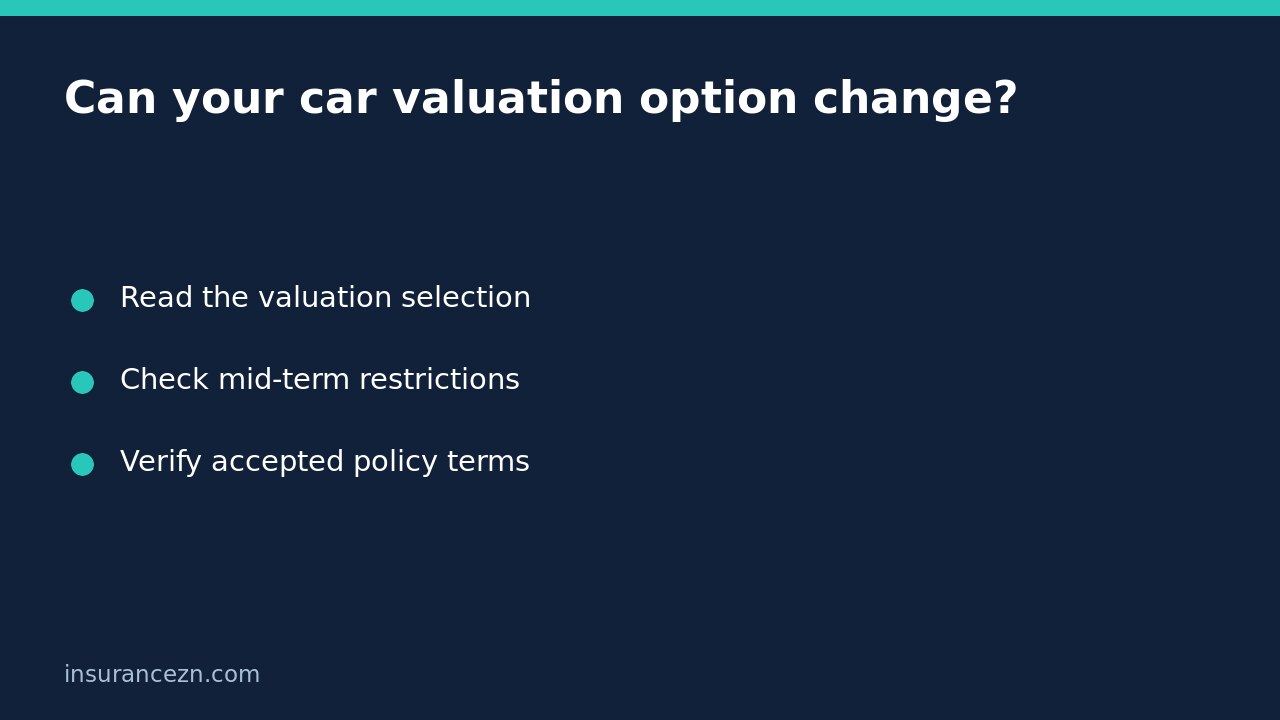

When comparing car insurance, ask whether a valuation option can be changed after you buy the policy. Do not select market value on the assumption that you can simply switch to a specified amount later if your circumstances change. Availability at purchase and permission to amend an existing policy are different questions.
This comparison is useful when a car’s replacement importance, finance arrangements or household budget could change during the year. The task is not to predict a future payout. It is to understand which choices you are making now and which changes the insurer may permit later.
Find the restriction attached to the actual option
As a provider-specific example, Suncorp’s car insurance page describes an optional market-value selection for its Comprehensive and Comprehensive Extras levels. It says that, once selected, this optional cover cannot be removed during the period of insurance. That restriction should be considered before purchase rather than discovered when you request an amendment.
The same page describes market value as a variable amount based on the insurer’s assessment of what the market would pay for the car at the time of the incident. It says recognised industry publications may assist that assessment. This is not a fixed amount you can fill in yourself, and a value displayed in an online advertisement is not an accepted claim settlement.
Do not generalise Suncorp’s restriction to every insurer or assume a product with a similar name has identical rules. Read the current Product Disclosure Statement and the option explanation for the precise quote you are considering.
Compare flexibility separately from the valuation basis
Make a short worksheet with one column for each quote. Record the following details rather than using a single tick beside ‘comprehensive’:
- The valuation basis actually selected and where it appears on the proposed certificate.
- Any specified amount or agreed amount, using the insurer’s own terminology.
- Whether a different basis is available for this vehicle and cover level.
- Whether switching the basis during the term is permitted, restricted or unconfirmed.
- Any premium adjustment, effective-date requirement or new assessment the insurer identifies.
- What choices are available at renewal and whether you must actively request them.
Write ‘not confirmed’ where the quote does not answer a question. A website offering two choices to new customers does not establish a right to move between them whenever you wish. Likewise, a customer-service discussion about a possible change is not a processed amendment.
Ask a question that produces a usable answer
A practical enquiry is: ‘For this vehicle and quoted policy, if I select market value now, can I change to the other offered valuation basis during this period of insurance? If not, when could I next request that change, and what would need to be accepted?’
Ask the insurer to identify the relevant wording and explain whether the answer applies to your particular quote. If a change is possible, request its proposed effective date, revised premium and updated insured amount or basis. Keep the answer with the quote and policy version, rather than relying on a general recollection of a phone call.
Do not use cancellation as an assumed workaround. A new application may involve different eligibility, pricing and terms, while the existing policy has its own cancellation arrangements. Confirm accepted replacement cover and timing before making a decision that could leave a gap. A quote alone is not proof that replacement cover has commenced.
Test a change scenario without inventing a benefit
Imagine a hypothetical motorist who chooses a market-value option, then later decides that a specified valuation would suit their replacement planning better. Their initial comparison recorded only the premium, so they assumed changing the option would be routine. The relevant question is whether the contract permits that amendment, not whether their preferred figure seems reasonable.
If the option cannot be removed during the term, ask the insurer to explain the available next steps and renewal choices. Do not describe a requested change as effective or assume it can alter the settlement basis for damage that already occurred. Incident-time cover and an accepted later amendment must be kept separate.
This is a different task from comparing two renewal amounts. For that related decision, see comparing renewal quotes without overlooking agreed value. Here the extra comparison dimension is whether a selected option can be changed during the current term.
Final checks before accepting a quote
Does a higher premium prove greater flexibility? No. Read the amendment rules rather than inferring them from price.
Does an amendment request change my cover immediately? Do not assume so. Obtain the insurer’s acceptance, effective date and updated documents, then check that the valuation selection and any premium adjustment were actually processed.
What if the certificate differs from the quote? Raise the mismatch promptly and preserve both versions. Ask which terms were accepted and request a corrected record if appropriate; an acknowledgement of your enquiry is not the correction itself.
This is general information for Australian readers, not personal financial advice. Cover, valuation, amendment rights and settlement depend on the applicable policy, PDS, schedule, exclusions, eligibility and insurer acceptance. The Suncorp example is a product-specific checking point, not a recommendation or a guarantee of claim payment.