
In the high-stakes environment of auto insurance claims, policyholders often believe that filing a report is sufficient to trigger payment. However, the reality of the claims process relies heavily on evidence verification. Among the various reasons claims are delayed or denied, missing documentation stands out as the single most frequent culprit. Insurance adjusters operate under strict guidelines to verify liability, assess damage costs, and prevent fraud. Without the proper paperwork, they cannot fulfill their contractual obligation to pay, regardless of the validity of the accident itself.
When a claim is rejected due to insufficient evidence, it usually stems from a failure to provide proof that the incident occurred as described or that the damages reported are accurate. This creates an immediate deadlock where the insurer cannot authorize funds without seeing specific items like police reports, medical records, or photos of the scene. Understanding exactly what documents are required and how to organize them before submitting a claim can prevent avoidable rejections and ensure a smoother financial recovery.
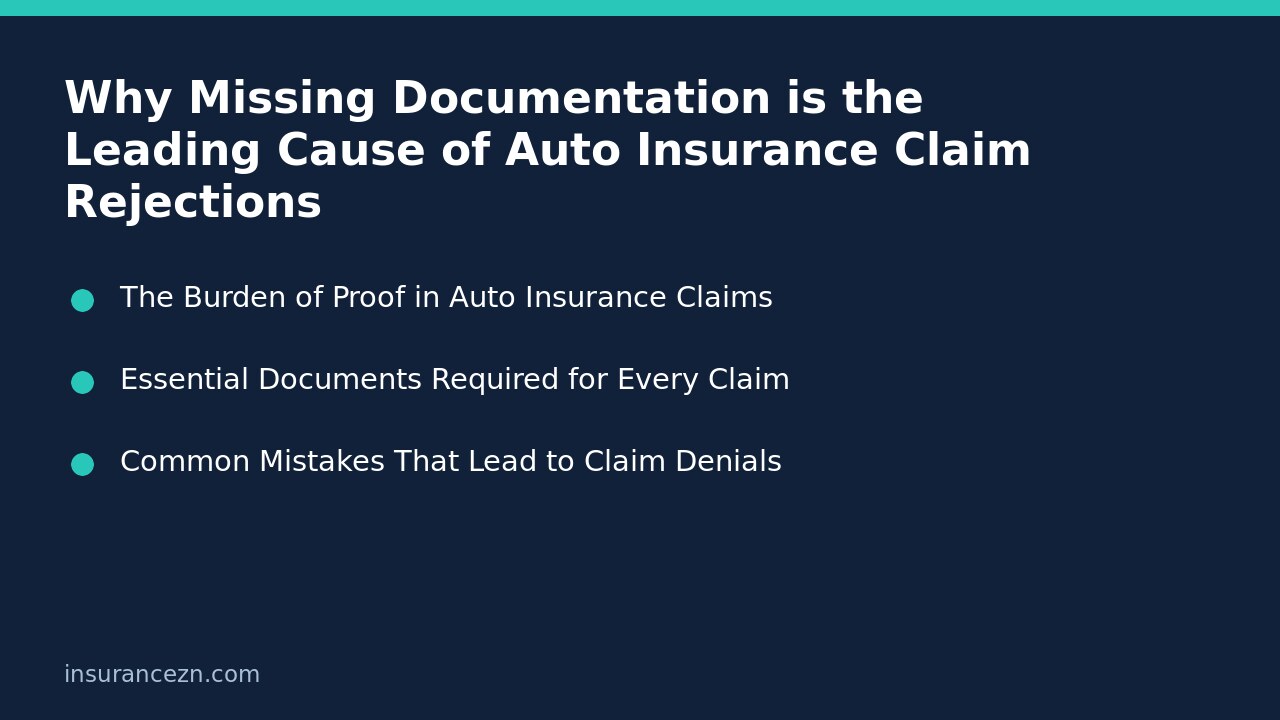
The Burden of Proof in Auto Insurance Claims
Unlike personal injury lawsuits where one party must prove negligence beyond a reasonable doubt, insurance claims operate on a principle of “duty to cooperate.” When you file a claim, you are contractually obligated to assist the insurer in investigating the loss. A critical part of this investigation is establishing the facts through documentation.
If a driver files a claim for a rear-end collision but fails to submit photos showing skid marks or impact points, the adjuster has no way to verify the mechanism of the crash. Similarly, if a claim involves injury, submitting only a generic statement without medical bills or diagnostic reports leaves the insurer unable to quantify the loss. In these scenarios, the missing documentation effectively breaks the chain of evidence required for approval.
Essential Documents Required for Every Claim
To avoid rejection, every auto insurance claim should include a core set of documents tailored to the specific type of incident. While minor fender-benders might require fewer items, comprehensive claims demand a rigorous paper trail. The following list represents the standard documentation expected by most carriers:
- Police Report: In almost all jurisdictions, if an accident results in injury or significant property damage, a police report is mandatory. This official record provides an unbiased account of events, including citations issued and witness statements.
- Photographic Evidence: Photos of vehicle damage from multiple angles, images of the surrounding scene (road conditions, traffic signs, lighting), and photos of any visible injuries are crucial.
- Medical Records and Bills: For bodily injury claims, a complete history of treatment is necessary. This includes ER visit summaries, physician notes, physical therapy invoices, and pharmacy receipts.
- Witness Statements: Contact information and written statements from anyone who saw the accident help corroborate your version of events.
- Repair Estimates and Receipts: Detailed invoices from authorized collision repair centers, along with photos of the work in progress or completed repairs, validate the cost of the claim.
- Rental Car Documentation: If a rental vehicle was used during the repair period, rental agreements and receipts prove the necessity of the expense.
Common Mistakes That Lead to Claim Denials
Even when drivers intend to provide full information, human error often leads to missing documentation. One common mistake is waiting too long to gather evidence. Photos taken at the scene fade from memory quickly, and physical debris may be cleaned up before it can be photographed. Another frequent error involves relying solely on verbal communication with an adjuster without following up in writing or uploading requested files immediately.
Furthermore, many policyholders fail to document the “before” state of their vehicle. If a claim is filed for hail damage but the policyholder cannot prove that the dents were caused by a recent storm versus pre-existing issues from months prior, the claim may be rejected as fraudulent or unsubstantiated. Similarly, failing to keep receipts for temporary repairs made while waiting for an official estimate can lead to disputes over the final payout amount.
The Impact of Digital Records and App Usage
The landscape of insurance documentation has shifted toward digital tools, yet many drivers still neglect them. Most modern smartphones have high-quality cameras and cloud storage capabilities that make capturing evidence effortless. However, simply taking a photo is not enough; the image must be timestamped and geolocated if possible to establish when and where it was taken.
Insurance companies are increasingly using apps for claims submission. These platforms often require specific fields to be filled out and files to be uploaded in particular formats (such as PDF or high-resolution JPEG). Failing to convert a blurry snapshot into a clear, high-definition image before uploading can result in the file being rejected by automated screening systems. Additionally, emails containing official correspondence from the insurer regarding document requests should be saved and organized, as they serve as proof of cooperation.
A Real-World Example: The Missing Police Report Scenario
Consider the case of Sarah, who was rear-ended while stopped at a red light. She filed her claim with her insurance company two days later. During the initial phone conversation, she described the event clearly, but when the adjuster asked for documentation, Sarah admitted she had thrown away the damaged bumper from her car and did not have the police report because she assumed it wasn’t necessary since no one was hurt.
The adjuster informed her that without a police report to confirm the time, location, and fault determination, and without photos of the damage to corroborate her story, the claim could not be processed. The insurer suspected that the damage might have been pre-existing or caused by an event unrelated to the reported accident. Sarah was forced to hire a private investigator to locate the officer who responded to the scene, a process that cost her money and delayed her payout for months. Had she secured the report at the scene and kept it in her glove box, the claim would have been resolved in days rather than months.
Steps to Secure Your Claim Documentation Immediately
To ensure your auto insurance claim is never rejected due to missing paperwork, adopt a proactive approach immediately after an incident occurs:
- Secure Safety First: Move vehicles out of traffic if possible and check for injuries before handling documents.
- Call the Police: Request a report number immediately. Do not leave the scene until the officer arrives or advises you to do so.
- Capture Comprehensive Photos: Take pictures of all vehicles involved, license plates, skid marks, debris, traffic signals, and weather conditions. Include wide shots of the entire scene.
- Gather Witness Info: Write down names, phone numbers, and insurance details of any witnesses before they leave the area.
- Document Injuries Immediately: Take photos of visible cuts, bruises, or swelling, even if they seem minor. Note the time and date on your device.
- Organize Digital Files: Create a dedicated folder on your phone or computer labeled with the date and location of the accident. Upload all documents to this folder before contacting your insurer.
- Follow Up in Writing: After speaking with an adjuster, send an email summarizing the conversation and attach copies of all relevant documents to ensure nothing is lost in transit.
Conclusion: Documentation Dictates Claim Success
The complexity of auto insurance claims often leads people to believe that honesty alone is sufficient for a payout. However, the administrative machinery of insurance companies requires concrete proof to process payments efficiently and legally. Missing documentation is not merely an oversight; it is a fundamental barrier to receiving compensation. By understanding the specific documents required, avoiding common pitfalls like discarding evidence or delaying reports, and utilizing modern digital tools effectively, policyholders can navigate the claims process with confidence. Proper preparation ensures that when an accident occurs, the focus remains on recovering losses rather than fighting bureaucratic hurdles caused by a lack of paperwork.