
When you shop for car insurance, the premium price tag is often the first number you scrutinize. However, looking solely at the monthly cost can lead to a dangerous financial trap. The true value of an insurance policy lies in understanding the deductible—the specific amount you must pay out of pocket before your insurer covers the rest of a claim. This article demystifies how deductibles work, how they impact your long-term savings, and why comparing policies requires a holistic view that goes beyond the sticker price.
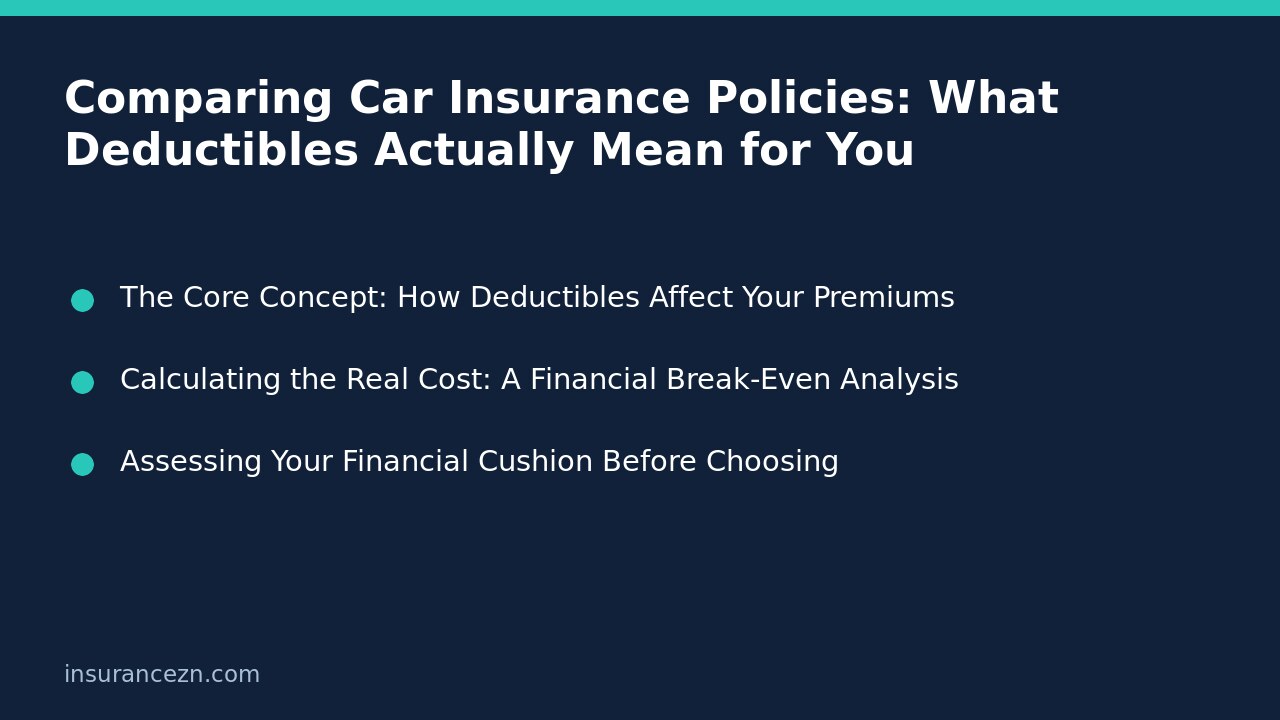
The Core Concept: How Deductibles Affect Your Premiums
A deductible is the portion of a covered loss you agree to pay before your insurance company steps in. In most standard auto policies, this applies to both collision and comprehensive coverage (which covers theft, vandalism, or hail damage). If you have a $500 deductible and your car suffers $4,000 in damage from an accident, you pay the first $500, and the insurer pays the remaining $3,500.
There is a direct inverse relationship between your chosen deductible and your monthly premium. By selecting a higher deductible, such as $1,000 or $2,000 instead of the standard $500, you are essentially acting as your own insurer for the first layer of risk. Because you have assumed more financial responsibility in the event of a claim, the insurance company reduces their risk exposure and lowers your monthly premium to reflect that. Conversely, choosing a lower deductible increases your monthly cost because the insurer is liable for more money if an accident occurs.
Calculating the Real Cost: A Financial Break-Even Analysis
Many drivers choose the lowest possible deductible to keep their monthly payments low. While this strategy seems sound on paper, it fails to account for the total cost of ownership in a worst-case scenario. To make an informed decision, you must perform a break-even analysis. This involves comparing the monthly savings gained by raising your deductible against the potential out-of-pocket expense if you file a claim.
For example, imagine two policies for the same vehicle:
* Policy A: $50 deductible with a premium of $120 per month.
* Policy B: $1,000 deductible with a premium of $85 per month.
In this scenario, Policy B saves you $35 every month. Over 12 months, that adds up to $420 in savings. However, if your car is damaged and the repair bill is $3,000:
* With Policy A, you pay the $50 deductible plus any gap between the payout and repairs (if applicable), totaling roughly $50 out of pocket for the claim itself before insurance kicks in.
* With Policy B, you must pay the full $1,000 deductible immediately.
In this specific math, Policy A is financially superior because the total cost ($50) is significantly lower than the savings accrued over a year ($420) plus the initial premium difference. However, if your car is totaled and only worth $8,000 with $6,000 in repairs needed, the deductible becomes a much larger percentage of your loss. The break-even point occurs when the total savings from lower premiums equals the difference in deductibles ($1,000 – $50 = $950). It would take roughly 27 months ($950 / $35) for Policy B to become cheaper than Policy A if you file a claim. If you go three years without filing a claim, the higher deductible policy might be worth it, provided you have the cash reserves to handle the $1,000 hit instantly.
Assessing Your Financial Cushion Before Choosing
The “correct” deductible is not a one-size-fits-all number; it depends entirely on your personal financial situation. You should never choose a deductible higher than what you can comfortably pay from savings without dipping into emergency funds or high-interest credit cards.
If you have a robust emergency fund that covers three to six months of living expenses, opting for a $1,000 or even $2,000 deductible might be a smart move to lower your monthly stress and insurance costs. On the other hand, if your budget is tight or you lack liquid savings, a $500 deductible provides necessary protection against unexpected large expenses. It is crucial to remember that insurance is designed to protect your assets in catastrophic events, not to serve as a source of income for routine repairs. If you cannot afford the deductible, raising it simply shifts the financial burden from your monthly wallet to your emergency savings at the moment of an accident.
Common Mistakes When Comparing Deductibles
When comparing quotes online or with agents, several common errors can skew your perception of value. One major mistake is ignoring the difference between collision and comprehensive deductibles. Some insurers allow you to set these independently; others tie them together. If you are worried about theft (comprehensive) but drive on dangerous roads (collision), ensure you aren’t paying a high premium for a low collision deductible while keeping a high comprehensive one, or vice versa, without realizing the cost implications.
Another frequent error is assuming that a lower deductible always means better coverage. Some budget carriers offer artificially low deductibles to attract customers, but their claims processes may be slower, or they may exclude certain types of damage entirely. Always read the fine print regarding what constitutes a “covered” loss under your chosen deductible level. Additionally, do not let a slightly higher monthly premium deter you from choosing a lower deductible if you anticipate a high risk of accidents in your area (e.g., snowy roads with black ice or congested urban centers).
Practical Steps to Optimize Your Deductible Choice
To compare car insurance policies effectively regarding deductibles, follow these practical steps:
1. Audit Your Savings: Determine exactly how much cash you could pay out of pocket today if your car was damaged tomorrow.
2. Request Multiple Quotes: Ask for quotes with varying deductible levels (e.g., $250, $500, $1,000) from at least three different insurers to see the premium jump-off.
3. Calculate the Payback Period: Divide the difference in annual premiums by the difference in deductibles to find out how many months you must go without a claim to break even.
4. Review Your Budget: Ensure that the higher deductible amount does not jeopardize your overall financial stability.
5. Consider Claim Frequency: If you are a safe driver with a clean record, you might qualify for discounts that could offset the cost of a lower deductible, making it a more attractive option.
Final Thoughts on Policy Comparison
Comparing car insurance policies is not just about finding the cheapest monthly payment; it is about constructing a financial strategy that aligns with your risk tolerance and liquidity. A low deductible offers peace of mind when you know you can afford the claim cost, while a high deductible acts as a savings mechanism during claim-free periods. By understanding the mechanics of deductibles and performing a realistic break-even analysis, you can select a policy that protects your finances without forcing you to gamble on whether an accident will ever happen. Remember that insurance terms, availability, and prices vary significantly by insurer, jurisdiction, and specific policy details, so always verify the fine print before signing up.