
When comparing health insurance plans, the monthly premium is often the first figure that catches the eye. However, relying solely on this number can lead to significant financial surprises later. Many insurers bundle costs into seemingly low premiums while reserving higher charges for specific services, out-of-pocket maximums, or administrative penalties. Understanding these hidden fees is crucial for maintaining a healthy budget and avoiding unexpected medical bills. This guide breaks down the less obvious costs embedded in health insurance policies and provides a checklist to help you identify them before you sign up.
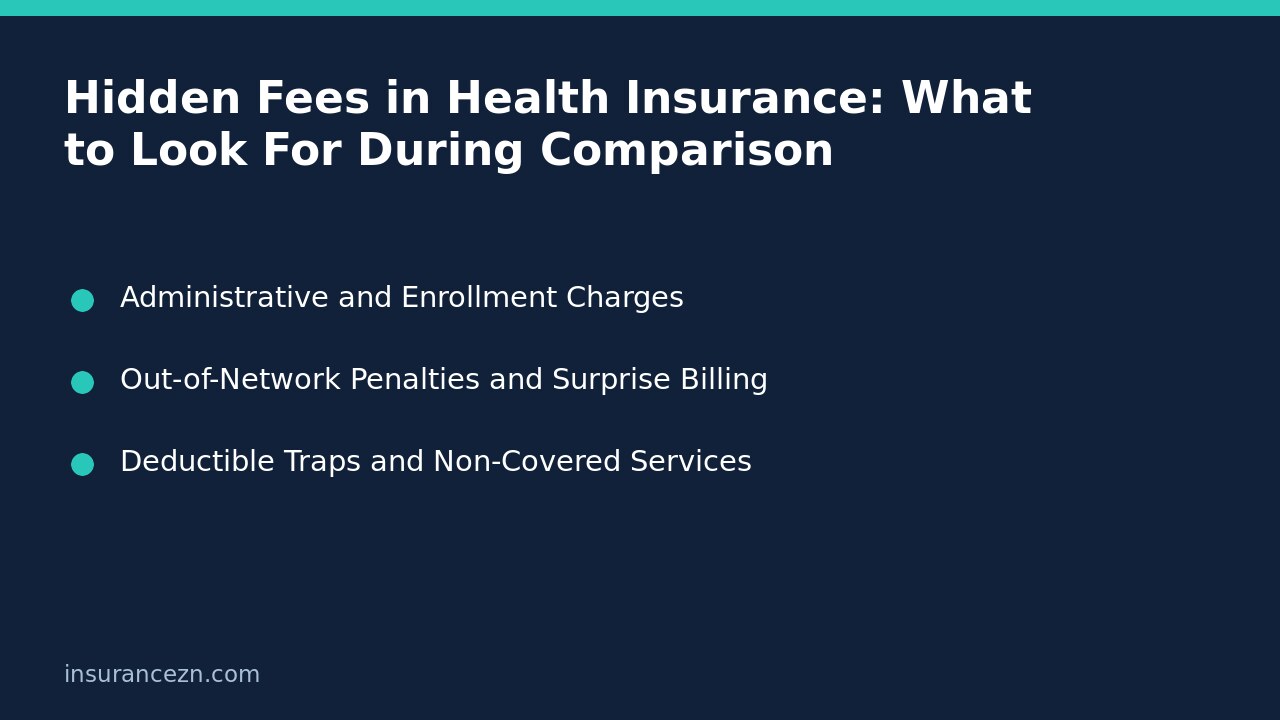
Administrative and Enrollment Charges
One of the most common sources of confusion involves upfront costs associated with enrolling in a plan rather than the coverage itself. Some insurers charge an administrative fee simply for processing your application or setting up your account. While many major carriers offer free enrollment, smaller regional plans or certain employer-sponsored options may include these charges.
Additionally, be wary of “processing fees” that appear on your first bill. These can sometimes be disguised as activation costs. Always check the policy documents under the section labeled “Initial Costs” or “Enrollment Fees.” If a fee is charged for paper applications versus online ones, this is another area where unnecessary markups can hide. A practical step is to ask a representative directly: “Are there any one-time fees just for signing up?”
Out-of-Network Penalties and Surprise Billing
Perhaps the most significant hidden cost in health insurance stems from the distinction between in-network and out-of-network providers. While policies explicitly state that they will not cover services rendered by out-of-network doctors, these plans often fail to clarify how they handle “surprise billing.”
Surprise bills occur when you receive emergency care or go to a facility where some staff members are not part of your specific insurance network. Even if your plan has an in-network hospital, the anesthesiologist or radiologist might be out-of-network. In many jurisdictions, laws now protect against these surprise balances, but loopholes exist, and enforcement varies by state.
To avoid this hidden fee trap, always verify the provider status of specialists before scheduling non-emergency procedures. Use your insurer’s online tool to search for doctors, but cross-reference with a second source, as databases are not always real-time. If you must see an out-of-network provider, request that the facility bill you on a “self-pay” basis if your plan allows it, or negotiate the rate before the service is rendered.
Deductible Traps and Non-Covered Services
A deductible is the amount you pay for covered healthcare services before your insurance plan starts to pay. However, not all medical services count toward your deductible. Some plans categorize certain tests, vaccinations, or telehealth visits as “non-covered” until a specific date or condition is met, effectively forcing you to pay full price indefinitely.
Furthermore, some plans have a separate “deductible for prescription drugs,” which can be significantly higher than the medical deductible. If you take multiple medications, this structure can result in paying double the expected cost. For instance, you might meet your $1,000 medical deductible but still owe thousands on medication costs because they are tracked separately.
Always review the “Exclusions” and “Limitations” sections of your policy. Look for terms like “not subject to deductible” or “copay only.” If a service is listed as excluded without exception, it will never count toward your deductible, meaning you pay full retail price every time. Common exclusions include cosmetic surgery, experimental treatments, and sometimes even specific brand-name drugs.
Premium Loading and Risk-Based Adjustments
While illegal in some states for individual markets, “premium loading” can still appear in the form of risk adjustments or grandfathered clauses that increase your rate based on prior claims history in group plans. In employer-sponsored plans, if a company decides to drop coverage due to high claim frequency, the cost is often passed directly to the employee via increased premiums or reduced benefits.
Another hidden element is the “waiting period fee.” Some policies impose a surcharge if you enroll within a specific window after a previous policy expires, treating it as a new risk profile. This is less common in individual marketplaces due to regulations but can appear in short-term health insurance or limited-duration plans. Always check if your plan has any clauses related to “renewability” that might trigger higher rates upon renewal.
Understanding the Fine Print: Copays vs. Coinsurance
Confusion between copays and coinsurance often leads to overpayment. A copay is a fixed amount you pay at the time of service, such as $20 for a doctor’s visit. Coinsurance is a percentage you pay after meeting your deductible, such as 20% of the bill.
The hidden fee here lies in the transition point. Once you meet your deductible, coinsurance kicks in. If you underestimate how quickly you will hit that threshold, you may find yourself paying 20% on expensive procedures without realizing it. Some plans cap coinsurance at a certain amount per year, but others do not. Reading the fine print to see if there is an “out-of-pocket maximum” that includes both copays and coinsurance is vital. Without this cap, your costs could theoretically rise indefinitely until you settle the bill personally.
Real-World Example: The $15 Plan Trap
Consider a scenario where two individuals compare plans. Person A chooses a plan with a low monthly premium of $150 but a high deductible of $3,000 and an out-of-pocket maximum of $6,000. Person B selects a plan with a higher premium of $250 but a $1,000 deductible and a $4,000 out-of-pocket maximum.
If Person A gets sick and needs surgery costing $15,000, they must pay the first $3,000 (deductible) plus 20% of the remaining $12,000 ($2,400), totaling $5,400 in hidden costs before insurance pays anything. If they hit the out-of-pocket max, they stop paying. However, if Person A had chosen Person B’s plan, their total cost would be capped at $4,000 regardless of the surgery price. The “hidden fee” for Person A was the high deductible structure, which shifted financial risk entirely onto them during a medical crisis.
Checklist for Identifying Hidden Fees
Before finalizing your health insurance comparison, run through this checklist:
1. Review Enrollment Documents: Look for any mention of administrative, processing, or activation fees in the first month’s billing cycle.
2. Verify Network Status: Ensure all anticipated specialists and facilities are explicitly listed as “in-network” in your specific plan document, not just generally on the website.
3. Check Drug Formulary Tiers: Confirm that your required medications are covered and note if they have a separate deductible or high coinsurance tier.
4. Read Exclusions Carefully: Identify services explicitly excluded from coverage or the deductible calculation.
5. Calculate Total Estimated Cost: Add up premiums, estimated deductibles, expected copays for routine visits, and potential out-of-pocket maximums to get a realistic annual cost.
6. Ask About Surprise Billing Protections: Confirm which states or federal laws apply to your plan regarding emergency room and air ambulance billing.
By meticulously examining these areas, you can compare health insurance plans based on true total cost rather than just the sticker price of the monthly premium. This proactive approach ensures that you maintain financial stability even when unexpected health issues arise.