
Losing your job is often accompanied by the immediate anxiety of how it will affect your daily life and financial stability. Among the most pressing concerns for any employee is the continuity of their health insurance coverage. Unlike car or home insurance, which can sometimes be transferred or paused more easily, employer-sponsored health plans are tied directly to your employment status. When that job ends, so too does the automatic payroll deduction for premiums and the active enrollment in that specific plan. Understanding exactly what happens next is crucial to avoiding gaps in care, unexpected out-of-pocket costs, and potential lapses in coverage that could lead to pre-existing condition exclusions or denial of claims.
When you are terminated from your employment or voluntarily leave a position, your employer’s obligation to provide health insurance ceases immediately. In most cases, the group health plan sponsored by the company will end for you on the day you resign or the date specified in your separation documents. You will typically receive a final paycheck that includes any accrued vacation time but rarely includes future health premium payments. This means that unless you take immediate action to secure alternative coverage, there is a high risk of going uninsured. The transition period between losing a job and securing new coverage can be dangerous if not managed carefully, as many individuals mistakenly believe they have a grace period built into their existing policy that does not actually exist under standard group plan rules.
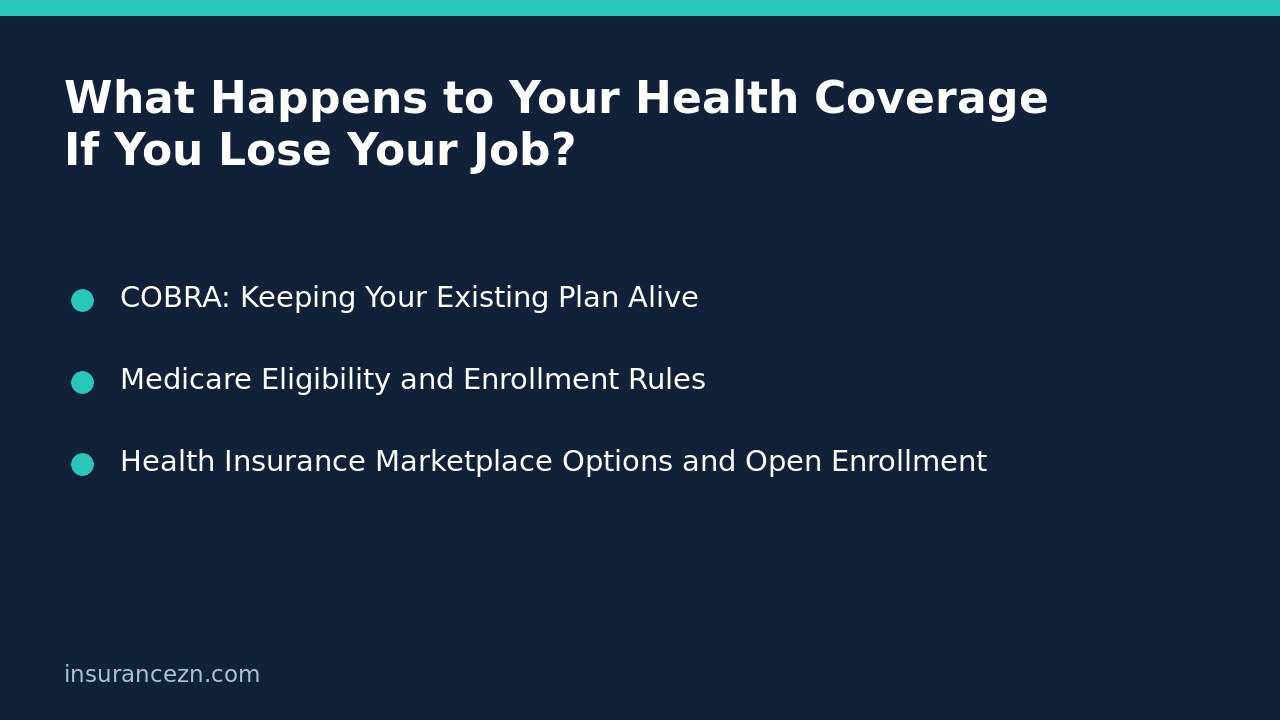
COBRA: Keeping Your Existing Plan Alive
The most common solution for maintaining your current health insurance after job loss is the Consolidated Omnibus Budget Reconciliation Act (COBRA). Enacted in 1985, this federal law allows qualified beneficiaries to temporarily extend group health benefits that were provided through an employer or union. Under COBRA, you can choose to continue the exact same coverage you had while employed, including the same doctors, network providers, and prescription drug formularies. This is particularly valuable if you have recently started a new medication or are undergoing specialized treatment; switching plans mid-cycle could disrupt this continuity.
However, coming with significant financial trade-offs is the requirement that you pay the full premium. While employers typically subsidize your share of the cost (often 50% to 70%), under COBRA, you must pay 100% of the premium plus a small administrative fee, usually capped at 2% of the total plan cost. This means if your monthly premium was $600 with employer assistance, you would now be responsible for the full amount, which might push the total to around $700 or more depending on the specific plan structure. Additionally, COBRA coverage is temporary, generally lasting up to 18 months for involuntary job loss, though extensions exist for specific circumstances like divorce, reduction in force affecting multiple employees, or the death of the covered employee. It is important to note that COBRA is not available to everyone; it applies to group plans with 20 or more employees and does not cover self-employed individuals, independent contractors, or those on unpaid leave prior to separation.
Medicare Eligibility and Enrollment Rules
If you are approaching retirement age, losing your job might trigger different pathways depending on your eligibility for Medicare. Generally, you become eligible for Medicare at age 65 regardless of your employment status. If you were already enrolled in Medicare when you lost your job, your coverage continues unaffected. Your employer’s insurance was likely a secondary payer to Medicare anyway. However, if you are under 65 and have not yet qualified for Medicare, losing your job does not grant you immediate access to it. Attempting to enroll in Medicare Part B while still working with other group coverage can lead to late enrollment penalties if done prematurely.
There is a critical nuance regarding the Special Enrollment Period (SEP). Losing job-based health coverage creates a SEP for enrolling in Medicare Parts A and B, provided you are turning 65 within 73 months of losing that coverage. However, if you are under 65, this rule does not apply. If you have been receiving Social Security Disability Insurance (SSDI) for 24 months, you may be eligible for Medicare regardless of age, but the loss of a job itself does not automatically activate these benefits. Relying on the assumption that you can switch to Medicare immediately after unemployment is a common mistake that leaves many vulnerable workers without coverage during their prime earning years.
Health Insurance Marketplace Options and Open Enrollment
If you do not wish to use COBRA or if your former employer’s plan was too expensive, the Health Insurance Marketplace (formerly known as the Exchange) offers an alternative. Losing job-based coverage qualifies you for a Special Enrollment Period outside of the annual Open Enrollment window. During this period, which typically begins within 60 days of losing coverage, you can apply for plans on your state or federal exchange. The key advantage here is the potential for financial assistance. Based on your new household income, you may qualify for Premium Tax Credits to lower your monthly costs and Cost-Sharing Reductions to lower your deductibles and copays.
To utilize this option, you must have documentation proving your loss of coverage, such as a termination letter or a statement from your former insurer showing that your group benefits have ended. Once enrolled, you can choose from various metal tiers (Bronze, Silver, Gold, Platinum) depending on your expected healthcare usage and budget. However, marketplace plans often operate differently than employer plans; they may not cover every service or provider in the same network, and pre-existing conditions are covered without additional premium charges under the Affordable Care Act. It is essential to compare networks carefully, as some doctors you rely on might be out-of-network in a marketplace plan but were in-network with your former employer’s plan.
State-Specific Continuation Laws and Short-Term Plans
Not all states adhere strictly to federal COBRA rules or offer additional protections. Some states have enacted their own continuation coverage laws that may offer more favorable terms, such as lower costs or extended durations beyond the standard 18 months. For example, California’s CalCOBRA allows for up to 18 months of continuation but can be purchased by family members even if the employee doesn’t elect COBRA. Other states might allow for shorter or longer periods depending on local legislation. Conversely, some individuals turn to short-term health insurance plans as a stopgap measure. These policies are designed to fill gaps in coverage for a few months but come with significant limitations. They often exclude pre-existing conditions, have lower maximum benefit limits, and may not cover essential services like maternity care or mental health treatment. Relying solely on a short-term plan is generally inadvisable unless used strictly as a bridge until COBRA expires or new employer coverage begins.
Practical Steps to Take Immediately After Job Loss
Navigating this transition requires swift action to prevent coverage gaps. The first step is to review your employment contract and the summary plan description provided by your former employer to understand the exact termination date of your benefits. Next, contact your human resources department or the insurance carrier directly to confirm when your last day of coverage will be. Do not wait for this information; assume coverage ends immediately upon separation unless told otherwise. Within 30 days of losing coverage, apply for COBRA if you decide to keep your current plan. Simultaneously, gather necessary documents for a marketplace application if you are considering switching plans. Finally, calculate the total cost of COBRA versus the subsidized marketplace options based on your projected income to make an informed financial decision.
Real-World Example Scenario
Consider Sarah, a 34-year-old marketing manager who loses her job due to a company-wide restructuring. Her employer’s health plan ends on her last day of work. She has a chronic condition requiring monthly injections and a specialist she visits twice a month. If Sarah waits a week to apply for COBRA, she might miss the notification window or face administrative delays. By applying immediately, she secures her current plan but must pay the full premium, which comes to $850/month. Alternatively, she calculates that her income has dropped significantly due to unemployment benefits, qualifying her for subsidies on the marketplace. She finds a Silver plan with a network that includes her specialist for $450/month plus a $200 deductible. After factoring in the subsidy, her net cost is $300/month. Sarah chooses the marketplace option, saves money, and ensures her specialist visits continue uninterrupted, demonstrating how quick calculation and action can mitigate the financial shock of job loss.
Checklist for Securing Coverage
- [ ] Confirm your last day of employer-sponsored coverage with HR.
- [ ] Request a COBRA election notice from your former employer within 14 days of separation.
- [ ] Calculate the full cost of COBRA premiums versus marketplace options.
- [ ] Check eligibility for state-specific continuation laws if available in your jurisdiction.
- [ ] Submit applications for COBRA or Marketplace plans before your current coverage expires.
- [ ] Verify that your new plan includes your preferred doctors and hospitals.
- [ ] Review the terms of any short-term plan carefully to ensure it covers necessary medications.
Remember that insurance terms, availability, eligibility, laws, and prices depend on the specific insurer, policy details, and local jurisdiction. Always verify current rules with official sources before making decisions.