
Removing a driver from your auto insurance policy is a common administrative task, but doing it incorrectly can lead to severe coverage gaps or claim denials. Whether a family member has moved out, a teenage driver has graduated, or an employee is no longer working at your business, the process requires more than just stopping payments. The core principle remains consistent: you must notify your insurer and formally request a policy amendment before the driver stops using the vehicle covered by that policy. If you simply stop paying premiums for a specific person without updating the contract, the insurer may still hold them liable under “named driver” clauses or fail to recognize that they are no longer insured, leaving both parties vulnerable in the event of an accident.
The process involves verifying eligibility, gathering necessary documentation, submitting a formal request, and confirming the update in writing. It is crucial to understand that insurance companies often require a specific timeframe for this change to take effect, usually at the start of a new billing cycle or immediately upon receipt of proof of address change or graduation status. Failing to follow these steps can result in double premium charges if you are charged for two drivers when only one should be covered, or worse, a claim rejection because the insurer discovers an unauthorized driver was operating the vehicle.
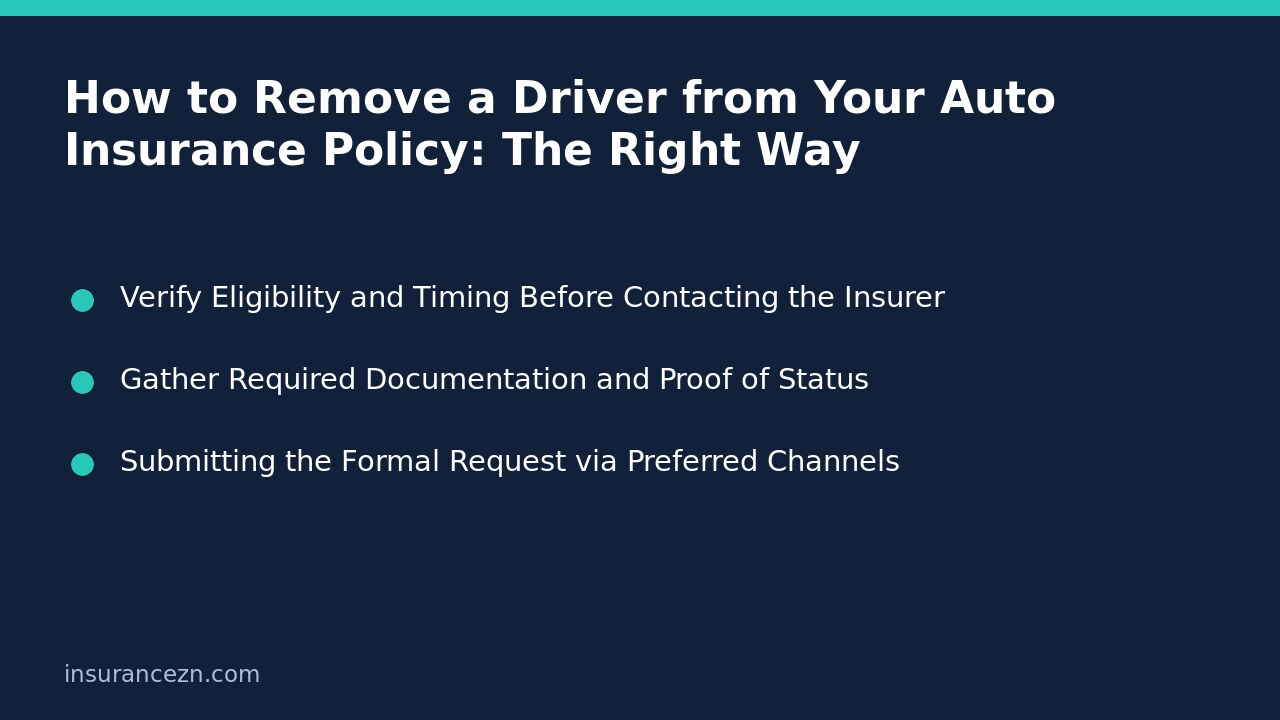
Verify Eligibility and Timing Before Contacting the Insurer
Before making the call or logging into your online portal, you must determine if the removal is legally permissible under current laws and your specific policy terms. In many jurisdictions, removing a licensed driver from a household policy is straightforward. However, some states have “residency requirements” that mandate all licensed residents of a household be listed as drivers on the policy. If the person you wish to remove still sleeps at your home or uses the car regularly, they may not be eligible for removal yet.
Additionally, consider the timing relative to your billing cycle. Most insurers allow changes at any time, but the effective date of the change often aligns with your next premium due date. Some companies charge a pro-rated refund for the unused portion of the premium if you remove a driver mid-cycle, while others do not offer refunds and simply adjust the current month’s rate. Check your policy documents or website to see if there are specific windows for making changes without administrative fees.
Gather Required Documentation and Proof of Status
Insurers rarely accept verbal requests alone; they require documented proof to validate the removal. The specific documents needed depend entirely on the reason for removing the driver. For a driver who has moved out, you will typically need a copy of their new lease agreement, utility bill, or driver’s license showing a different address. If the driver is an adult child moving into a roommate situation, a notarized affidavit stating they no longer reside with you may be required.
For teenage drivers, proof of high school graduation is essential. Most states require teens to remain on their parents’ policy until they graduate or turn 25. You will need an official transcript, diploma, or a letter from the school administration confirming graduation status. If the driver is being removed due to license suspension, you must provide the official notice from the Department of Motor Vehicles (DMV) or relevant licensing authority. Without these documents, your request may be denied, and the insurer could continue charging premiums for a driver who is effectively “uninsured” in their eyes.
Submitting the Formal Request via Preferred Channels
Once you have verified eligibility and gathered documents, submit the request through your insurer’s preferred channel. Most modern insurers offer online portals where you can log in, navigate to the policy management section, and select “Update Policy” or “Remove Driver.” This digital trail provides immediate confirmation of your request. If your insurer does not support online updates, use their dedicated phone line for auto policy changes. Avoid using general customer service numbers that handle billing disputes; ask specifically for the “policy administration” or “endorsement specialist” team.
When speaking with a representative, clearly state the name of the driver to be removed and provide the effective date you desire. Ask them to send an updated policy declaration page via email or mail within 24 to 48 hours. This document is your legal proof that the change has been processed. If the insurer refuses to make the change without a physical signature on a form, ask for the specific form number and how to obtain it. Do not rely solely on verbal assurances; always request written confirmation of the policy adjustment.
Understanding Financial Implications and Refund Policies
Removing a driver often results in an immediate reduction in your premium, as you are insuring fewer risks. However, the financial mechanics of this change can vary significantly between carriers. Some insurers will prorate your current month’s premium based on the number of days the removed driver was covered, issuing a check or credit for the difference. Others may wait until the next billing cycle to apply the new rate.
It is also important to be aware of potential fees. Some policies charge an administrative fee for processing endorsements or amendments, while others do not. Conversely, if you remove a driver and then realize you need them back quickly, re-adding them might incur a reinstatement fee or require a waiting period where they are considered a “new” applicant again. Always ask about these costs before finalizing the removal. If you are removing a driver who was previously added as a temporary driver (e.g., for a summer job), ensure that the policy clearly states they are no longer covered to avoid liability issues if they drive without insurance.
The Critical Importance of Written Confirmation
The most common mistake drivers make is assuming the change is complete after speaking to an agent or checking their online profile. Insurance contracts are legal documents, and verbal agreements do not hold up in court or during a claims investigation. You must obtain a signed endorsement or a revised policy declaration page that explicitly lists the removed driver as no longer covered.
Review this document carefully for typos or errors regarding the effective date. If the removal is dated incorrectly, you could face coverage gaps. Keep this document in a safe place alongside your other insurance records. In the event of an accident involving the car while the removed driver is operating it, this document will be the first piece of evidence your insurer reviews to determine liability. Without written confirmation, you risk being held financially responsible for damages caused by someone you thought was no longer insured.
Real-World Example: The Graduated Teen Driver Scenario
Consider a common scenario: A teenager named Alex has been driving for two years and recently graduated high school. The parents decide to remove Alex from the family auto policy because he now meets the minimum age requirement for standalone insurance or because they feel the risk profile has changed. They call the insurer on a Monday morning. The agent tells them, “Sure thing, we’ll take him off today.” Two weeks later, Alex gets into a fender-bender while borrowing a friend’s car. The friend calls the police and mentions that Alex was insured by his parents’ policy.
The insurance company investigates and discovers that they never received formal proof of graduation or an updated declaration page. Because the paperwork was never processed, the insurer determines that Alex was still a required named driver under the household residency clause at the time of the accident. Since the policy was not officially amended in their system, the claim is complicated, potentially leading to higher deductibles or coverage disputes. Had the parents gathered the diploma, submitted it via the secure portal, and received the updated declaration page before the accident occurred, the removal would have been valid, and Alex would have needed his own policy for that specific incident. This example highlights why documentation and official processing dates are non-negotiable in insurance administration.
Final Checklist for a Smooth Removal Process
To ensure you remove a driver correctly every time, follow this practical checklist:
1. Confirm Residency Status: Verify the driver no longer lives with you or has graduated if applicable.
2. Collect Documents: Gather utility bills, lease agreements, diplomas, or DMV suspension notices.
3. Check Billing Cycle: Determine if the change aligns with your next premium due date for accurate pricing.
4. Submit Request: Use the online portal or dedicated phone line; avoid general support lines.
5. Request Written Proof: Ask for an updated policy declaration page immediately after submission.
6. Verify Effective Date: Ensure the document reflects the correct start date for the removal.
7. Update Records: Store the new declaration page and cancel any automatic payments associated with the removed driver if they were billed separately.
By adhering to these steps, you ensure that your auto insurance policy accurately reflects your current risk profile, protecting both your assets and your peace of mind.