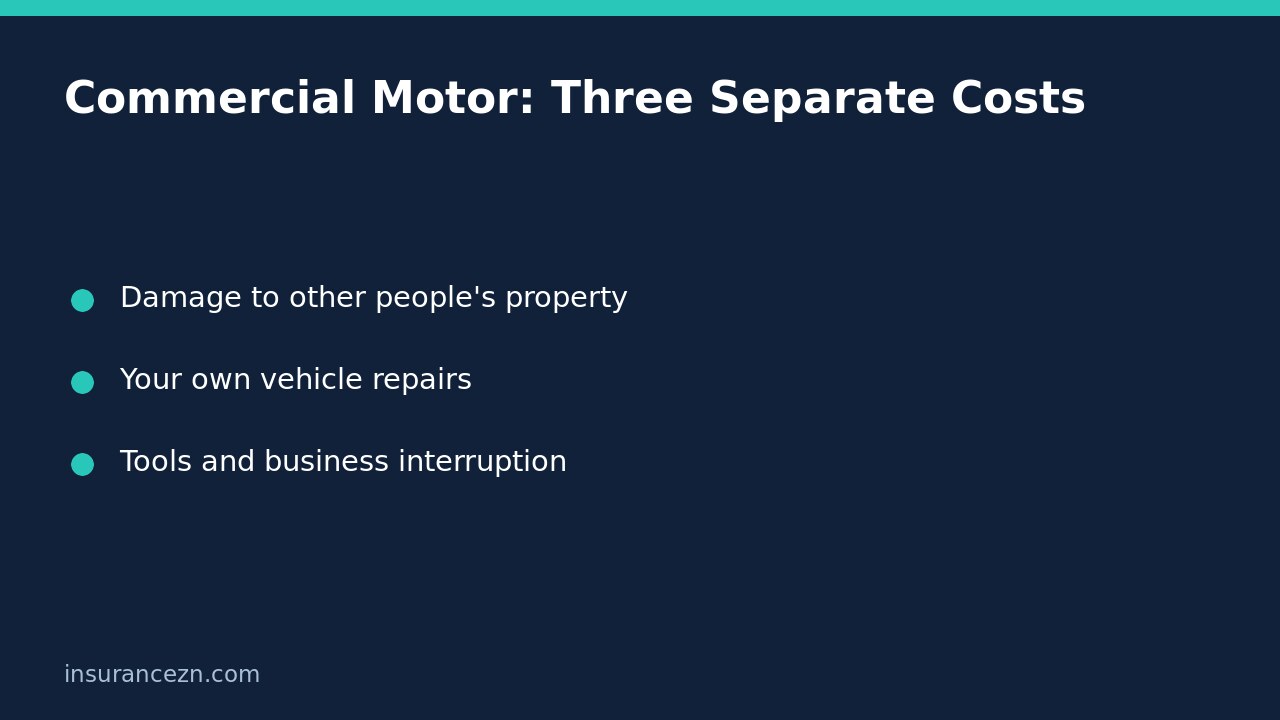

If your commercial motor quote says Legal Liability Only, do not treat it as a repair budget for your own business van. Ask the insurer to identify separately what happens to another person’s damaged property, your vehicle, and the tools or stock carried inside. The business-insurance label alone does not establish cover for all three.
This is especially important when replacing a comprehensive policy with a lower-priced option. A reduction in premium may come with a different set of insured losses, not simply a cheaper version of the same protection.
Start with the cover level, not the business package name
AAMI’s commercial motor overview lists Comprehensive, Fire, Theft & Legal Liability, and Legal Liability Only. It also says not all levels are available for all vehicle types. Those are provider-specific options; another insurer may use different names or conditions.
Write the exact level from your quote beside the actual vehicle registration. Then ask which policy sections would respond if you reversed into a customer’s fence and also damaged your own van. Do not substitute a public liability certificate for the commercial motor documents. An insurance document addressing one business risk is not proof that every loss involving the vehicle is insured.
Build a three-column accident worksheet
Use a hypothetical low-speed collision outside a customer’s premises. There are three separate cost headings: the customer’s fence, the van’s damaged rear door, and a portable machine damaged inside. Record a separate answer for each rather than writing one overall claim limit.
- Other people’s property: ask about legal liability, applicable exclusions, the excess and how the insurer wants correspondence handled.
- Your vehicle: ask whether accident damage to the insured van is included under the selected level and which settlement terms would apply.
- Carried equipment: identify the item and ask which section, if any, covers its damage in this particular journey.
The worksheet is a way of finding gaps, not evidence that the hypothetical accident will be accepted. Fault, the insured use, policy conditions and the actual incident still need assessment.
Do not move tools into the motor column by assumption
AAMI’s small business overview describes Portable & Valuable Items as a separate cover for items commonly carried for business. That distinction is useful: insuring a vehicle and insuring the working equipment it transports can require different checks.
List permanently fitted equipment separately from removable tools, customer goods and sale stock. Ask the insurer to classify each under the applicable wording. Do not assume an item is a vehicle accessory merely because it stays in the van overnight. Our guide to checking tools away from business premises explains why the journey and location deserve their own review.
Price the operational gap before changing cover
A van that cannot be driven may interrupt work even when another person’s damage is insured. Request otherwise matched quotes using the same vehicle, drivers, business activities and excess assumptions. Compare the actual payable premiums alongside your ability to fund repairs or replacement yourself.
Ask separately about replacement transport. The AAMI commercial motor overview lists Rental vehicle after accident among optional covers for Comprehensive policies, subject to conditions and vehicle restrictions. Its presence on the website does not mean it has been selected on your quote or that your particular vehicle qualifies. Confirm the purchased option, accepted use and applicable limits before relying on it.
Also ask whether lost revenue has any separate protection. A motor claim, hire vehicle benefit and business interruption claim are not interchangeable. Avoid counting the same expense under several sections as if each will independently reimburse it.
Before accepting the quote
Keep the quote version, PDS or policy wording and vehicle schedule together. Request written answers to unresolved own-damage and equipment questions, then check the issued documents match the accepted selection and commencement date. A request to upgrade is not a processed change.
Does having commercial motor insurance prove the van’s collision repairs are covered? No. Check the precise cover level and applicable wording rather than the product heading. If an accident has already happened, describe it accurately and ask about the policy that applied then; do not assume a later upgrade protects the earlier event.
This is general information for Australian readers, not personal financial advice. Cover depends on the policy/PDS, schedule, purchased sections, limits, exclusions and insurer assessment. Provider examples are not endorsements or guarantees of payment.