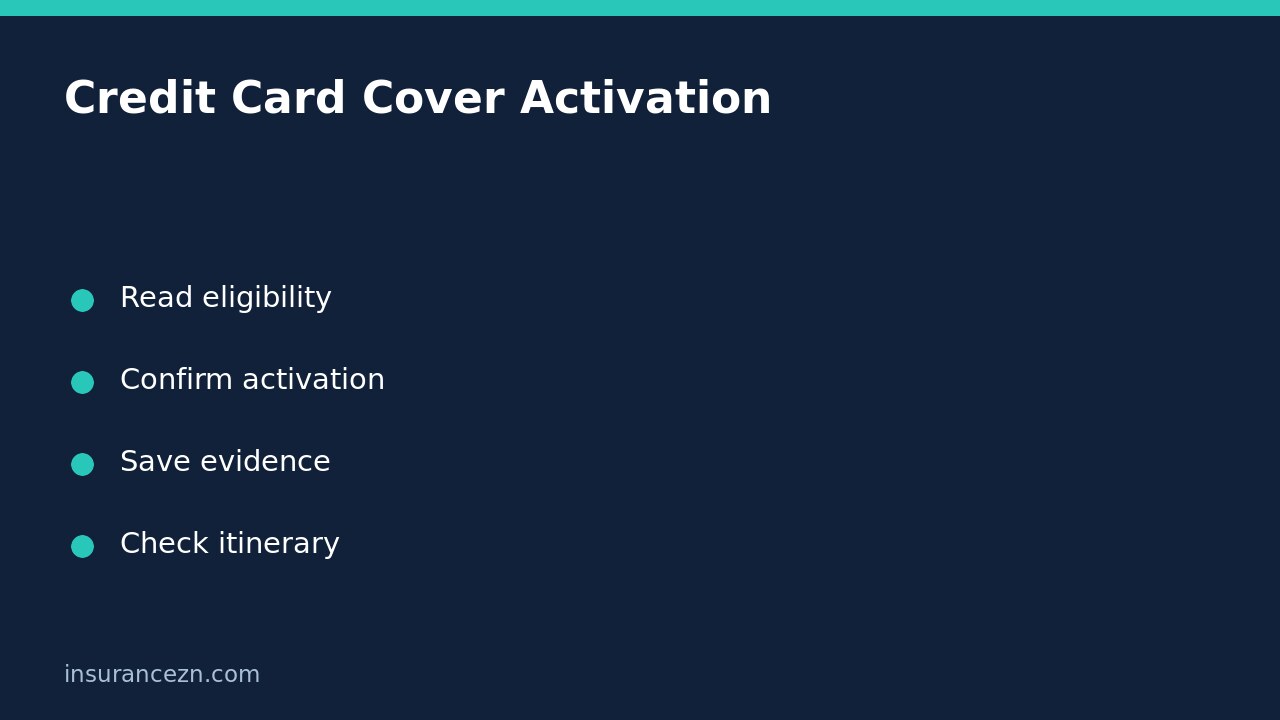

Having a credit card with travel insurance does not establish that your next overseas journey is insured. Before relying on it, confirm the activation requirements in the current policy documents, check that your particular journey and travellers qualify, and save evidence. A card advertisement or a booking receipt alone may not answer those questions.
This is general information for Australian readers, not personal financial advice. Cover depends on the current Product Disclosure Statement (PDS), eligibility rules, exclusions, limits and your circumstances. This checklist does not replace those documents or guarantee a claim.
Start with the policy attached to your exact card
Find the insurance documents through your card provider rather than a comparison article. Record the card product name, policy document version, insurer identity and assistance contact. Similar card names do not necessarily have identical benefits. Check whether the policy version applies to your booking and proposed journey, particularly if you received notice of a policy change.
Smartraveller warns that credit card travel insurance usually needs activation and says to confirm the process with your bank. It also recommends comparing the PDS with comprehensive travel insurance rather than assuming a free benefit provides equivalent cover. Use that as a reason to investigate, not as proof that every card has the same activation rule.
Turn activation wording into a written checklist
Read the eligibility and activation sections separately from the benefits table. Write each requirement as a question you can answer with a document. Depending on the particular policy, questions to investigate may concern eligible payments, travel dates, residency, cardholder status or registration. These are checks to make, not universal conditions asserted here.
- What action, if any, activates this journey?
- When must that action occur relative to booking and departure?
- Which travellers qualify, and must they travel together?
- Is a confirmation document available after activation?
- What happens if a booking is refunded, changed or paid another way?
If the wording is unclear, ask the bank or the insurer contact identified in the policy. Provide the actual itinerary and payment circumstances. Request the relevant policy clause and keep the written response. Do not rely on a general telephone statement that the card comes with insurance.
Build a small evidence file before you leave
Create a folder containing the applicable PDS, itinerary, relevant payment records and any activation confirmation. Keep a copy accessible offline, with another secure backup. Avoid placing complete card numbers or unnecessary identity documents in an openly shared folder.
For example, imagine an Australian traveller books flights using a mixture of card payment and reward points. Their useful question is not simply whether reward bookings are covered. It is whether that exact payment arrangement satisfies their policy wording for that journey. They should retain the booking invoice showing how payment was made and seek clarification before assuming eligibility. No claim outcome can be inferred from that hypothetical example.
Make a one-page summary with the insurer assistance number, policy reference if issued, departure and return dates, insured travellers and the location of supporting documents. Give a trusted travelling companion access to the emergency contact details without sharing account login credentials.
Activation does not settle the rest of the cover
An activated policy may still have restrictions that matter to your plans. Check all destinations, including transit stops, the maximum length of each journey, medical declarations, activity exclusions and benefit limits. Smartraveller specifically notes that credit card policies can restrict individual trip duration. An activation email therefore should not be treated as approval for every activity or every day away.
If the itinerary includes a domestic coastal cruise, separately review our onboard medical cover checklist for Australian coastal cruises. A benefit linked to overseas travel should not be assumed to solve a different itinerary risk.
Quick questions before departure
Is the card statement enough? It may help prove a payment, but it does not by itself establish every eligibility condition, covered traveller or exclusion. Match evidence to each applicable rule.
What if I cannot confirm activation? Seek clarification before travel. If considering separate insurance, compare its terms and eligibility first; do not assume a new purchase will retrospectively cover an event that already happened.
Should I keep documents after returning? Keep the records needed for any potential claim and follow the policy instructions. Check reporting requirements promptly rather than guessing a deadline.
Before leaving, be able to explain which policy applies, why you believe activation is complete, who qualifies and where the evidence is stored. That is a stronger starting point than relying on the card name alone.
Source
Australian Government Smartraveller: Travel insurance explains activation checks, policy comparison, trip-duration restrictions and the importance of reading the PDS.