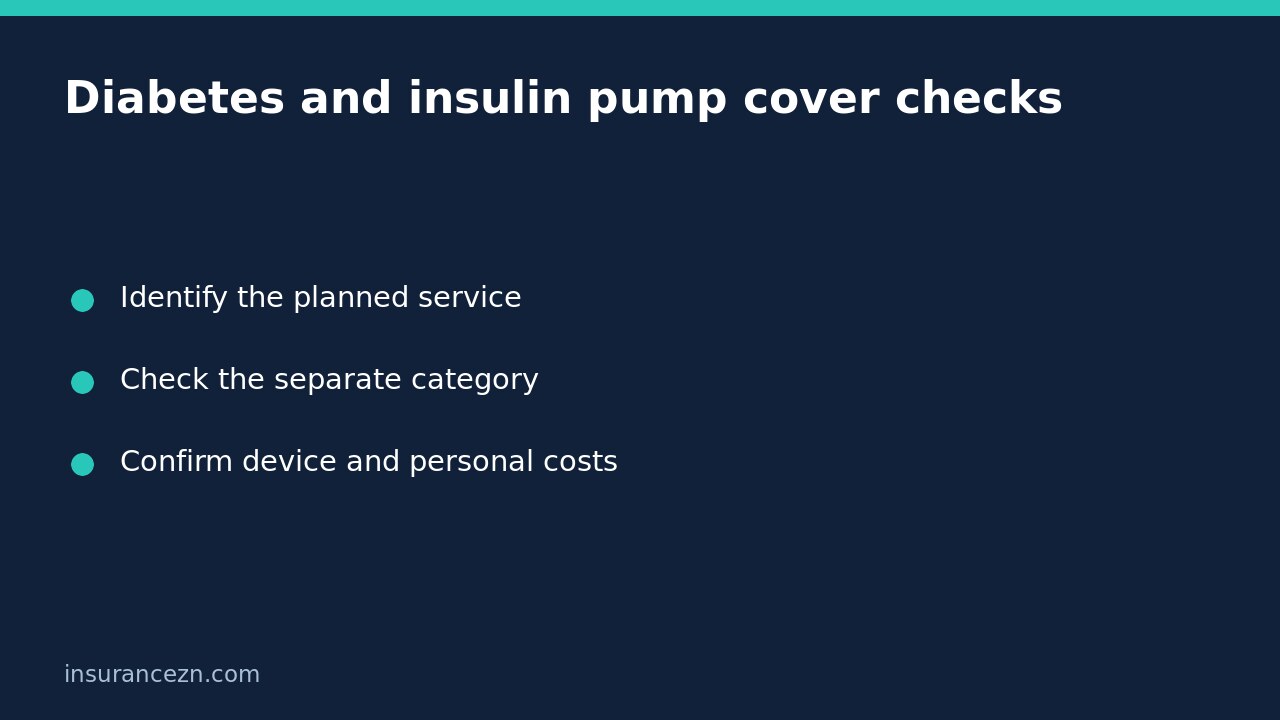

A hospital policy showing diabetes management does not, by that label alone, establish cover for providing or replacing an insulin pump. Australia’s standard hospital categories list those services separately. Before agreeing to a planned pump-related admission, ask the treating team and insurer to match the exact service and device to your actual policy.
This is general information for Australian readers, not personal financial advice. Benefits depend on your policy, applicable PDS and other policy documents, exclusions, restrictions, waiting periods and the insurer’s assessment. This article does not recommend a device or treatment. Do not delay urgent medical care while checking insurance.
Read the two category definitions separately
The Australian Government’s clinical categories page describes diabetes management as hospital treatment for investigating and managing diabetes. Its examples include stabilisation of low or high blood glucose and contour problems from insulin injections. It expressly places the provision and replacement of insulin pumps in the separate Insulin pumps category.
The same source defines Insulin pumps as hospital treatment for provision and replacement of insulin pumps for diabetes treatment. It states there are no specific MBS item numbers associated with that category. Consequently, the absence of a category-specific MBS number is not a reason to assume the pump belongs under the general diabetes-management label.
These definitions explain the boundary; they do not tell you that your own product pays for your proposed device, that every related cost is included, or that a particular provider’s quote will be paid in full. A general treatment recommendation is also not an insurer’s personal benefit estimate.
Get a service description before asking about benefits
Ask the treating team for a written description of the plan. Is it provision of a first pump, replacement of an existing pump, a separate admission to stabilise diabetes, or an appointment to review settings? Do not substitute your own description if you are unsure. Ask whether a formal hospital admission is planned and identify the facility and proposed dates.
For a pump proposal, request the device’s exact name or model and any device or billing identifiers the provider can supply. Ask the provider to separate the device price from hospital charges, professional fees and follow-up services. You are collecting enough information for a meaningful enquiry, not deciding clinical suitability yourself.
Do not assume that paying for the main device also pays for every ongoing supply, accessory, education appointment or later review. Ask about those items individually if they appear on your treatment plan. A category title is not an itemised promise.
Ask the insurer a matched set of questions
- Does my exact hospital product include the Insulin pumps category, and is the proposed service subject to any restriction or exclusion?
- Are any waiting periods or other eligibility checks outstanding for this treatment?
- What information is needed to assess the proposed device and any replacement conditions?
- What estimated benefits apply to the named device and hospital episode, and which quoted charges remain mine?
- Are separate follow-up appointments assessed differently, and what details are needed to check them?
Request a written response tied to your membership, product, device, facility and planned date. If information is still missing, record the outstanding requirement rather than describing the enquiry as approval. If the model or admission plan changes, ask for an updated response before relying on the earlier estimate.
A practical way to compare two quotations
Suppose one clinic quotes a replacement pump and another quotes a consultation to review your current pump. Those are hypothetical examples of different services, not equivalent prices. Comparing only the totals could hide the fact that one includes a device and a hospital episode while the other includes neither.
Create a short comparison sheet with separate rows for the device, hospital charges, treating professionals, follow-up and ongoing items. Put each provider’s actual quoted charge beside the insurer’s corresponding estimated benefit. Mark unanswered rows as unresolved; do not turn a blank answer into a zero-cost assumption. Also check whether an excess or co-payment has already been included in the estimate so it is not counted twice.
Before paying or booking
Keep the dated treatment description, provider quotation and insurer response together. An estimate is not the final claim assessment, and a booked appointment or paid deposit does not itself establish entitlement. For the payment side, see why a surgery deposit is separate from insurance approval. The same administrative distinction matters when paying a planned treatment deposit.
Does diabetes-management cover mean all diabetes complications are covered? No such conclusion follows from that label. The government category page places diabetes-related conditions under the relevant body-system categories, such as Eye for diabetes-related eye conditions. Ask about the actual proposed treatment.
Should I change treatment to fit a category? No. Discuss clinical choices with your treating team. Insurance enquiries should clarify costs and eligibility for the proposed care, not replace medical advice or justify relabelling an invoice.