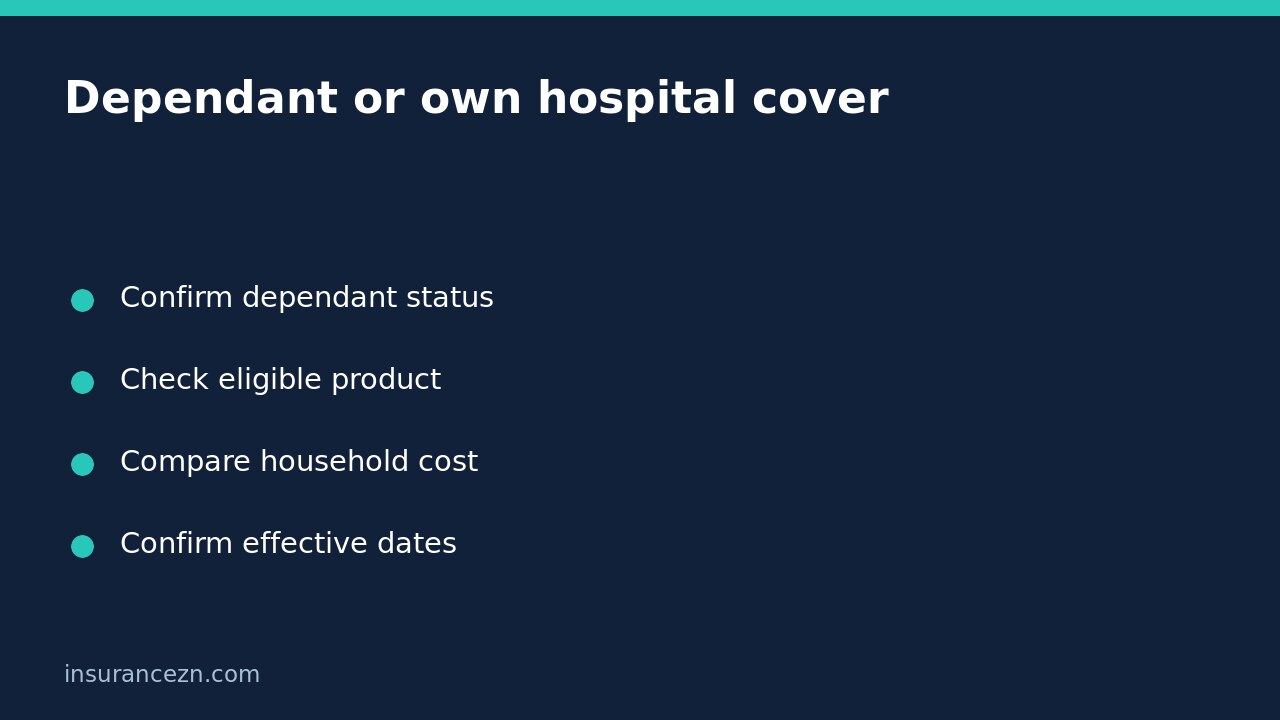

If you are a young adult comparing remaining on a parent’s hospital policy with buying your own, do not count an age-based discount on both options. The Australian Government’s PrivateHealth.gov.au explains that the discount does not apply to people aged 18–29 covered as a dependant on a family or single-parent policy. A person can have their own eligible policy and receive the discount, or be covered as a dependant, but not both.
That eligibility distinction does not prove a separate policy is cheaper. The useful comparison is the actual household cost and cover under each arrangement, with membership changes confirmed before anyone is removed.
Confirm the current membership arrangement first
Ask the existing fund whether you are recorded as a dependant, the eligibility conditions for remaining in that category, and whether those conditions are changing. Do not infer your status from the fact that your name appears on a membership card. Obtain the answer for your particular policy and circumstances.
Next, ask what the household would actually pay if you left the membership. A reduction should not be assumed. The remaining family may still need the same membership category. If the premium would not change, that is an important input when assessing the extra cost of a separate policy.
Check whether the proposed hospital product offers a discount
PrivateHealth.gov.au’s age-based discount guidance says insurers can offer discounts on hospital premiums to eligible people aged 18–29. The word can matters: do not assume every insurer or every product offers the same arrangement. Where a policy offers age-based discounts, they are available to both new and existing policyholders.
The government guidance describes an allowable discount of two per cent for each year under 30, capped at ten per cent for ages 18–25. Ask the fund to confirm the percentage that applies to your proposed commencement date and the dollar premium after its calculation. This is a hospital-premium measure, not a promise that your entire hospital-and-extras package will fall by that percentage.
Obtain the quote in writing with the product name, membership type and start date. If you already hold a discount and are changing products or insurers, the government guidance says to confirm whether it transfers before changing. Do not assume an earlier discount history automatically follows you.
Build a household-cost worksheet without double counting
Use two columns and the same payment period. Label one stay as a dependant and the other separate hospital membership. Enter actual insurer quotes rather than applying an advertised percentage to an assumed premium.
- Current family premium if you remain on the membership.
- Revised family premium if you leave, confirmed by the current fund.
- Your separate hospital premium after any confirmed age-based discount.
- Any extras premium needed for the comparison you actually want.
- Any other quoted pricing changes, with their conditions recorded separately.
Compare the current household total with the revised family premium plus your new premium. If you personally would pay the new policy while a parent pays the family premium, show both the household total and each person’s contribution. Moving the bill between people is not, by itself, a saving.
Keep benefits and administration separate from the discount
A lower premium does not establish equivalent treatment benefits. Compare treatment categories, exclusions or restrictions, excesses, hospital arrangements and other relevant conditions separately. Ask both funds about waiting periods and continuity for the specific change; do not assume that leaving a family membership guarantees immediate benefits under every new option.
For an upgrade, our guide to comparing hospital cover by benefit start dates explains why the policy commencement date and the date a particular benefit becomes available can differ. The age-based discount calculation does not answer that treatment-eligibility question.
Once you decide, request written confirmation of the new policy’s commencement and the processed change to the family membership. An application acknowledgement is not evidence that both records have been correctly updated. Reconcile the next premium notices and payments, and resolve unexpected amounts before assuming the quoted saving has occurred.
Frequently asked question: should I leave just to get the discount?
Not on the percentage alone. First establish whether you are eligible, whether the product offers it, the actual total payable and what cover changes. Keep your quote, household worksheet, membership confirmations and any outstanding questions together. Do not cancel existing cover merely because an online quote displays a discount.
This is general information for Australian readers, not personal financial advice. Benefits and pricing depend on the fund’s rules, policy documents, any applicable PDS, exclusions, limits and your circumstances. A discount is not confirmation of treatment eligibility or claim-payment entitlement.