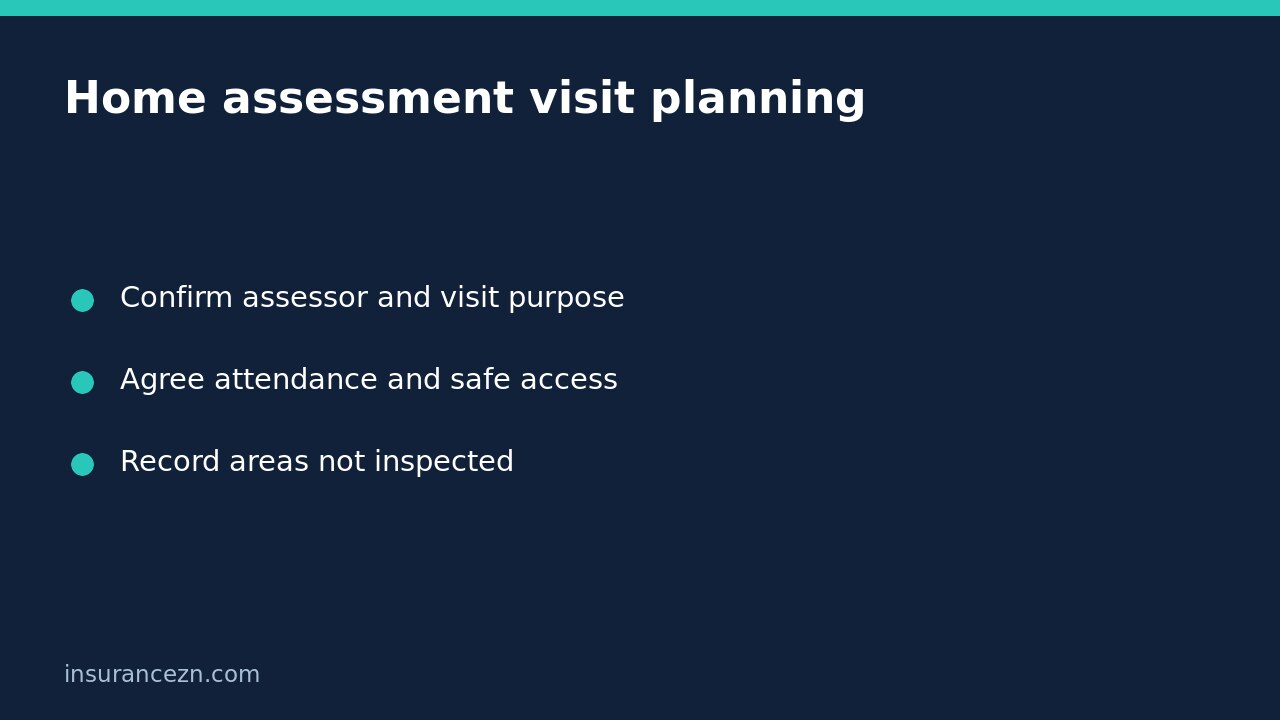

Before taking time off for a home insurance assessment, confirm who is attending, what they intend to inspect and how they will safely enter the property. An appointment time is not a promise that every damaged area will be inspected, that repairs are authorised or that the claim has been accepted.
This checklist is for Australian households arranging an assessment after a claim. It focuses on making the visit workable, rather than challenging the eventual report or choosing a specialist.
Ask about duration and the purpose of the visit
Suncorp’s assessment FAQ says a home assessment appointment may take from 30 minutes to several hours, and the assessor can provide a clearer indication when booking. That is Suncorp’s guidance, not a guaranteed duration across insurers. Ask your own appointed assessor for the expected arrival window and approximate time needed.
Clarify whether the visitor is assessing damage, inspecting a particular cause, measuring for a quote or carrying out urgent temporary work. A plumber attending a leak is not necessarily conducting the whole building assessment. Ask which rooms, external areas and outbuildings are on the visit list, and identify any damaged location that appears missing.
Agree who needs to attend and how access will work
Contact the insurer through a verified channel and check the supplier’s business name and appointment reference. Do not give keys, alarm details or personal documents to an unverified caller simply because they know there has been a storm.
- Ask whether the policyholder must attend or whether another adult can provide access.
- If someone else will attend, confirm what authority the insurer needs and what the person can discuss or approve.
- Explain access constraints such as locked side gates, shared entrances or a separate garage.
- Arrange pets and household routines so they do not obstruct safe entry.
- Confirm any communication or mobility support needed for the appointment.
Providing entry is different from authorising repairs or agreeing to settlement terms. If a neighbour is only opening the gate, say that explicitly. Do not assume their presence makes them your claims representative.
Do not make dangerous areas accessible yourself
Tell the assessor about visible hazards before the visit: standing water near electrical equipment, loose ceilings, unstable structures or suspected contamination. Do not climb onto a roof, enter a damaged ceiling space or move heavy debris merely to help an inspection. Ask what safe access arrangements the appointed professionals require.
Suncorp’s home claims instructions distinguish temporary make-safe work from subsequent assessment and describe possible attendance by multiple trades. They also warn that weather and claim volumes can delay attendance. These are provider-specific instructions, not evidence that your insurer has approved a particular repair or will attend within the same timeframe.
If immediate safety is at risk, use the appropriate emergency response rather than waiting for an assessment appointment. Ask the insurer separately about necessary temporary protection and consent requirements.
Prepare a short inspection route, not a rehearsed conclusion
Create a room-by-room note listing what you observed, when you first noticed it and the supporting photo filename. Keep uncertain causes marked as uncertain. Show the assessor a stain and its location without asserting that it proves a particular insured event.
For example, your note might say: ‘Laundry ceiling stain photographed after the storm; rear shed door will not close; roof space not entered because access may be unsafe.’ Ask whether all three locations fall within this visit. This is a practical example, not a diagnosis or coverage finding.
Have existing photographs and itemised emergency-work invoices available. Avoid unnecessary disposal before inspection; where safety requires removal, preserve evidence as safely as possible. See our cleanup photo checklist for documenting damage before materials disappear.
Close the visit with an unresolved-access list
Before the assessor leaves, ask which areas were inspected, which could not be accessed and who will arrange any return visit. Record a missed area without describing it as excluded or accepted. Request the next contact and any documents you still need to supply.
What if the arrival window no longer works? Contact the booking party promptly and obtain confirmation of the revised appointment; a rescheduling request alone is not a confirmed replacement. Ask about urgent protection separately rather than assuming a later inspection resolves it.
Does the visit mean repairs can start? No. Obtain the insurer’s specific decision and authorised scope before treating assessment attendance as repair approval.
This is general information for Australian readers, not personal financial advice. Cover, consent requirements, limits and exclusions depend on your policy, schedule and applicable PDS. Confirm arrangements with your insurer and follow professional safety advice.