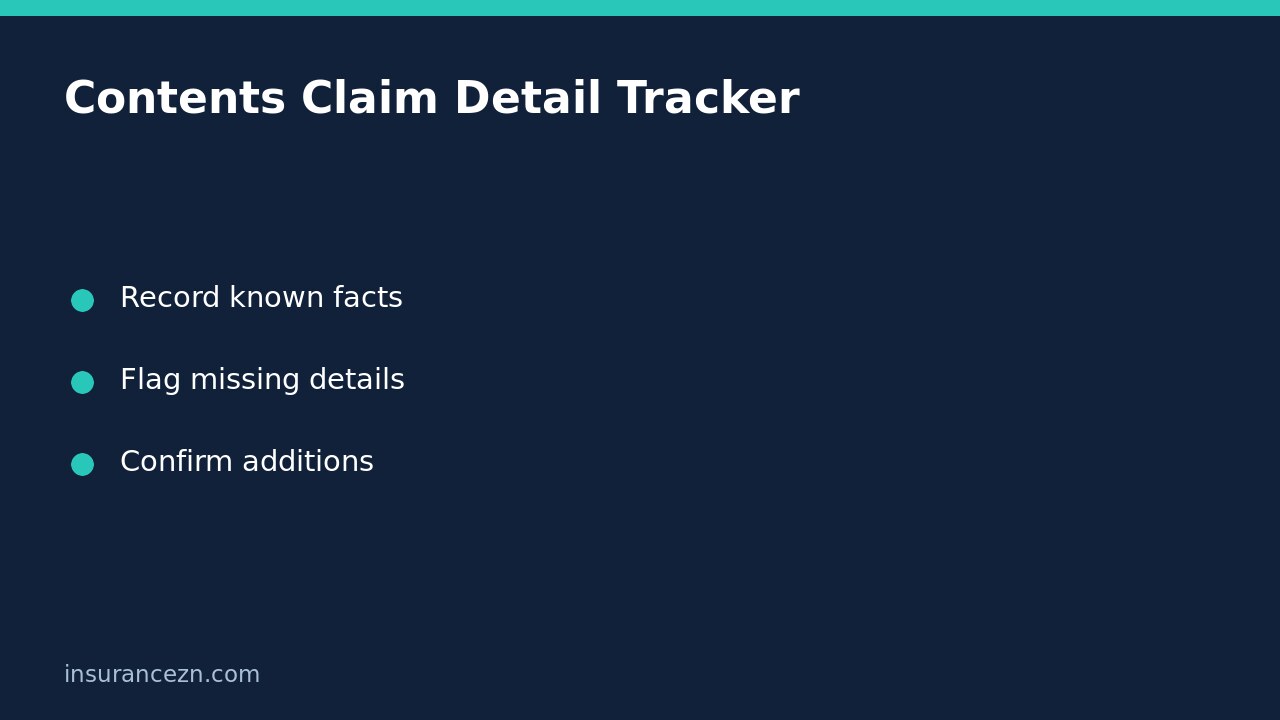

An incomplete list of damaged belongings does not have to become an inaccurate list. Start with what you know, identify what still needs checking and ask your insurer how to add information to the same claim. Do not invent purchase dates, ownership evidence or replacement prices just to fill every box.
AAMI’s home-claim preparation guidance says it is useful to have incident details and details of damaged contents, but that customers can lodge now and add details later. That is a provider-specific pathway, not a guarantee that every insurer or every claim works identically. Check your own policy and submission process.
Build a working list with stable item references
Use one spreadsheet or document as your master record rather than several competing notes. Give each item a reference that will stay the same when you change its description. Suggested columns are item reference, room, description, quantity, what happened, supporting file names, unknown details and next action.
For example, record C-01 as a television in the living room with visible water damage. If the model label is not safely accessible, write ‘model not yet confirmed’ rather than selecting a similar model online. Keep C-01 when the correct model becomes known, so the photographs and correspondence still connect to the same item.
Separate observation from interpretation. ‘Screen does not turn on’ describes what you noticed; ‘irreparable’ may require an assessment. Do not put yourself at risk or energise wet electrical equipment to gather information. Ask how the insurer wants an inspection arranged.
Use a missing-information register instead of estimates presented as facts
Next to each uncertain entry, record the exact gap and how you might resolve it. A missing purchase date could be checked against an order history; an uncertain quantity could be checked against existing photographs. These are possible research routes, not proof that the insurer must accept any particular evidence.
- Label a date as approximate when it is approximate.
- Distinguish the original price, any current advertised price and an insurer’s valuation.
- Record whether an item belongs to you, another household member or someone else.
- Keep an unconfirmed item separate from items already supported by records.
If the portal requires a value you cannot substantiate, ask the insurer how to proceed. Do not enter a token amount without explaining it, or treat a retailer’s current price as an agreed settlement. Coverage, depreciation, replacement terms, sublimits and excesses depend on the contract and assessment.
Submit additions as traceable changes
Before sending the first version, save a dated copy. Ask which channel to use for later information and whether an amended list should replace the old file or accompany it. Include the claim reference and a short change note with every revision.
A useful note might say: ‘Version two adds the model number for C-01 and introduces C-07, a damaged floor lamp found during the room inventory. It does not withdraw the other items.’ Avoid silently deleting rows. If you discover an error, identify the previous entry, the correction and the reason.
In this hypothetical example, discovering a lamp later does not establish that it is covered or that the claim value will increase. The purpose of the register is to make the evidence understandable, not to determine the outcome.
Check receipt and outstanding requirements
Uploading a file is not the same as confirming it reached the correct claim. Save the submission confirmation where available and ask the insurer to identify any outstanding information. A recorded document is also not an acceptance of liability or an approval to pay.
Ask: ‘Have you received version two, which version are you assessing, and what do you still require for C-01 and C-07?’ Keep the answer with your master list. If you are also organising photographs before cleanup, use our evidence and disposal checklist; listing an item is not permission to discard it.
Quick questions before you send
Should I wait until every detail is known? Ask your insurer about notification requirements and how to lodge incomplete information. Do not assume AAMI’s published process applies to your product.
Does adding an item guarantee payment? No. An addition is information for assessment. Ask for the coverage decision and any reasons separately.
What should I keep? Retain each submitted version, its supporting files and confirmation of the next step. Send sensitive records only through a verified insurer channel.
Sources and important limitations
Read AAMI’s home-claim preparation guidance and its claims overview. These explain AAMI’s process and do not independently endorse any insurer.
This is general information for Australian readers, not personal financial advice. Your policy, Product Disclosure Statement (PDS), exclusions, limits and insurer’s assessment govern cover and payment. Seek advice appropriate to your circumstances where needed.