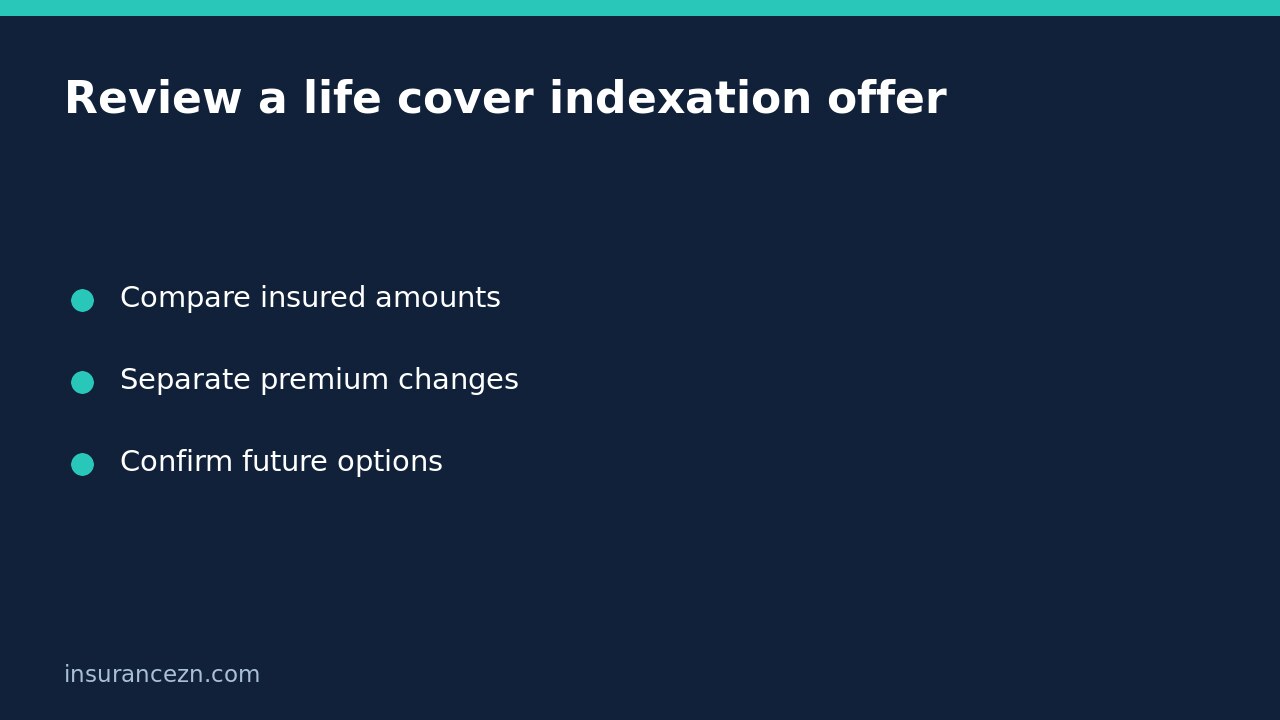

Before declining benefit indexation on an Australian life insurance policy, compare the proposed sum insured with the amount that would remain without the increase. Then ask what happens to future indexation offers and whether restoring cover later requires a new application. A smaller premium increase today and the same protection tomorrow are not necessarily the same decision.
This is general information for Australian readers, not personal financial advice. Your policy schedule, Product Disclosure Statement (PDS), endorsements and insurer-confirmed terms determine the available options and claim conditions. This article does not recommend a particular insurer or level of cover.
Identify what the offer actually changes
Benefit indexation is a mechanism for increasing the insured amount over time. Its purpose is to help address the erosion of purchasing power, rather than to promise that the benefit will always match your household needs. In its life insurance FAQ, AIA describes benefit indexation as an automatic sum-insured increase intended to help with inflation. AIA also describes choices about including indexation and removing it from a subsequent policy anniversary. Those are provider-specific explanations, not a rule that every Australian policy has identical options.
Find the actual indexation paragraph in your own documents. Note which benefits it affects, the applicable increase method, any maximums, and the response deadline shown on the notice. Do not assume that death cover, disability cover and income protection all change together merely because they appear in one renewal package.
Separate the cover increase from the premium increase
Place last year’s schedule beside the anniversary offer and record three separate details: the current insured amount, the proposed insured amount, and the proposed premium. Ask the insurer for the premium that would apply if you retained the current amount instead. That comparison is more useful than assuming the whole premium rise is caused by indexation.
The AIA FAQ lists several possible premium factors, including age, cover type and amount, smoking status, discounts and benefit indexation. It does not establish the cause of a change to your own policy. Ask for a written explanation of the relevant factors rather than trying to reverse-engineer a quote from the percentage change alone.
Consider a fictional household whose anniversary letter offers increased death cover while its monthly premium also rises. Their first question should be: what would the premium be at the unchanged sum insured? Their second should be: would that unchanged sum still address the debts, dependants and essential costs they want covered? This example illustrates a comparison process, not a suggested cover amount or forecast price.
Ask whether declining once affects later choices
Do not treat declining one offer, permanently removing indexation and reducing existing cover as interchangeable instructions. Ask the insurer to explain precisely which action it will record. A useful message is: ‘If I decline this anniversary increase, will indexation be offered next year, and under what conditions could I restore the forgone increase? Please identify the relevant policy clause.’
Also ask whether a later voluntary increase requires health or lifestyle questions, evidence, age eligibility or underwriting. AIA says increasing cover under its described arrangements requires new health and lifestyle questions. That is a reason to check the applicable rules, not evidence that every indexation decision triggers underwriting or that all future increases will be accepted.
Do not cancel existing insurance while investigating alternatives. If you are considering replacement cover, obtain advice about acceptance, exclusions and commencement before making changes that could leave a gap.
Use a short anniversary review record
- Save the dated offer, current schedule and policy wording together.
- Record the insured amount with and without the offered indexation.
- Request a comparable premium for unchanged cover.
- Check whether your debts, dependants or available savings have changed.
- Ask how declining affects next year’s offer and later increases.
- Keep written confirmation of the option selected and its effective date.
If the documents use different company names, first reconcile the issuer using our explanation of matching a life policy’s legal insurer to APRA. Direct the indexation question to the organisation administering your actual policy, rather than assuming a familiar brand name identifies the relevant contract.
Common questions before responding
Does indexation guarantee an adequate benefit? No. An automatic increase does not assess every household commitment or establish what amount is appropriate for you.
Will declining it keep my premium unchanged? Not necessarily. Other pricing factors may change. Ask for the insurer’s specific unchanged-cover quote and explanation.
Can I simply add the increase back later? Do not assume so. Confirm the future-increase rules before responding. Where the affordability and protection trade-off is significant, consider licensed personal financial advice rather than treating an anniversary checkbox as a purely administrative choice.