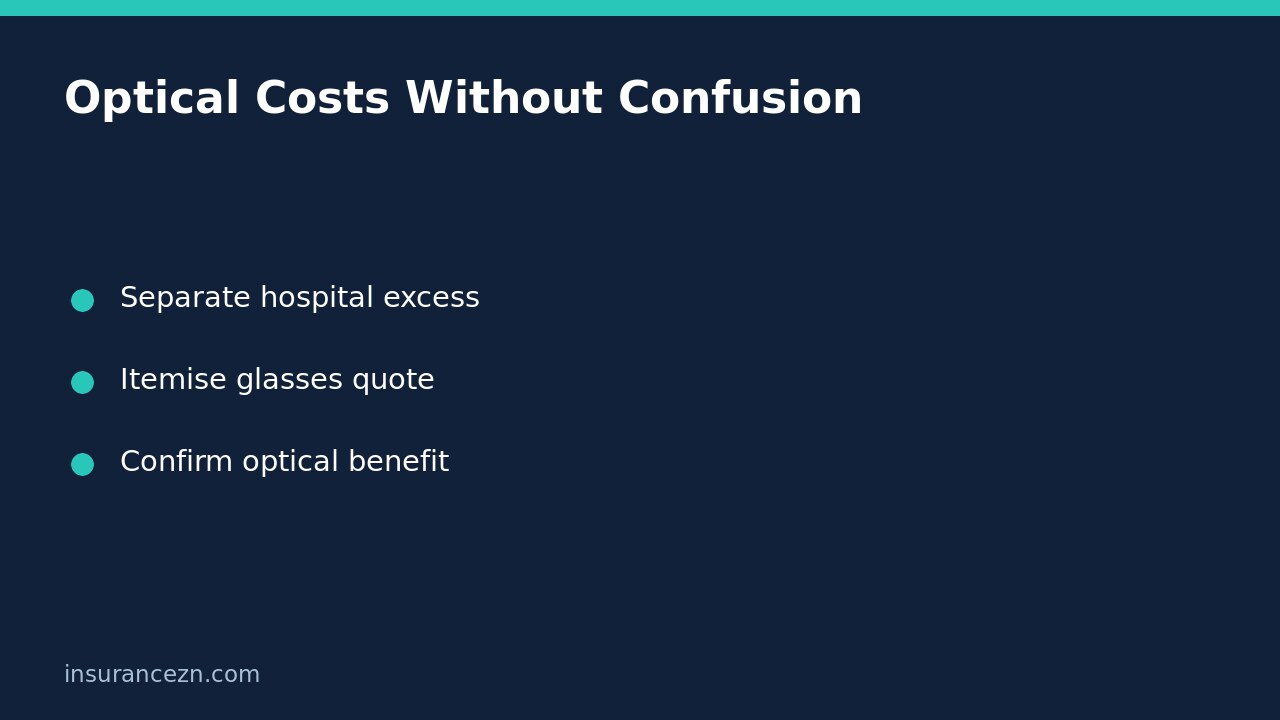

A zero-excess hospital policy does not make prescription glasses free. Hospital excess and the amount left to pay on an optical extras claim describe different costs. Before buying glasses, obtain an itemised retail quote and ask your insurer what benefit your actual extras policy would pay for that purchase.
This is general information for Australian readers, not personal financial advice. Benefits and costs depend on your policy, applicable PDS or fund rules, limits, exclusions and claim assessment. The following checks are not a recommendation to buy, cancel or change cover.
Separate three different amounts
Your premium is what you pay to maintain insurance. Your hospital excess is a contribution toward eligible hospital treatment under the hospital policy. Your optical gap is the amount you pay for an optical purchase after any applicable benefit or discounts. Paying premiums, or choosing a lower hospital excess, does not by itself settle an optical bill.
PrivateHealth.gov.au explains hospital excess and co-payments as contributions toward hospital treatment. Its separate general treatments guide describes optical extras as including prescription lenses, spectacle frames and contact lenses. It also notes that insurers do not pay benefits for optometrist consultations, as these are generally eligible for Medicare benefits. Keep the consultation and the purchased products separate when asking who pays.
Turn the glasses package into an itemised quote
Ask the optical retailer to show what you are buying rather than relying only on a package name. Identify the frame, prescription lenses and optional additions. Ask whether coatings, lens thinning or other upgrades are included in the advertised price and whether removing an optional item changes that price.
Record any retail discount separately from an insurance benefit. A discount reduces the selling price; an insurer benefit is assessed under your policy. Confirm whether a quoted promotional price assumes that a particular fund pays a benefit, whether there are eligible-product restrictions and whether the same discount is available without making a claim.
Do not assume that a consultation advertised as bulk billed makes every service or product at that appointment free. Ask the practice about the consultation charge and Medicare eligibility, then ask separately about glasses. Clinical recommendations should come from the treating professional, not from an insurance allowance or a promotional deadline.
Get a benefit estimate for the actual purchase
Send the itemised quote to your insurer or ask the retailer to obtain a benefit estimate using your current membership details. Confirm which person on the membership is claiming, the proposed purchase date and the provider. Ask about waiting periods, remaining optical benefits, product eligibility and whether previous purchases affect the amount available.
- Does the quoted benefit apply to these exact frames and lenses?
- Are any optional additions outside the benefit calculation?
- Is the displayed annual limit an individual limit or subject to other conditions?
- What benefit remains after claims already processed or pending?
- Which date determines the benefit year for this order?
- If the order changes, must the benefit be estimated again?
These are policy-specific questions, not a claim that every fund uses identical limits or date rules. Ask for the basis of the estimate and keep any reference number. A headline limit is not a promise to reimburse every dollar of a purchase up to that limit.
Budget from the confirmed gap, not the excess
Use a short worksheet with separate lines for the final retail price after discounts, the estimated eligible insurance benefit, the amount payable by you, and any deposit already paid. Check that a deposit is credited against the same final bill. Do not subtract it twice or confuse it with an insurer payment.
For example, imagine a customer selecting a frame-and-lens package and then adding an optional lens upgrade. The original benefit estimate may no longer describe the final order. The right next step is to confirm the revised price and benefit before authorising the upgrade, not to assume that having no hospital excess covers the difference. This illustration makes no claim about actual product prices or fund benefits.
Keep your premium budget separate from this purchase worksheet. A benefit can reduce a particular bill without proving that the whole policy offers good value for your household. Conversely, one optical gap alone does not establish that cover should be cancelled.
Quick questions before paying
Can changing the hospital excess remove this optical gap? Do not assume so. Ask which policy component would change and request a separate extras benefit explanation. For the hospital side of the distinction, see why hospital excess is not the total hospital bill.
What if the retailer says there is no gap? Ask exactly which products, member eligibility and benefit availability that offer assumes. Obtain the final amount payable before agreeing to extras.
What should I keep? Save the itemised quote, benefit estimate, promotion conditions, receipt and claim statement. If the final benefit differs, compare the actual purchase and membership details with the estimate, then ask the insurer to explain the difference.