
If you have an age-based discount on Australian private hospital insurance, turning 41 can change the discount even though you have not changed products. The important budget question is not simply whether your premium increased. Ask what discount was recorded before the change, what will apply afterwards, and when the revised payment will take effect.
This is general information for Australian readers, not personal financial advice. Your policy, applicable PDS or fund rules and written premium quotation determine your particular position. Discount eligibility does not establish treatment eligibility or guarantee claim payment.
Understand what actually phases out
The Australian Government’s age-based discount explanation says insurers can offer eligible younger adults discounts on hospital premiums. The discount is optional for insurers to offer; do not assume everyone who purchased health insurance young has one.
The official page explains that an existing discount starts reducing at age 41 and reduces further each year until it reaches zero. Its example shows a person with a 10 per cent discount moving to 8 per cent when they turn 41. This means a reduction of two percentage points, not a reduction of two per cent of the old discount.
For an illustrative individual discount that is 10 per cent before age 41, the stated progression gives 8 per cent at 41, 6 per cent at 42 and zero at 45. This describes the discount percentage only. It is not a forecast of premiums, a quotation or a guarantee that every reader starts with that discount.
Find your recorded starting position
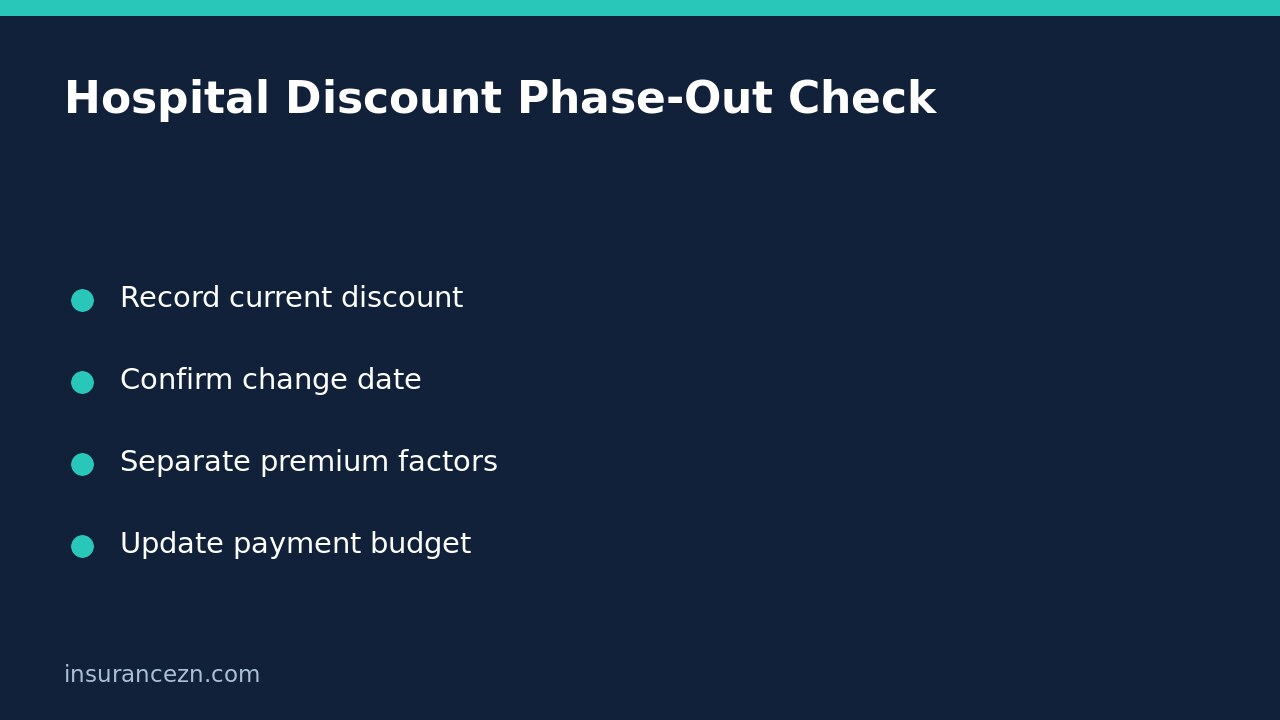
Before attempting to explain a changed direct debit, collect your current premium notice, previous notice and any membership document showing an age-based discount. Record the product name, hospital component, membership type, discount percentage and effective date. Keep extras separate: the government explanation describes a hospital-premium discount, not a blanket discount on every component of a combined product.
Ask the fund to confirm the current recorded percentage if the notice gives only a final payment amount. Do not reconstruct it from the payment alone, because other adjustments may also affect that figure. A longstanding membership does not by itself prove the maximum discount was recorded.
Request a before-and-after breakdown
A useful enquiry is: Please show my hospital premium immediately before and after the age-based discount change, identify each discount percentage and explain the effective date and resulting payment schedule. This is a request for information only; I am not authorising a product change.
Then ask the fund to separate the age-discount movement from any other premium changes. Relevant questions include whether the underlying product price changed, whether another discount ended, and whether the quoted payment includes extras or a changed membership arrangement. Ask about personal rebate or loading adjustments where relevant rather than assuming they caused the difference.
Do not assume a two-percentage-point discount reduction produces a two per cent increase in the final bill. The comparison base matters, and the final payment may contain components to which this discount does not apply. Use the fund’s actual breakdown instead of applying one percentage to the entire combined premium.
Check couple and family membership carefully
The official page says that on a couple or family policy, the discount is calculated as the average of the individual discounts of the two adults. Consequently, one adult reaching the phase-out age needs a membership-level explanation, not an assumption that the entire household loses the same percentage.
Ask which individual discount is recorded for each adult and what average applies before and after the change. If you are also adding a partner, changing products or changing insurers, request separate explanations for those changes. The government page says transfer treatment is at the insurer’s discretion, so a current discount should not be assumed to carry to a different product unchanged.
Update payments without making an accidental coverage change
Once the fund confirms the revised payment and date, check that your payment account can accommodate it. If the increase is difficult to manage, ask for product comparisons that preserve the treatment categories you need before authorising any reduction in cover or increase in excess. A cheaper quote is not an equivalent quote if the benefits change.
For a complementary cost check, read why hospital excess is not the total hospital bill. A lower recurring premium and an affordable treatment-time bill are separate budgeting questions.
Short FAQ
Will my discount stay indefinitely if I keep paying? The official age-based discount framework includes phase-out from age 41. Confirm your recorded discount and the fund’s implementation date.
Does the phase-out change what treatment is covered? A discount change is a pricing matter. Ask separately whether any product or benefit change accompanies the notice; do not infer one from price alone.
Should I cancel before the increase? Cancellation is a different decision with coverage consequences. First obtain the written breakdown and compare alternatives without authorising a change merely by requesting a quote.