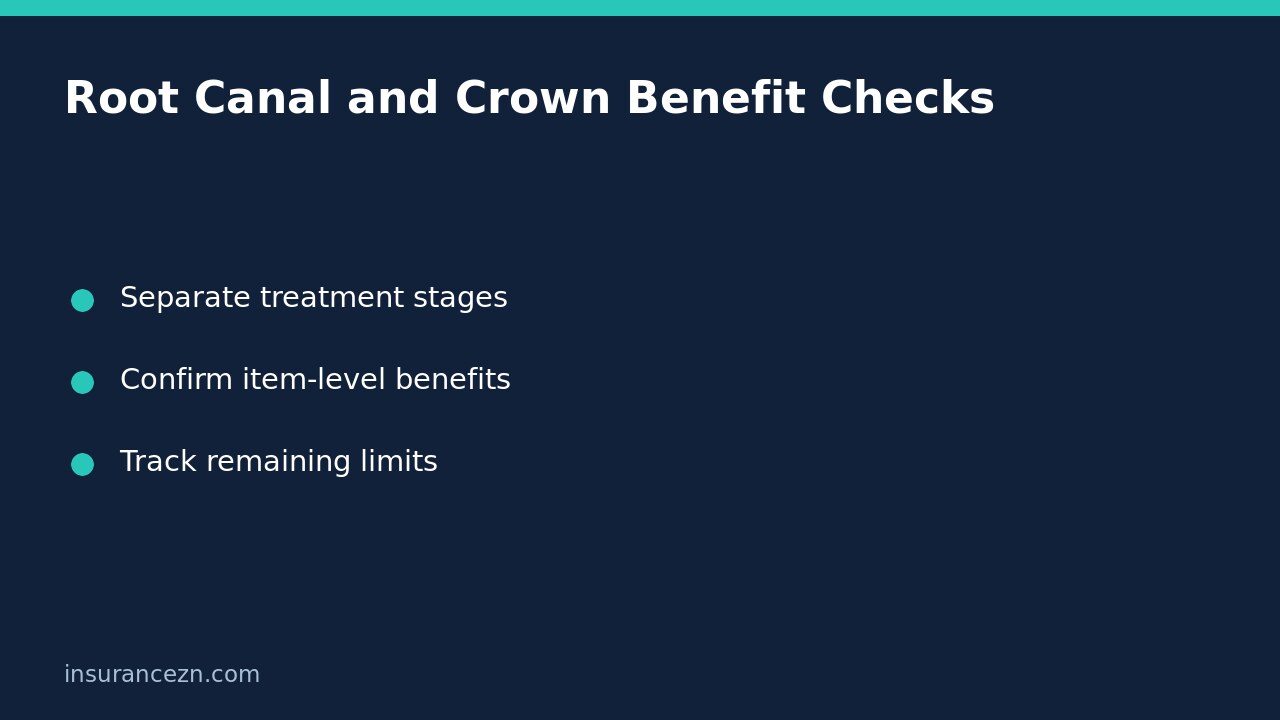

If your dentist proposes root canal treatment followed by a crown, ask for the treatment stages to be itemised before requesting an extras estimate. A benefit quoted for the root canal does not establish a benefit for the crown, and a first-stage estimate may not cover the entire planned course. Confirm the charges, proposed dates and fund assessment for each component.
This is general information for Australian readers, not personal financial advice. Benefits depend on your policy, applicable PDS or fund rules, waiting periods, exclusions and remaining entitlements. This is not dental advice; clinical decisions belong with your treating dental professionals. Do not delay urgent treatment while checking insurance.
Separate the clinical plan from the insurance categories
The government’s general treatments guide describes endodontic services as specialised treatment relating to dental pulp, including root canal treatment. It also lists crowns under major dental and warns that classification of particular dental items depends on each insurer’s rules.
These descriptions help explain why one broad question about dental cover is insufficient. They do not establish your product’s benefit classification or payment amount. Ask the dentist to identify the actual item numbers and descriptions, then ask the fund where each belongs. Do not change an item description yourself to obtain a different benefit.
Build a staged treatment record
Ask whether the current estimate includes the complete proposed treatment or only the work that practice will perform. If a specialist performs one stage and your usual dentist performs another, obtain both estimates. Request clarification about anything described as provisional, optional or dependent on later findings.
- Record the tooth identifier and the proposed work, as supplied by the clinician.
- List each item number, provider and practice location separately.
- Record the fee and anticipated service date for each stage.
- Identify diagnostic work, temporary restorations and later restorative work if they are separately quoted.
- Mark uncertain future work as unconfirmed rather than assuming it is included.
A written clinical estimate is not an insurer approval. Its purpose here is to give the fund a specific service list to assess and to avoid budgeting from a single incomplete headline price.
Request benefits for the whole sequence
Send the same complete itemised plan to your insurer. Ask for an estimated benefit against each item, confirmation of provider recognition and any applicable waiting period. If two practices are involved, identify both; recognition or an estimate for one provider does not answer the question for the other.
Ask whether root canal and crown items use separate limits or draw on a shared dental pool. Request the remaining available balance after claims already paid, and ask how the proposed sequence would use that balance. Do not apply the starting annual maximum separately to every stage.
PrivateHealth.gov.au explains that extras benefits can have per-service, annual or lifetime limits and that some services are not covered. This overview supports checking your actual rules; it does not supply a personal benefit amount.
Use dates without assuming a fresh allowance
If treatment may cross a benefit-year boundary, ask the fund which service dates and claiming rules determine the assessment. Explain the proposed appointment sequence rather than simply asking whether your annual limit resets. Ask whether any multi-stage treatment provisions affect payment and whether a previously paid benefit reduces what remains.
Do not reschedule clinically necessary work merely to chase an assumed benefit. A new calendar year does not itself prove that every item becomes payable, and changing products does not guarantee restored limits or waived waits. Ask for a revised estimate if the dates, provider, item numbers or cover change.
Check the gap at each payment point
Create a simple worksheet with columns for stage, quoted charge, estimated benefit, expected personal payment and due date. Keep an unconfirmed benefit labelled unconfirmed; neither full reimbursement nor a zero benefit should be silently assumed. Ask the practice when deposits and final payments are due, separately from asking the insurer when a benefit might be paid.
For the broader difference between comparison material and personal estimates, see why PHIS example benefits are not your own claim estimate. Keep the fund response with the exact treatment-plan version it assessed.
Does an estimate guarantee the final benefit?
No. The final assessment depends on services actually delivered, correct claim details and the applicable membership rules. Compare the completed invoice and assessment with the estimate. If a stage was classified differently, request an explanation using its actual item code and tooth details. An amended classification may explain the result without increasing payment. Preserve both versions of any corrected assessment rather than assuming the original estimate remains valid.