
A bag can feel safely nearby without meeting the supervision requirements in your travel insurance. Before taking expensive belongings overseas, read how your policy defines unattended property and check that definition against the places you actually expect to leave your bags. A baggage benefit limit is not a promise that every theft will be covered.
This is general information for Australian readers, not personal financial advice. Cover depends on the policy wording, Product Disclosure Statement (PDS), exclusions, limits and your circumstances. Written answers help clarify the policy but do not replace its terms or guarantee a claim.
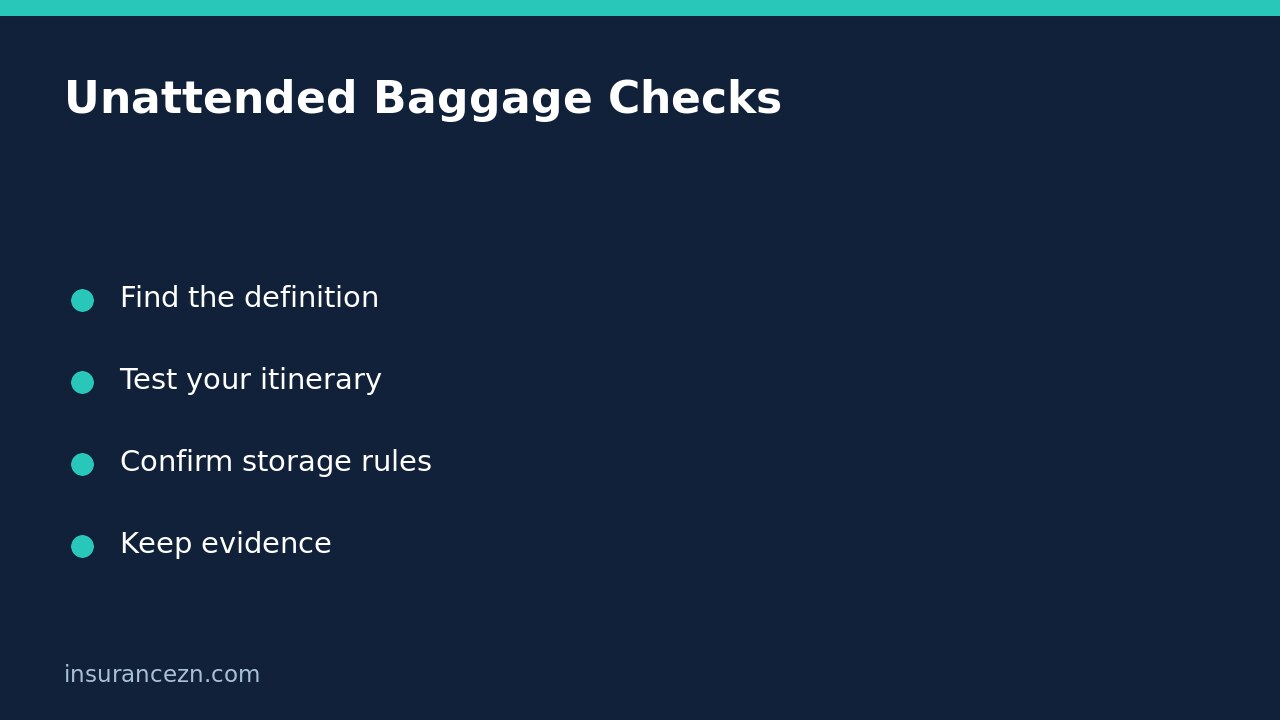
Start with the definition, not the headline benefit
The Australian Government’s Smartraveller travel insurance guidance says travel insurance will rarely cover theft of items left unattended. It also recommends reading the PDS for definitions, inclusions, exclusions and claims requirements. That makes the definition a practical packing question, not just a technical detail after a loss.
Search your PDS for unattended, reasonable care, supervision, baggage, valuables and vehicle. Read each definition alongside the baggage benefit and general exclusions. Some words may be defined in a separate section. Do not assume that a familiar everyday meaning is the meaning your insurer uses.
Write down the document version and page references. If you cannot connect the definition to the relevant exclusion, ask the insurer to identify both clauses in writing. A sales summary alone may omit a condition that matters to your itinerary.
Run three realistic scenarios past the wording
Use specific situations rather than asking only whether your luggage is insured. These are hypothetical checks, not statements about what a particular policy covers:
- A cafe stop: Your backpack is on a chair while you collect an order. Does the policy require you to see it, remain close enough to intervene, or satisfy another supervision test?
- A transfer day: Your suitcase is stored at a hotel reception after checkout. Does the wording distinguish property accepted into formal custody from a bag left in an open lobby?
- A rental-car break: You leave luggage in the vehicle while sightseeing. Is there a separate vehicle exclusion, storage condition or restriction for valuables?
Do not infer that locking a bag, being nearby or travelling with a companion automatically satisfies the policy. Describe where the item is, who is responsible for it and how it is secured. Ask the insurer which condition applies to that exact arrangement.
Keep storage conditions separate from dollar limits
A higher baggage limit cannot by itself solve an excluded storage situation. Review eligibility first, then check the overall baggage limit, individual item limits, any special valuables limits and the excess. Smartraveller notes that policies often limit each item’s value and that an excess can be greater than the value of the belongings being taken.
For example, a traveller carrying a laptop should check both whether the planned storage is acceptable and how that laptop would be valued under the policy. Buying an increased item limit may address one issue without changing an unattended-property exclusion. Ask whether an optional upgrade changes the relevant condition, rather than assuming it does.
If the planned arrangement is unclear, consider changing the storage plan or taking fewer valuables. The aim is to avoid relying on an unresolved interpretation while overseas, not to find a clever label for an unsafe arrangement.
Prepare evidence without assuming it creates cover
Before departure, save purchase records, device serial numbers and photographs of important belongings. Keep policy documents and insurer contact details accessible separately from the bag. Where an operator formally takes custody of luggage, retain the receipt or ticket.
After a loss, prioritise personal safety. Record the location, timing, storage arrangements and who witnessed the incident while details are fresh. Contact the insurer for the policy’s reporting and evidence requirements; these may involve police or transport-provider reports. Do not invent proof or describe a bag as supervised simply because that seems more favourable.
For organising the wider paperwork, see our policy records review checklist, then adapt it to the specific travel documents and receipts needed for your journey.
Quick questions before departure
Does travelling with someone automatically count as supervision? Do not assume so. Check who was actually watching the belongings and what the definition requires.
Does a baggage receipt guarantee payment? No. It can help establish custody and timing, but the policy still governs coverage.
What should I save from an insurer conversation? Keep the scenario you described, the response, the date and the clauses identified. If the answer remains vague, seek clarification before relying on it. Repeat the check if your itinerary or policy changes.