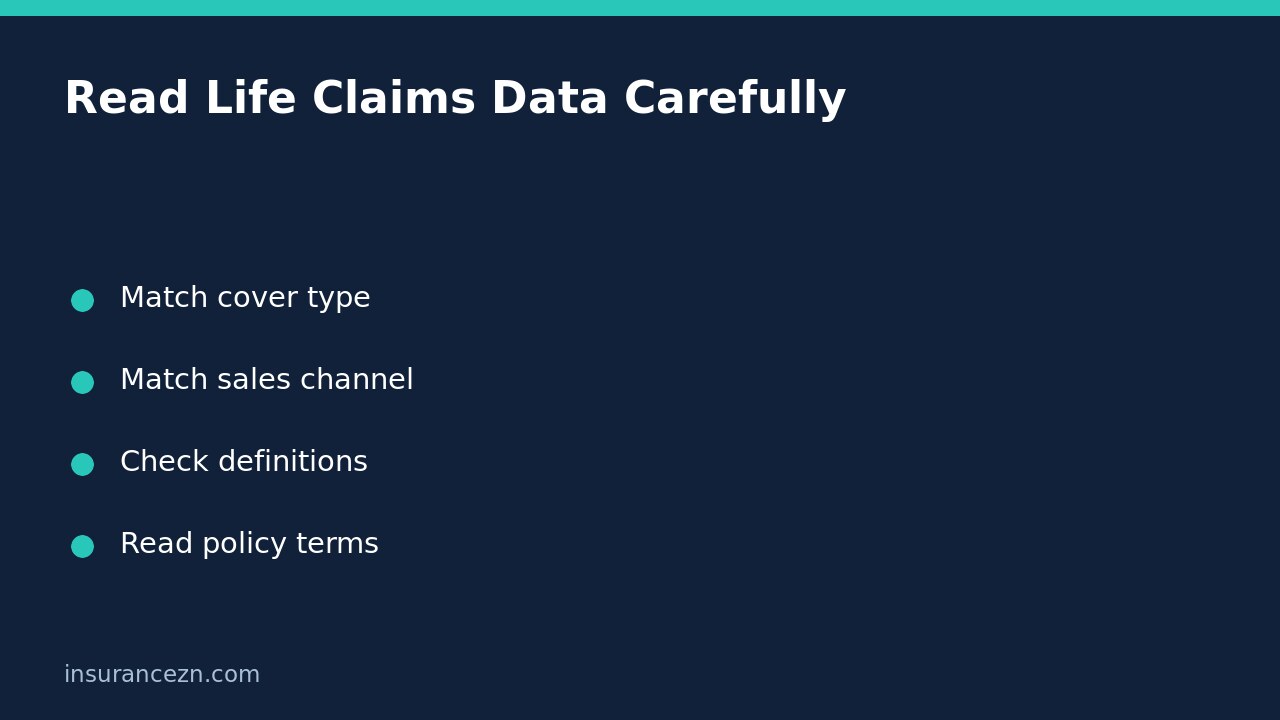

Australian life insurance claims statistics can help you ask better questions, but they cannot tell you whether your own future claim will be paid. Before comparing insurers, match the cover type, distribution channel and reporting period, then read the definitions behind the figures. A headline percentage without that context can create false confidence.
APRA publishes industry and insurer-level claims and disputes information. Use it as one part of your research alongside the actual policy wording, cost, exclusions and suitability for your circumstances, not as an automatic ranking of the best insurer.
Begin with the reporting period and supporting notes
Open the APRA life insurance claims and disputes publication page. Check the period covered by the workbook, rather than assuming its publication date describes when the underlying claims happened. Save the edition you use and record the table or worksheet name so you can reproduce your comparison later.
Also open the supporting explanatory notes and glossary. The linked document is dated December 2019 and explains the publication definitions; check for updated instructions when using later data. This article explains interpretation and does not reproduce insurer percentages or recommend a provider.
Compare the same benefit and sales channel
Death cover, total and permanent disability (TPD), trauma and disability income insurance address different events and use different policy definitions. An insurer can therefore appear in several separate categories. A death-cover result is not a substitute for investigating a TPD product.
APRA also distinguishes distribution channels, including individual advised, individual non-advised and group super. The glossary describes group insurance as cover purchased by an employer or superannuation trustee for eligible members under a group policy. These categories are not interchangeable with an individual policy purchased directly.
Create a comparison sheet with one row for each like-for-like combination. Record the insurer, benefit type, channel, reporting period and metric definition. If one of those fields differs, do not silently combine the results into a league table.
Understand what the measures actually count
APRA defines a finalised claim as one where a final decision has been made and communicated. Undetermined claims remain open for assessment. A result concerning finalised claims should not be described as an outcome for every person who contacted the insurer during the period.
The glossary also gives specific meanings to admitted and declined claims. Its admitted category includes full ex-gratia admissions. Its declined category includes some other payments or settlements where the full claim has not been admitted. That means everyday assumptions about the word “declined” can differ from the statistical classification. Consult the definitions before interpreting a cell as proof that no money ever changed hands.
Another potential trap is the claims paid ratio: the glossary defines this using dollars paid relative to annual premiums receivable, not simply the proportion of claim applications approved. Do not relabel a dollar-based ratio as your personal chance of success.
A practical comparison without inventing a winner
Suppose you are researching TPD cover through super. You find a death-cover result for individual advised business and a TPD result for group super. Comparing those two figures directly would mix both the insured event and the distribution channel.
Instead, find the same TPD/group-super category for the providers you are investigating, within the same edition. Record any missing values. APRA explains that some small-sample data is masked to protect statistical credibility, and some combinations may be unavailable. A masked cell is not zero claims and is not evidence of good or bad performance.
Next, turn the research into policy questions: What disability definition applies? What exclusions or eligibility conditions matter? What evidence may be requested? Ask the fund or insurer to identify the relevant contract sections. Historical outcomes cannot replace those answers or guarantee an individual result.
Use duration data as context, not a deadline
The glossary defines claim duration as the period from receipt to finalisation. It describes estimated average duration using grouped time buckets. An estimate derived from groups is not a promise that your claim will finish within that time.
Claim complexity and required evidence can differ. If you are already claiming, request an explanation of outstanding information and the next steps rather than treating an industry average as a contractual service commitment. Our family life insurance claim-readiness guide can help organise supporting records.
Quick comparison checklist and FAQ
- Same reporting period, benefit type and channel?
- Metric definition read and recorded?
- Masked, missing and unfinished outcomes identified?
- Relevant PDS and policy definitions checked separately?
Does a stronger historical result guarantee payment? No. Your policy terms and claim circumstances still matter.
Should I replace cover because of one table? A table alone cannot establish that replacement suits you. Consider professional advice and the implications of new underwriting or changed terms before cancelling existing cover.
General information: This is general information for Australian readers, not personal financial advice. Benefits depend on the relevant policy, PDS, schedule, eligibility rules, exclusions and claim circumstances. Seek advice appropriate to your situation.