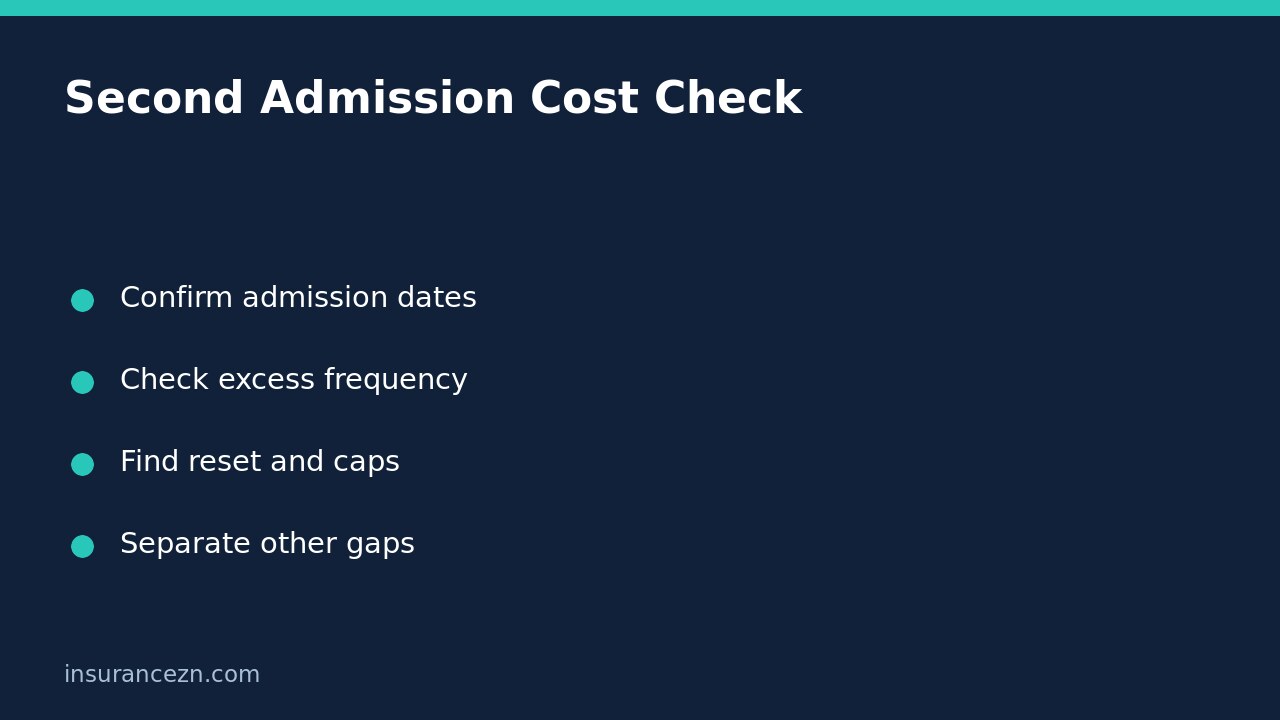

Paying a private hospital excess once does not automatically mean your next admission is excess-free. Before a second planned admission, ask your health insurer whether another excess applies, which period any cap covers and whether the calculation is per person or shared across the policy. Then obtain a separate estimate for other hospital and medical costs.
This is general information for Australian readers, not personal financial advice. Benefits and out-of-pocket costs depend on your policy, applicable policy documents or PDS, eligibility, exclusions, waiting periods and treatment details. No example below is an insurer quote or a guarantee of cover.
Find the frequency rule before using an annual budget
The Australian Government website PrivateHealth.gov.au explains hospital out-of-pocket costs. It states that an excess is a set contribution towards hospital treatment and that people on the policy may need to pay it every time they go to hospital, or less often, depending on the policy.
That distinction matters when you have staged treatment, a later unrelated procedure or another family member needing hospital care. Your previous payment is relevant evidence, but it does not establish the rule for the next admission. Find the excess wording in your current cover documents rather than relying only on a remembered sales conversation.
Record the amount, frequency and any exceptions as separate fields. If your documents use an annual limit, ask what annual means for that specific benefit. Do not assume a calendar-year reset, membership anniversary or financial-year reset without confirmation.
Build a short admission timeline
Prepare a simple timeline for the insurer. Include the patient name, earlier admission and discharge dates, hospital, amount paid and the proposed next admission date. Add the proposed procedure and expected Medicare Benefits Schedule (MBS) item numbers if available. Keep the invoice and receipt from the earlier stay.
Ask these questions using that timeline:
- Does the proposed stay trigger a new excess under my current product?
- Does a maximum apply per person, per policy or through another calculation?
- When does the relevant counting period begin and reset?
- How are a readmission, transfer or same-day procedure treated under this wording?
- Will any recent policy change affect the calculation or eligibility?
These are questions to resolve, not suggestions that all policies provide caps or special readmission treatment. Ask for the relevant clause and a written estimate. If the insurer needs more information, find out exactly what is missing before treating the estimate as reliable.
Work through a date-boundary example without inventing a price
Imagine a patient who has one planned admission near the end of a calendar year and another early the following year. They have already paid the excess shown on the first hospital invoice. Their question is whether the second stay falls within the same excess-counting period.
The correct next step is not to assume that the earlier payment carries forward. Ask the insurer to apply the actual reset rule to both dates and explain any cap already used. Equally, do not assume January automatically starts a new excess period: that also requires the product wording.
If the treatment date changes, request an updated estimate. Confirm financial arrangements with the clinical and hospital teams, but do not delay medically necessary care solely to fit an insurance calculation. Treatment timing is a clinical decision to discuss with the treating practitioner.
Separate the excess from daily co-payments and doctor gaps
PrivateHealth.gov.au distinguishes an excess from a co-payment, which is a set contribution for each day in hospital. It also explains that hospital agreement arrangements do not remove an agreed excess or co-payment. Ask whether both contributions apply and whether any daily charge has its own limit.
Medical fees require a separate check. A surgeon, anaesthetist or other practitioner may have charges not fully met by Medicare and your insurer. The official guidance recommends obtaining MBS item numbers and preferably written fee estimates, including estimates from other doctors involved in the admission. Confirm whether each practitioner will use the insurer’s gap arrangement for this particular treatment.
For planning discussions with family members, our family coverage decision worksheet can help organise questions. Keep the current insurer and provider estimates as the basis for actual costs.
Final checklist and common questions
Does an agreement hospital mean no excess? Not necessarily. Check the agreed excess and co-payment separately from other hospital charges.
Can I rely on last time’s invoice? Use it to document what you paid, then confirm how that payment counts towards the next stay under your current policy.
What should I have before admission? Keep the insurer’s excess calculation, reset-period explanation, hospital estimate and separate practitioner estimates together. Note the assumptions and dates on each. If one document disagrees with another, ask the relevant parties to reconcile it before you rely on the total.