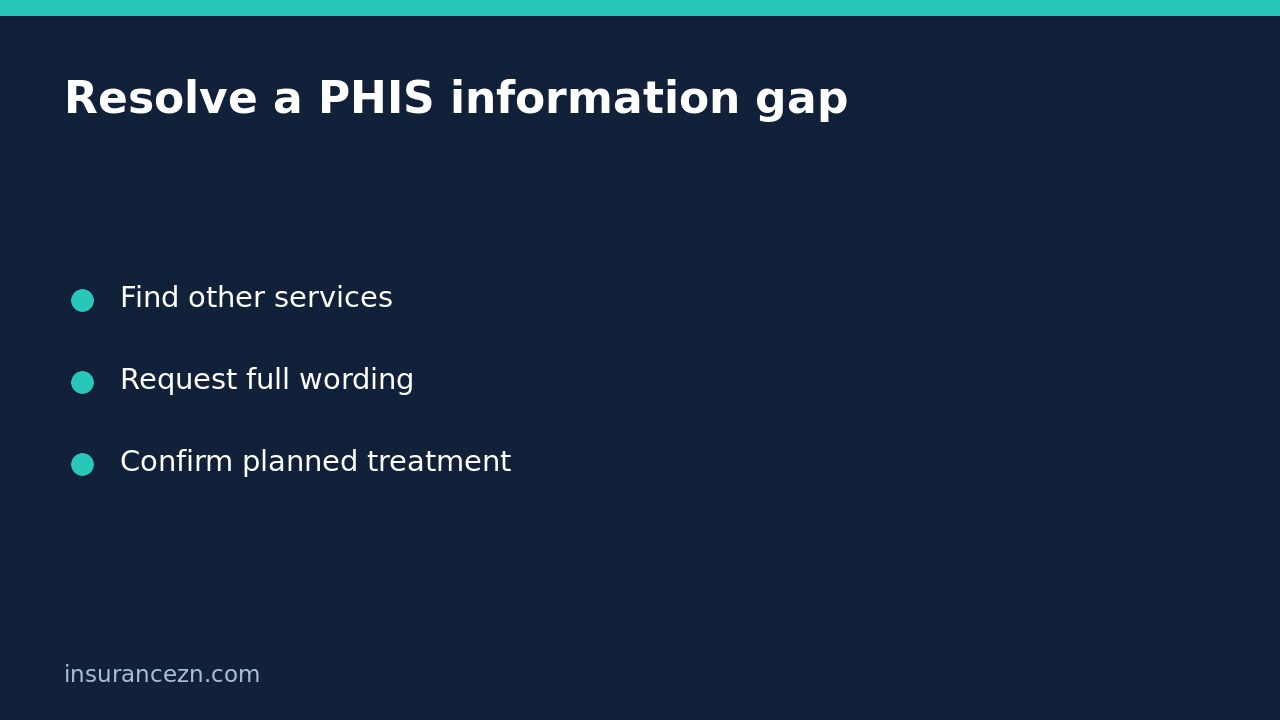

If an Australian Private Health Information Statement (PHIS) includes ‘Other services (see insurer for detail)’, do not treat that line as a harmless catch-all. Ask the insurer which additional services are restricted or not covered, then check those details against the treatment you are considering. The statement is a comparison summary, not all the information needed to decide whether a particular admission or service will attract benefits.
This is general information for Australian readers, not personal financial advice. Benefits depend on your policy, applicable fund rules, membership circumstances and treatment details. Read the full policy documents and any relevant PDS, and obtain insurer confirmation rather than relying on this article as a coverage decision.
Understand what the statement leaves unresolved
The Australian Government’s guide to Private Health Information Statements explicitly explains the ‘Other services’ wording. It means that services beyond those listed may be restricted or not covered, and that you need to contact the insurer for details. A short statement cannot resolve every limitation or describe every possible claim circumstance.
The guide distinguishes hospital statements, general treatment statements and combined statements. A hospital PHIS describes clinical categories, restrictions, waiting periods and additional payments. A general treatment PHIS describes features such as covered services, limits and example benefits. First identify which type you are reading: an extras benefit example cannot answer a hospital admission question.
Save a copy of the statement with its product name and identifying details. If you are comparing two policies, keep each document clearly labelled. Similar marketing names do not prove that the restrictions, membership type or version are identical.
Ask for a list, not a reassuring summary
A practical enquiry is: ‘My PHIS includes Other services (see insurer for detail). Please list the services this refers to for this exact product, explain whether each is excluded or restricted, and send the relevant full policy wording.’ Attach the statement or give its product identifier so the answer relates to the policy you actually reviewed.
If the response simply says that cover is comprehensive, repeat the specific question. Ask where the limitation is explained and whether an alternative term in the insurer’s documents refers to the same service. The government guide warns that terminology in a statement may differ from the insurer’s wording. A difference in vocabulary should be resolved explicitly, not guessed away.
Keep the reply and reference number. A written explanation is useful evidence of what you asked, but it does not override the policy or guarantee payment for treatment that differs from the information provided.
Turn a planned treatment into a precise enquiry
Imagine a reader comparing cover before a possible admission. The statement appears to include the broad clinical category, but also carries the ‘Other services’ line. Instead of asking only ‘Am I covered?’, the reader obtains the proposed procedure description and available item numbers from the treating practice, identifies the hospital, and asks the fund how that specific treatment is assessed under the exact product.
Ask separately about relevant waiting periods, membership eligibility, restrictions and the treatment of hospital charges. Then request estimates from the hospital and treating practitioners. Inclusion of a category is not a promise that every bill will be reimbursed. Clinical advice should guide necessary care; do not postpone treatment simply to fit a comparison exercise.
For a related billing distinction, see why an agreement hospital does not necessarily mean no gap. The hospital arrangement and individual practitioners’ charges need separate attention even after the service itself has been clarified.
Do not turn comparison figures into a personal quote
The official PHIS guide says premium and benefit dollar amounts are for comparison, and that actual premiums can vary with personal circumstances. Benefits can also vary with the policy details, treatment, hospital and practitioner. Obtain an actual quote for your proposed membership and a benefit response based on the treatment information supplied.
For extras, ask whether a quoted example applies to your provider and service, what limits remain, and whether any waiting period still applies. A headline annual limit is not the same as the amount payable for a single appointment.
Final checklist and common question
- Confirm the exact product and statement type.
- Request the full list behind Other services.
- Match unfamiliar terms across the statement and policy wording.
- Give the insurer specific treatment and provider details where available.
- Obtain personalised premiums and written benefit information.
- Read the full documents before joining or changing cover.
Is a PHIS useless because it is only a summary? No. It is a useful starting point for comparing broad features. Its value is in helping you identify differences and ask better questions, not replacing the full policy. An unexplained catch-all is a reason to finish the enquiry before paying, rather than assuming either complete cover or complete exclusion.