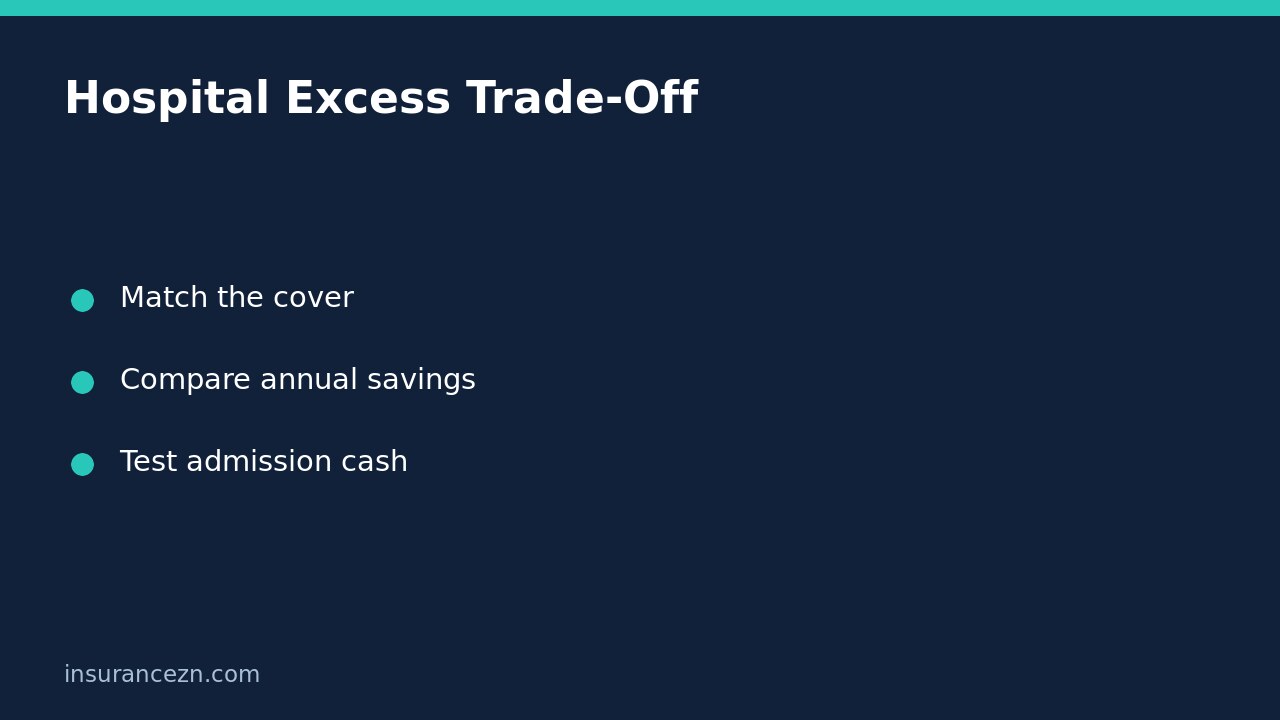

A cheaper hospital premium can be attractive, but a higher excess shifts more of the cost towards the time you need treatment. Compare the annual premium reduction with the extra excess under realistic admission scenarios, then check whether you could actually access the money. A favourable annual calculation is not the same as having cash available next week.
This is general information for Australian readers, not personal financial advice. Your policy, applicable PDS or fund rules, benefit eligibility, exclusions and waiting periods govern your cover. The numbers below are fictional illustrations, not quotations or recommendations.
Compare the same cover before comparing excesses
Obtain two written quotes with the same insured people, treatment coverage, extras component, payment frequency and effective date wherever possible. Ask the insurer to isolate the premium change attributable to the excess. If a cheaper option also removes treatment categories or changes hospital access, the saving cannot fairly be attributed to the excess alone.
Use the actual payable premium in both columns, with equivalent assumptions about any applicable rebate, loading or discount. If a promotional price expires, record that date and request the ongoing price. Do not compare one policy’s temporary monthly price with another policy’s ongoing annual price.
Establish when the excess is payable
The government’s out-of-pocket costs guidance describes an excess as a set amount paid towards hospital treatment. It explains that the frequency can be every admission or less often, depending on the policy. A co-payment is a separate set daily contribution.
Ask each fund whether the excess applies per admission, per person or subject to another cap. Confirm any exemptions and reset dates rather than assuming a household pays it only once. Ask when the hospital collects payment, whether day admissions are treated differently and whether changing excess affects any waiting-period or benefit conditions.
The same guide explains that an agreement hospital does not remove an agreed excess or co-payment. A hospital agreement is therefore not a reason to omit the excess from your budget.
Work through a fictional annual comparison
Suppose otherwise equivalent quotes are $180 per month with a $250 excess and $160 per month with a $750 excess. Annual premiums would be $2,160 and $1,920 respectively, a $240 saving with the higher excess. The increase in the stated excess is $500.
Under a deliberately simplified scenario with one eligible admission and exactly one excess charged on either option, the higher-excess choice costs $260 more overall that year: its extra $500 excess exceeds its $240 premium saving. With no excess-triggering admission, its premium cost is $240 lower. These scenarios do not predict whether you will need hospital care.
Do not extend that result to several admissions until you know the actual caps and reset rules. If different household members can each incur an excess, write a separate scenario for that possibility. Keep co-payments and other charges in additional rows rather than pretending the example measures your complete treatment bill.
Test the cash position separately
A full year’s saving accumulates over time, while an admission can occur early in the policy period. Ask yourself whether the higher excess would already be available without relying on savings you have not yet made. Keep the amount realistically accessible; money earmarked for rent or another unavoidable expense is not automatically an available medical reserve.
This is not a reason to postpone necessary treatment. Discuss clinical timing with your treating team, and ask the hospital and insurer about payment arrangements if affordability is a concern. An enquiry does not establish that instalments or a waiver will be accepted.
Keep other hospital bills outside the excess comparison
Medical gaps, hospital charges and device costs can remain even after you pay an excess. Ask the treating providers, hospital and insurer for treatment-specific written estimates. For a broader budgeting method, see why the hospital excess is not your total bill.
Does a higher excess guarantee a worthwhile saving? No. The actual premium difference, payment frequency and admission rules determine the trade-off.
Can I treat last year’s lack of admissions as a forecast? No. Use no-admission and admission scenarios as budget tests, not predictions.
Before authorising a change, retain both quotes, the confirmed excess rules and your scenario worksheet. Ask for the effective date and any conditions in writing. Make clear that requesting a comparison is not permission to cancel or alter your existing policy.