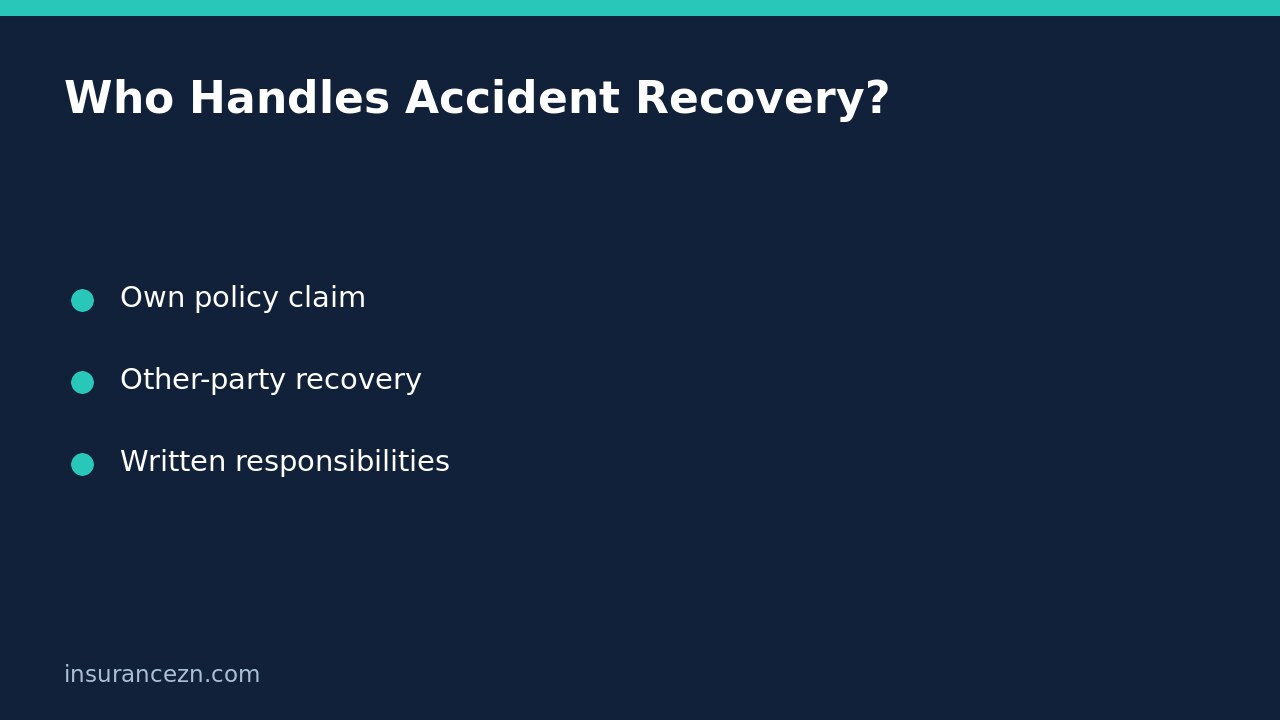

When comparing Australian car insurance, ask who will actually handle recovery from another driver if you believe you were not at fault. Having the other driver’s details is not the same as having an insurer agree to manage your repairs. Compare the claim route available under your own policy with the work you might need to do when seeking payment directly from the other party.
This matters particularly when a cheaper quote changes your cover from comprehensive to third party property insurance. A lower premium may come with a very different practical position after someone else damages your car.
Separate your own policy from the other driver’s responsibility
Legal Aid NSW explains the different insurance and recovery routes. Comprehensive insurance addresses damage to your own car as well as other vehicles or property, subject to the policy. Third party property insurance primarily addresses claims for damage you cause to other property. Some third party property policies offer limited own-car benefits when an identifiable uninsured driver is at fault, but those conditional benefits are not general comprehensive cover.
The same guidance explains that, when you claim under your own applicable insurance, your insurer contacts the other driver, owner or insurer and handles your claim. That does not establish that every quoted product will manage every recovery request. Ask each insurer to identify the section that applies to your scenario.
Put the same accident scenario to each insurer
Use a concrete hypothetical: another driver hits your parked car, you have their registration and contact details, and they have not confirmed whether they will lodge an insurance claim. Your car needs assessment and you need transport. Ask the following questions without assuming any answer:
- Can I lodge an own-car damage claim under this quoted cover?
- Who investigates liability and communicates with the other party?
- Which excess might I initially need to pay, and what conditions affect waiver or refund?
- If the other driver is uninsured, what additional conditions or payment limits apply?
- What repairs, transport or other expenses require approval before I incur them?
- Which recovery steps would remain mine rather than yours?
Keep cover type and vehicle valuation consistent wherever possible. Otherwise, you may be comparing different risks rather than two prices for the same service.
Build a responsibility worksheet, not just a price table
Create one row for each practical task: arranging assessment, authorising repair, corresponding about liability, considering a hire car, paying the excess and following up unresolved expenses. For each quote, record the insurer’s written answer, relevant wording and any condition still outstanding.
For example, imagine one quote provides applicable own-car accidental-damage cover while another provides only third party property cover. If the other driver’s insurer has not accepted responsibility, do not enter ‘other insurer pays’ as a confirmed funding plan for the second quote. Mark repair funding and recovery arrangements as unresolved until the relevant party confirms them. This illustration describes a comparison method, not an actual product or guaranteed claim outcome.
Also distinguish a policy benefit from recovery of a loss from someone else. A requested hire-car expense is not automatically an approved policy benefit or an accepted debt owed by the other driver.
Do not confuse notification with lodging a claim
Legal Aid NSW notes that the policy may require accident notification even when you decide not to claim. Before choosing a recovery route, check those obligations. Our article on comparing accident notification rules provides a separate checklist for that decision.
Ask how the insurer records an enquiry, a notification and a lodged claim. Also ask about possible excess, no-claim-bonus and future premium consequences without treating an estimate as a promise about renewal pricing. Keep records of dates, reference numbers and instructions. Do not assume withdrawing a claim erases all reporting obligations.
Quick questions before choosing a quote
Will the other driver’s insurer automatically organise my repairs? Do not assume so. Confirm whether the other party has made a claim and what responsibility or payment their insurer has actually accepted.
Does believing I was not at fault remove my excess? The answer depends on the policy and its conditions; obtain written confirmation rather than relying on your own assessment of fault.
What if the other party disputes responsibility? Preserve evidence and seek appropriate advice about the available routes. The source contains NSW-specific legal procedures; do not apply those procedures or deadlines nationally. A comparison worksheet is not a substitute for responding to legal documents.
This is general information for Australian readers, not personal financial advice or legal advice. Cover, recovery assistance, excesses and settlement depend on the policy, PDS, endorsements and circumstances. Check the actual quoted wording and obtain individual advice where needed.