
To compare health insurance for dietitian appointments, start with the specific practitioner and service you intend to book. Obtain an itemised quote, then ask each fund for a membership-specific benefit estimate. A policy mentioning dietary advice or healthy lifestyle programs does not by itself confirm that your appointment, meal-planning package or ongoing subscription is eligible.
This is general information for Australian readers, not personal financial advice. Benefits depend on the policy, relevant PDS or fund rules, waiting periods, limits and insurer assessment. Follow your treating professional’s advice about care and timing; do not delay necessary treatment while trying to optimise insurance benefits.
Separate the appointment from the marketing label
The Australian Government’s General Treatments explanation identifies dietetics and dietary advice as work involving human nutrition based on a person’s medical condition and individual needs. It separately describes health-management or healthy-lifestyle benefits, under which some products may pay towards approved programs. These descriptions help frame an enquiry, but do not make every nutrition-related purchase a covered service.
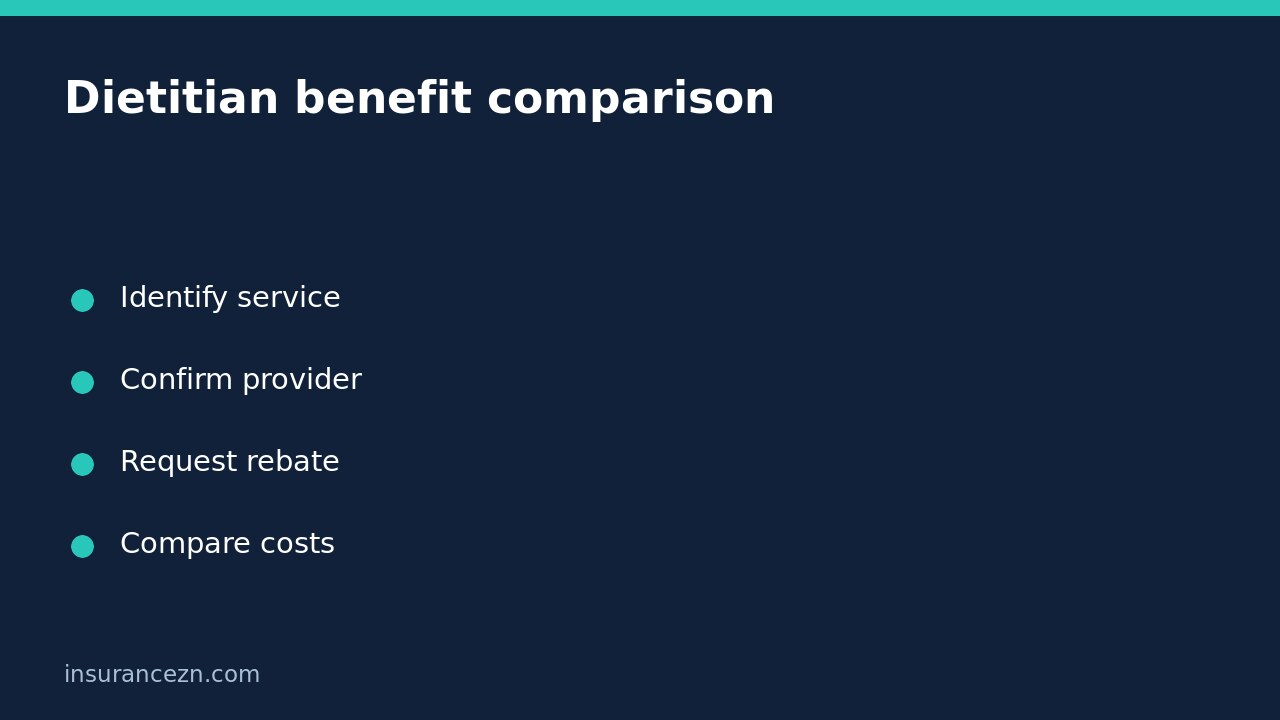
Ask the clinic for the actual practitioner’s name and profession, the appointment type, delivery format, duration and quoted fee. If a package includes an initial consultation, follow-up appointments, an app and written resources, ask for the charges to be separated. Do not assume a package total can be submitted as one eligible consultation or that every component receives a rebate.
Request written confirmation for the exact service
Send the same quote details to every fund you are considering. Provide the product name you are comparing and the expected appointment date. An existing member should also identify the current membership and ask whether a product change would alter the answer.
- Is this practitioner recognised for this service under the proposed product?
- Is the quoted appointment format eligible, including remote appointments if relevant?
- Which benefit category and billing description apply?
- What estimated benefit applies to the initial consultation and each follow-up?
- Do waiting periods, per-service caps or remaining annual limits reduce the estimate?
- Does this benefit share an allowance with any other service?
- Which date determines the benefit year, and what evidence must the invoice contain?
These are product-specific questions, not a statement that every fund uses identical restrictions. If the clinic says patients commonly receive rebates, treat that as a reason to enquire, not confirmation about your membership. Likewise, an automated reply confirming receipt of the quote is not a completed eligibility assessment.
Compare the expected appointments, not the headline limit
Make a worksheet with one row for each planned appointment: service, fee, fund-confirmed estimated rebate and expected remaining amount to pay. Keep uncertain rows marked as unresolved. An annual limit is a ceiling subject to applicable rules, not money automatically available for any nutrition service.
For example, a fictional clinic may offer an initial assessment plus several follow-ups and optional app access. Ask for a rebate estimate for each actual service and leave the app outside the benefit calculation unless the fund specifically confirms eligibility. Do not multiply the initial-assessment rebate across every visit when follow-ups may be treated differently.
Check whether earlier claims have already used a shared allowance. If comparing a new product, ask how claims made before the change affect available benefits afterwards. Do not assume that switching resets limits or that unused benefits transfer. Save the written explanation with the quote so the comparison can be revisited if appointments change.
Put additional benefits beside additional premiums
If adding or upgrading extras mainly for these appointments, compare the additional expected eligible rebates with the additional premiums over the same period. Use the actual premium quote and realistic appointments, not a maximum limit you do not expect to use. Distinguish a premium for combined hospital and extras cover from the incremental cost of changing only extras.
Include other benefits only where you reasonably expect eligible use, and keep the clinical decision separate from the insurance purchase. A more generous advertised limit can still offer little practical value if your provider is not recognised or the relevant waiting period has not finished. The same quote-first approach is explained for a different service in comparing extras with an itemised dental quote; dietitian eligibility requires its own confirmation.
Before booking or changing cover
Does a referral guarantee an extras rebate? Do not assume so. Ask the fund what documentation is required and whether the particular service is eligible. If another funding pathway may apply, confirm its interaction separately rather than adding two estimated payments for the same service without checking.
What if the practitioner or appointment format changes? Request a revised estimate. Confirmation for one person or service should not be reused as proof for a different booking.
Finally, match the confirmed product, practitioner, service, date and estimated rebate before authorising an insurance change. Keep the provider’s invoice and the fund’s claim assessment afterwards. An estimate supports budgeting; the actual claim still needs to satisfy the applicable rules.