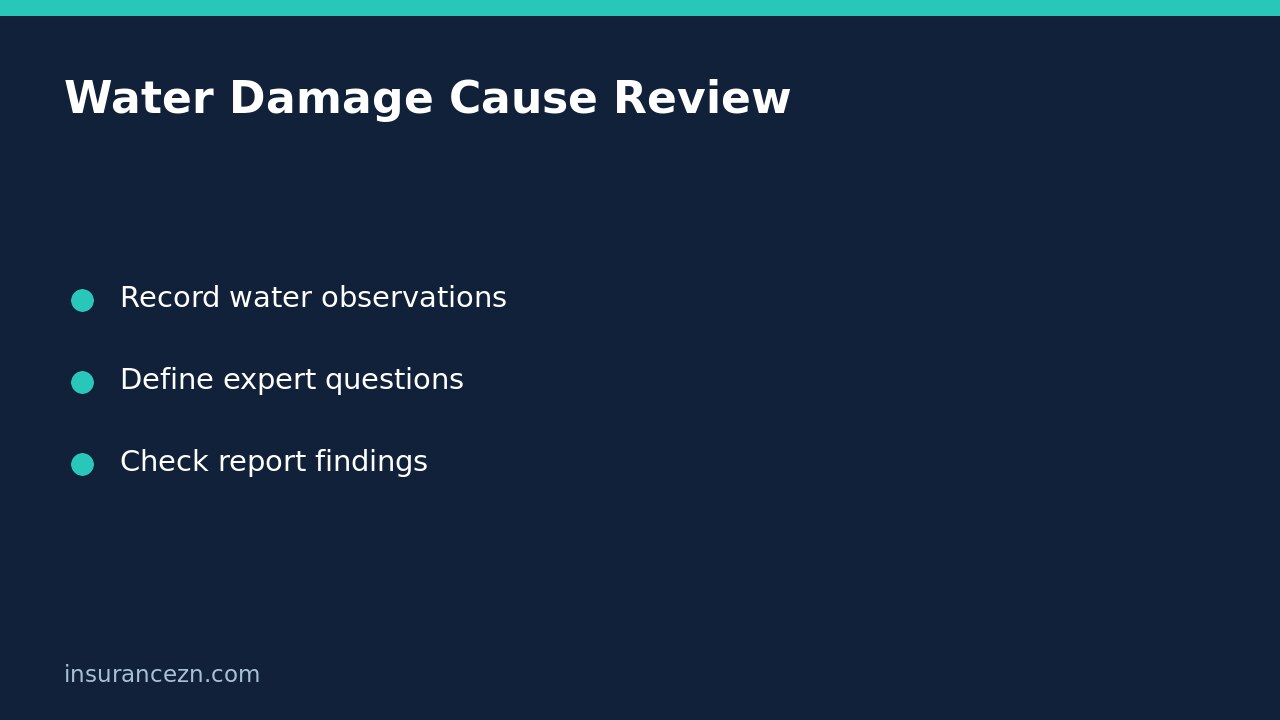

If your home insurer and you disagree about where damaging water came from, ask whether a hydrologist should investigate the disputed cause. Start with the specific question that remains unanswered, rather than simply demanding another inspection. Specialist findings can inform the claim, but they do not themselves decide whether your policy covers the damage.
This is general information for Australian readers, not personal financial advice or legal advice. Cover depends on your policy, Product Disclosure Statement (PDS), exclusions, endorsements and the facts. Obtain individual advice where a claim or legal right is disputed.
Separate the water question from the policy question
Water damage discussions can become confused when observations, expert explanations and insurance terminology are treated as interchangeable. Your observation might be that water first appeared at a rear doorway. The technical question is how it reached that location. The coverage question is how the established circumstances fit the actual policy wording.
Ask the insurer to identify the cause it is currently considering and the evidence supporting that view. Request the relevant definition or exclusion if it has made a coverage decision. Avoid labelling the event solely from a neighbour’s description or a social media post: those accounts may concern different properties or times.
Decide what a specialist needs to investigate
Legal Aid NSW’s Insurance claims after a disaster explains that insurers may use hydrologists when assessing water damage and recommends requesting expert reports. Its October 2023 edition supports that practical distinction, not a guarantee that every water claim requires the same specialist.
Possible questions for the insurer include whether the investigation needs to distinguish different routes of water entry, whether the existing inspection addresses the disputed location, and what evidence would help resolve uncertainty. Ask the insurer which appropriately qualified specialist should answer the actual question. Plumbing, building-condition and water-movement issues may require different expertise.
Prepare a safe observation timeline
Use records you already have or can gather safely. Do not enter floodwater, unstable structures or contaminated areas to improve your evidence. Follow emergency and professional safety advice. Never create a demonstration by running water into a damaged building.
- Record when you first noticed water, distinguishing exact timestamps from estimates.
- Identify the room and entry point you actually observed, without assuming the upstream source.
- Preserve original photographs and videos, including wider views that explain location.
- Note relevant earlier repairs, previous water problems and changes to the property honestly.
- Keep available contractor notes and insurer correspondence alongside the timeline.
For example, a homeowner might have a kitchen photograph taken before leaving and a hallway video recorded after returning. Those records establish two observations, not the precise minute water entered between them. State that gap openly instead of turning an estimate into an apparent fact.
Request appointment and cost confirmation
Send a short request naming the unresolved question and the relevant claim number. Suggested wording is: ‘Please explain whether the existing assessment establishes the source and route of water at the rear doorway. If not, please confirm whether you will appoint a hydrologist or another suitable specialist and what questions their report will address.’
Ask who appoints the expert, who pays, whether access arrangements are safe, and whether you will receive the report and its attachments. If considering your own expert, obtain a fee proposal and ask the insurer about reimbursement before committing. A request for approval, or an automated acknowledgement, is not written approval to incur the cost.
Check the report against the actual disputed issue
When the report arrives, check the inspected address, locations, observation dates, materials reviewed, assumptions and limitations. Does it answer the question you raised, or only describe damage after the event? Identify missing evidence or inaccurate observations precisely. Distinguish a factual correction from disagreement with a technical conclusion.
If the report affects repair decisions, compare it with the repair scope. Where additional insured damage is identified during works, our repair-variation checklist explains how to organise a separate scope request. Do not assume a specialist report automatically authorises extra work.
Quick questions before following up
Does requesting a hydrologist guarantee cover? No. The insurer still needs to assess the evidence against the policy.
Can photographs replace an expert opinion? They can support the investigation, but a photograph alone may not establish the source or mechanism of water entry.
What if the disagreement remains? Ask for the insurer’s written reasoning, identify the specific unresolved issue and consider independent advice. Keep safety decisions, technical findings and coverage correspondence in separate parts of your claim file.