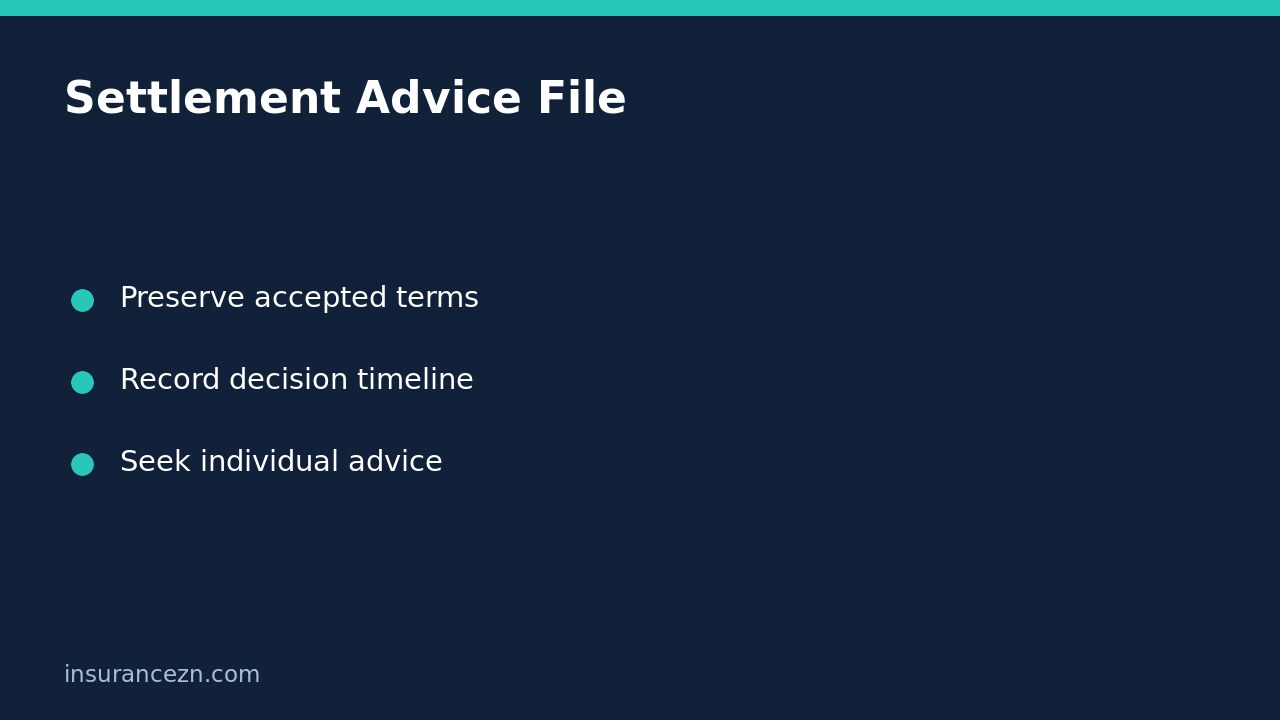

If you regret accepting a disaster insurance settlement, preserve exactly what you agreed to and seek individual legal advice promptly. Do not assume an email withdrawing acceptance cancels an agreement, or that discovering a more expensive repair automatically reopens the claim. A useful first step is assembling a focused advice file rather than repeatedly negotiating from memory.
This is general information for Australian readers, not personal financial advice or legal advice. Your policy, Product Disclosure Statement (PDS), settlement documents and individual circumstances matter. This checklist does not establish that an agreement can be cancelled or varied.
Establish what stage the settlement actually reached
Start by separating an offer, your response, any signed document, and the payment. Save each record in its original form. A discussion about a possible amount is not necessarily the same as acceptance, and payment receipt does not explain every term of the agreement.
Write down what you did: signed a release, clicked an acceptance button, agreed during a call, sent an email, or received funds without a clear explanation. Give an adviser the exact words and documents instead of deciding for yourself that there was either definitely a binding agreement or definitely no agreement.
Record whether the documents describe all damage, a particular repair component, or a particular benefit. Our article on additional damage discovered during repairs addresses scope variations while a claim is being managed; an already-accepted settlement requires separate attention to the agreement itself.
Build a chronology of the decision
Legal Aid NSW’s Insurance claims after a disaster warns that changing your mind after settlement is usually difficult and recommends urgent legal advice where someone felt pressured or lacked the relevant facts. The October 2023 publication is a practical starting point, not confirmation of current deadlines or a right to undo your particular agreement.
Create a short timeline covering the disaster, claim lodgement, offer, relevant conversations, acceptance and payment. Add when you received repair scopes, expert reports and independent quotes. Keep dates you know separate from dates you estimate.
For a fictional example, a homeowner accepts an emailed offer and only later receives a builder’s quote describing omitted work. The useful questions are which scope was offered, what information was available at acceptance, and what the later quote actually adds. The sequence alone does not prove the settlement is invalid.
Document the concern without overstating it
Identify why you are seeking advice. You may believe important damage was omitted, accommodation treatment was unclear, or the acceptance process involved pressure. Describe conduct and records rather than attaching legal labels you cannot substantiate.
- For an alleged deadline, preserve the actual message and its stated consequence.
- For a missing report, record when you requested and received it.
- For financial pressure, explain the practical circumstances and any hardship discussions.
- For a verbal assurance, note who spoke, when, the words you remember and whether a recording may exist.
- For a later cost increase, obtain an itemised explanation distinguishing necessary repairs from upgrades.
Do not manufacture certainty about a conversation you only partly recall. Ask the insurer about relevant call records and documents through its approved process; do not assume every requested record will be supplied or that making the request suspends time limits.
Prepare a compact adviser pack
Include the policy schedule and wording applying to the loss, the offer and attachments, acceptance evidence, any deed or release, payment records, reports and the latest relevant repair quote. Add a one-page summary explaining what outcome you want assessed: clarification, a further payment, variation, or whether any challenge is available.
Flag every deadline appearing in correspondence and any work already booked. Ask the adviser which limits apply and whether immediate protective action is needed. An online summary or an older brochure is not a reliable basis for calculating your personal deadline.
Avoid creating another problem while seeking advice
Do not sign a replacement release, authorise major additional expenditure or send an admission simply to obtain a faster response without understanding the implications. Ask what to do with disputed settlement funds and urgent repair commitments. Do not assume returning money, spending it or sending a reservation of rights has a predictable legal effect.
Maintain essential safety measures and keep the insurer informed of urgent circumstances. If you ask for extra time, obtain a clear written response identifying what has been extended. A request, acknowledgement or ongoing conversation is not confirmation that a deadline has changed.
Final checklist
Can you show the exact accepted documents, the decision timeline, the missing information or pressure concern, and the outcome you want advice about? If so, you have a practical foundation for a targeted consultation. Gathering that file improves the quality of the discussion; it does not guarantee the settlement can be reopened or that further claim money is payable.