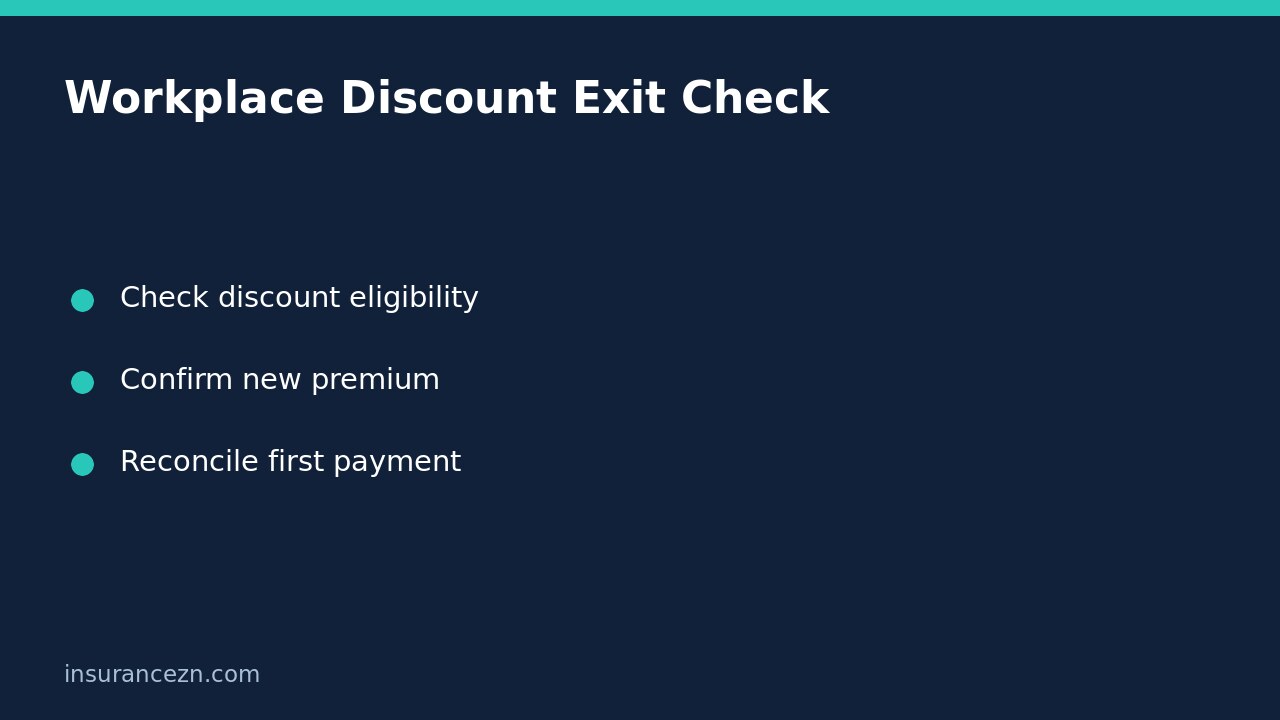

If your Australian health insurance premium includes a workplace or contribution-group discount, leaving the job is a reason to request a fresh written premium confirmation. Do not assume the discount disappears immediately, continues indefinitely, or ends your membership. Ask the insurer which rule applies to your arrangement, the effective date of any change and how the next payment will be collected.
This is general information for Australian readers, not personal financial advice. Eligibility, premiums and benefits depend on the insurer, specific policy, fund rules and policy documents or PDS where applicable. A premium confirmation is not approval for treatment or a claim.
Identify what the workplace arrangement actually provides
PrivateHealth.gov.au’s managing-your-policy guidance lists contribution-group membership, including products organised through a workplace or organisation, among circumstances in which insurers may offer premium discounts. It also lists payment arrangements such as payroll deduction or pre-arranged direct debit. These are possible arrangements, not a promise that every insurer offers every discount.
Find your latest premium notice and the original workplace offer. Check whether the saving is described as a group discount, a payment-method discount, an employer contribution or something else. If payroll records show money leaving your wages, establish whether that amount is your contribution, the entire premium, or only one part of the arrangement. Do not calculate your future premium from an unexplained payslip deduction.
Ask about eligibility and timing before the final pay
Give the fund your membership details and the date your employment ends. Ask whether leaving this employer changes eligibility for the product or only a discount. Request the rule that determines when any change takes effect and whether an alternative arrangement is available. Avoid assuming that notice to payroll automatically updates the insurer’s membership records.
A useful written request is: ‘My employment ends on this date. Please confirm whether my current product and group discount continue, the effective date of any premium change, my paid-to date and the amount and due date of my next payment.’ Include other covered people in the request so the response clearly identifies the membership affected.
Separate the new price from the new payment method
A revised premium amount does not establish that payment collection has been arranged. If deductions have come through payroll, ask when the final deduction reaches the insurer and when you must begin paying directly. Confirm which account or card will be used and how the first collection will be notified. Use the insurer’s secure channel for banking details.
Keep the final payslip and the insurer’s transaction history. Reconcile them rather than assuming a payroll deduction has already been credited to your membership. PrivateHealth.gov.au advises checking statements to ensure regular premium payments have actually been debited and keeping contributions up to date. If an expected payment is missing, ask both organisations to trace it before making a second payment for the same period.
Build a simple before-and-after premium record
Use a short worksheet without inventing a percentage saving. Record the current product, people covered, payment frequency, premium charged and the discount description. Beside those details, record the fund’s confirmed post-employment premium, its effective date, payment frequency and first due date.
For example, a reader moving from payroll collection to monthly direct debit needs confirmation of the period each payment covers. The first direct debit may relate to a different interval from the final payroll deduction. Ask the insurer to explain any overlap, adjustment or outstanding amount in writing rather than treating two differently sized transactions as proof of an overcharge.
If the replacement premium is difficult to afford
Contact the insurer before payments fall behind. Ask about available payment arrangements and eligible discounts, without assuming that another discount can be combined with the existing one. A cheaper product should be compared on treatment inclusion, benefit limits, excesses and co-payments as well as premium.
Do not increase an excess just to restore the previous payment amount without checking whether you could meet it at admission. Our guide to why a hospital excess is not your total bill explains why medical and hospital estimates also matter. If considering a switch, obtain continuity and benefit-start information before cancelling existing cover.
Final confirmation checklist
- The insurer has recorded the employment change, not merely acknowledged a message.
- The continuing product, covered people and any discount decision are identified.
- The next premium, effective date, paid-to date and payment method are confirmed.
- The final payroll deduction and first direct payment have been reconciled.
- Any affordability request has a recorded outcome and unresolved questions remain visible.
Does leaving the employer automatically cancel health cover? Do not infer that from the discount alone; obtain the fund’s answer for your membership. Does an accepted direct-debit request prove everything is current? No. Check the processed payment and membership record separately, and seek a treatment-specific benefits assessment before relying on cover for care.